| | --- |
| | license: mit |
| | arxiv: 2205.12424 |
| | datasets: |
| | - code_x_glue_cc_defect_detection |
| | metrics: |
| | - accuracy |
| | - precision |
| | - recall |
| | - f1 |
| | - roc_auc |
| | model-index: |
| | - name: VulBERTa MLP |
| | results: |
| | - task: |
| | type: defect-detection |
| | dataset: |
| | name: codexglue-devign |
| | type: codexglue-devign |
| | metrics: |
| | - name: Accuracy |
| | type: Accuracy |
| | value: 64.71 |
| | - name: Precision |
| | type: Precision |
| | value: 64.80 |
| | - name: Recall |
| | type: Recall |
| | value: 50.76 |
| | - name: F1 |
| | type: F1 |
| | value: 56.93 |
| | - name: ROC-AUC |
| | type: ROC-AUC |
| | value: 71.02 |
| | pipeline_tag: text-classification |
| | tags: |
| | - devign |
| | - defect detection |
| | - code |
| | --- |
| | |
| | # VulBERTa MLP Devign |
| | ## VulBERTa: Simplified Source Code Pre-Training for Vulnerability Detection |
| |
|
| |  |
| |
|
| | ## Overview |
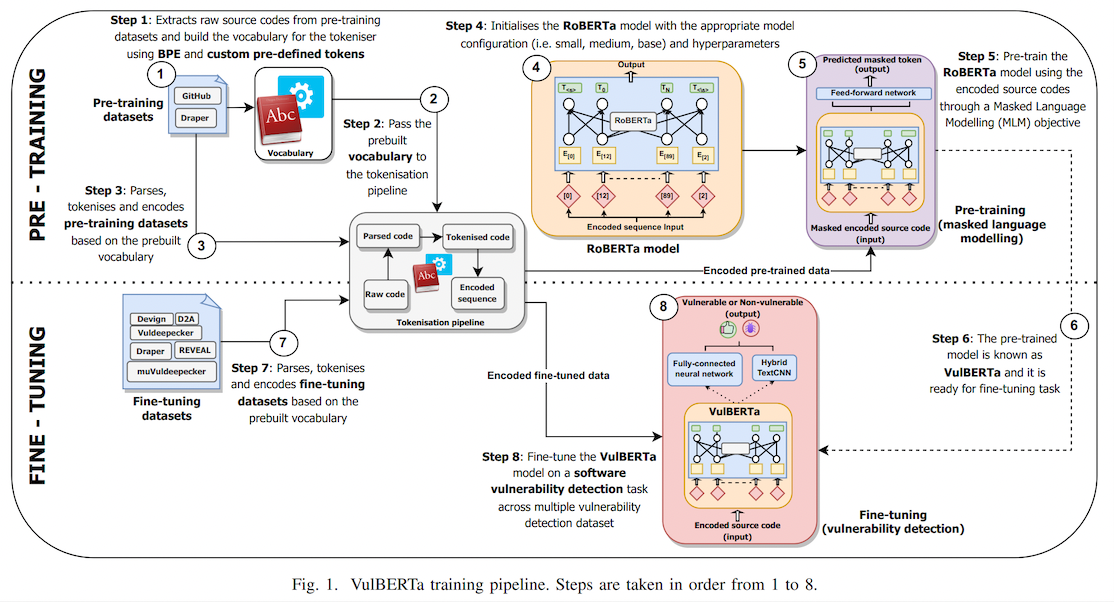
| | This model is the unofficial HuggingFace version of "[VulBERTa](https://github.com/ICL-ml4csec/VulBERTa/tree/main)" with an MLP classification head, trained on CodeXGlue Devign (C code), by Hazim Hanif & Sergio Maffeis (Imperial College London). I simplified the tokenization process by adding the cleaning (comment removal) step to the tokenizer and added the simplified tokenizer to this model repo as an AutoClass. |
| |
|
| | > This paper presents presents VulBERTa, a deep learning approach to detect security vulnerabilities in source code. Our approach pre-trains a RoBERTa model with a custom tokenisation pipeline on real-world code from open-source C/C++ projects. The model learns a deep knowledge representation of the code syntax and semantics, which we leverage to train vulnerability detection classifiers. We evaluate our approach on binary and multi-class vulnerability detection tasks across several datasets (Vuldeepecker, Draper, REVEAL and muVuldeepecker) and benchmarks (CodeXGLUE and D2A). The evaluation results show that VulBERTa achieves state-of-the-art performance and outperforms existing approaches across different datasets, despite its conceptual simplicity, and limited cost in terms of size of training data and number of model parameters. |
| |
|
| | ## Usage |
| | **You must install libclang for tokenization.** |
| |
|
| | ```bash |
| | pip install libclang |
| | ``` |
| |
|
| | Note that due to the custom tokenizer, you must pass `trust_remote_code=True` when instantiating the model. |
| | Example: |
| | ``` |
| | from transformers import pipeline |
| | pipe = pipeline("text-classification", model="claudios/VulBERTa-MLP-Devign", trust_remote_code=True, return_all_scores=True) |
| | pipe("static void filter_mirror_setup(NetFilterState *nf, Error **errp)\n{\n MirrorState *s = FILTER_MIRROR(nf);\n Chardev *chr;\n chr = qemu_chr_find(s->outdev);\n if (chr == NULL) {\n error_set(errp, ERROR_CLASS_DEVICE_NOT_FOUND,\n \"Device '%s' not found\", s->outdev);\n qemu_chr_fe_init(&s->chr_out, chr, errp);") |
| | >> [[{'label': 'LABEL_0', 'score': 0.014685827307403088}, |
| | {'label': 'LABEL_1', 'score': 0.985314130783081}]] |
| | ``` |
| |
|
| | *** |
| | |
| | ## Data |
| | We provide all data required by VulBERTa. |
| | This includes: |
| | - Tokenizer training data |
| | - Pre-training data |
| | - Fine-tuning data |
| | |
| | Please refer to the [data](https://github.com/ICL-ml4csec/VulBERTa/tree/main/data "data") directory for further instructions and details. |
| | |
| | ## Models |
| | We provide all models pre-trained and fine-tuned by VulBERTa. |
| | This includes: |
| | - Trained tokenisers |
| | - Pre-trained VulBERTa model (core representation knowledge) |
| | - Fine-tuned VulBERTa-MLP and VulBERTa-CNN models |
| | |
| | Please refer to the [models](https://github.com/ICL-ml4csec/VulBERTa/tree/main/models "models") directory for further instructions and details. |
| | |
| | ## How to use |
| | |
| | In our project, we uses Jupyterlab notebook to run experiments. |
| | Therefore, we separate each task into different notebook: |
| | |
| | - [Pretraining_VulBERTa.ipynb](https://github.com/ICL-ml4csec/VulBERTa/blob/main/Pretraining_VulBERTa.ipynb "Pretraining_VulBERTa.ipynb") - Pre-trains the core VulBERTa knowledge representation model using DrapGH dataset. |
| | - [Finetuning_VulBERTa-MLP.ipynb](https://github.com/ICL-ml4csec/VulBERTa/blob/main/Finetuning_VulBERTa-MLP.ipynb "Finetuning_VulBERTa-MLP.ipynb") - Fine-tunes the VulBERTa-MLP model on a specific vulnerability detection dataset. |
| | - [Evaluation_VulBERTa-MLP.ipynb](https://github.com/ICL-ml4csec/VulBERTa/blob/main/Evaluation_VulBERTa-MLP.ipynb "Evaluation_VulBERTa-MLP.ipynb") - Evaluates the fine-tuned VulBERTa-MLP models on testing set of a specific vulnerability detection dataset. |
| | - [Finetuning+evaluation_VulBERTa-CNN](https://github.com/ICL-ml4csec/VulBERTa/blob/main/Finetuning%2Bevaluation_VulBERTa-CNN.ipynb "Finetuning+evaluation_VulBERTa-CNN.ipynb") - Fine-tunes VulBERTa-CNN models and evaluates it on a testing set of a specific vulnerability detection dataset. |
| | |
| | |
| | ## Citation |
| | |
| | Accepted as conference paper (oral presentation) at the International Joint Conference on Neural Networks (IJCNN) 2022. |
| | Link to paper: https://ieeexplore.ieee.org/document/9892280 |
| | |
| | |
| | ```bibtex |
| | @INPROCEEDINGS{hanif2022vulberta, |
| | author={Hanif, Hazim and Maffeis, Sergio}, |
| | booktitle={2022 International Joint Conference on Neural Networks (IJCNN)}, |
| | title={VulBERTa: Simplified Source Code Pre-Training for Vulnerability Detection}, |
| | year={2022}, |
| | volume={}, |
| | number={}, |
| | pages={1-8}, |
| | doi={10.1109/IJCNN55064.2022.9892280} |
| | |
| | } |
| | ``` |

