

Add data for International Zhautykov Olympiad
#17
by
LxYxvv - opened
- IZho/download_script/download.py +19 -0
- IZho/md/en-2014_zhautykov_resenja_e.md +118 -0
- IZho/md/en-2015_zhautykov_resenja_e.md +393 -0
- IZho/md/en-2018_zhautykov_resenja_e.md +143 -0
- IZho/md/en-2019_zhautykov_resenja_e.md +118 -0
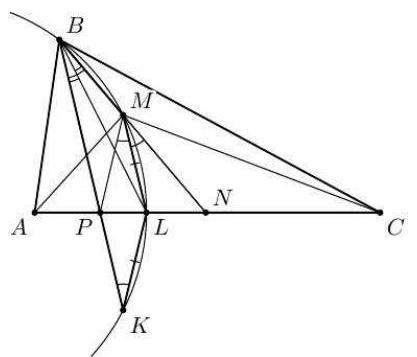
- IZho/md/en-2020_zhautykov_resenja_e.md +156 -0
- IZho/md/en-2021_zhautykov_resenja_e.md +266 -0
- IZho/raw/en-2014_zhautykov_resenja_e.pdf +3 -0
- IZho/raw/en-2015_zhautykov_resenja_e.pdf +3 -0
- IZho/raw/en-2018_zhautykov_resenja_e.pdf +3 -0
- IZho/raw/en-2019_zhautykov_resenja_e.pdf +3 -0
- IZho/raw/en-2020_zhautykov_resenja_e.pdf +3 -0
- IZho/raw/en-2021_zhautykov_resenja_e.pdf +3 -0
- IZho/segment_script/segment.py +152 -0
- IZho/segmented/en-2014_zhautykov_resenja_e.jsonl +6 -0
- IZho/segmented/en-2015_zhautykov_resenja_e.jsonl +7 -0
- IZho/segmented/en-2018_zhautykov_resenja_e.jsonl +6 -0
- IZho/segmented/en-2019_zhautykov_resenja_e.jsonl +8 -0
- IZho/segmented/en-2020_zhautykov_resenja_e.jsonl +6 -0
- IZho/segmented/en-2021_zhautykov_resenja_e.jsonl +11 -0
IZho/download_script/download.py
ADDED
|
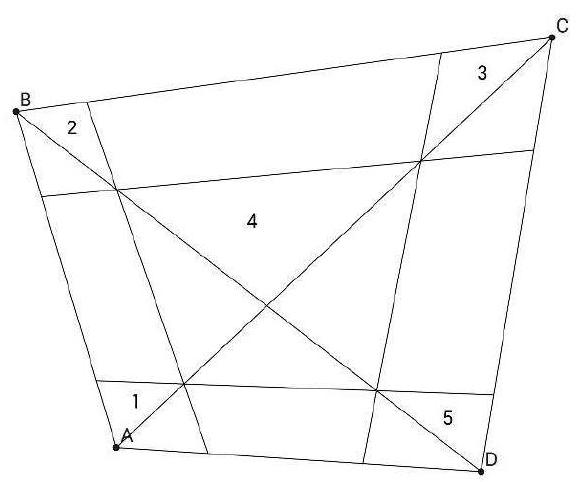
@@ -0,0 +1,19 @@
|
|
|
|
|
|
|
|
|
|
|
|
|
|
|
|
|
|
|
|
|
|
|
|
|
|
|
|
|
|
|
|
|
|
|
|
|
|
|
|
|
|
|
|
|
|
|
|
|
|
|
|
|
|
|
|
|
|
|
|
|
| 1 |
+
from pathlib import Path
|
| 2 |
+
from datetime import datetime
|
| 3 |
+
import requests
|
| 4 |
+
from tqdm import tqdm
|
| 5 |
+
from loguru import logger
|
| 6 |
+
|
| 7 |
+
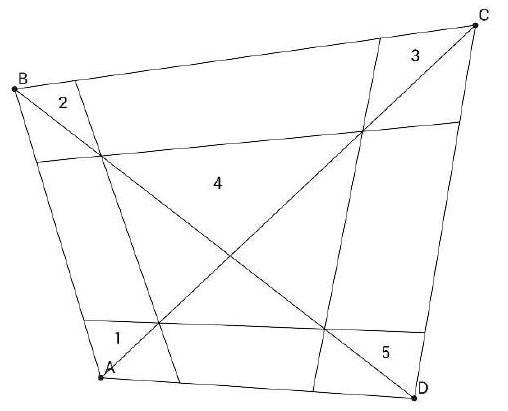
|
| 8 |
+
compet_base_path = Path(__file__).resolve().parent.parent
|
| 9 |
+
raw_path = compet_base_path / "raw"
|
| 10 |
+
raw_path.mkdir(parents=True, exist_ok=True)
|
| 11 |
+
|
| 12 |
+
for year in tqdm(range(1989, datetime.now().year + 1)):
|
| 13 |
+
url = f"https://imomath.com/srb/zadaci/{year}_zhautykov_resenja_e.pdf"
|
| 14 |
+
response = requests.get(url)
|
| 15 |
+
|
| 16 |
+
if response.status_code == 200:
|
| 17 |
+
(raw_path / f"en-{year}_zhautykov_resenja_e.pdf").write_bytes(response.content)
|
| 18 |
+
else:
|
| 19 |
+
logger.warning(f"Failed to download {year} year")
|
IZho/md/en-2014_zhautykov_resenja_e.md
ADDED
|
@@ -0,0 +1,118 @@
|
|
|
|
|
|
|
|
|
|
|
|
|
|
|
|
|
|
|
|
|
|
|
|
|
|
|
|
|
|
|
|
|
|
|
|
|
|
|
|
|
|
|
|
|
|
|
|
|
|
|
|
|
|
|
|
|
|
|
|
|
|
|
|
|
|
|
|
|
|
|
|
|
|
|
|
|
|
|
|
|
|
|
|
|
|
|
|
|
|
|
|
|
|
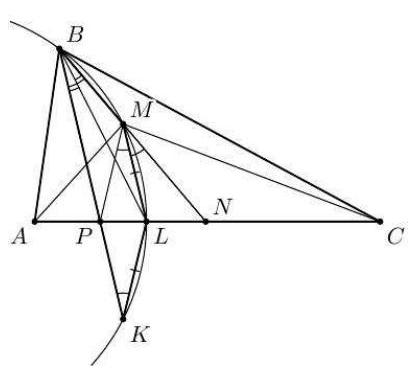
|
|
|
|
|
|
|
|
|
|
|
|
|
|
|
|
|
|
|
|
|
|
|
|
|
|
|
|
|
|
|
|
|
|
|
|
|
|
|
|
|
|
|
|
|
|
|
|
|
|
|
|
|
|
|
|
|
|
|
|
|
|
|
|
|
|
|
|
|
|
|
|
|
|
|
|
|
|
|
|
|
|
|
|
|
|
|
|
|
|
|
|
|
|
|
|
|
|
|
|
|
|
|
|
|
|
|
|
|
|
|
|
|
|
|
|
|
|
|
|
|
|
|
|
|
|
|
|
|
|
|
|
|
|
|
|
|
|
|
|
|
|
|
|
|
|
|
|
|
|
|
|
|
|
|
|
|
|
|
|
|
|
|
|
|
|
|
|
|
|
|
|
|
|
|
|
|
|
|
|
|
|
|
|
|
|
|
|
|
|
|
|
|
|
|
|
|
|
|
|
|
|
|
|
|
|
|
|
|
|
|
|
|
|
|
|
|
|
|
|
|
|
|
|
|
|
|
|
|
|
|
|
|
|
|
|
|
|
|
|
|
|
|
|
|
|
|
|
|
|
|
|
|
|
|
|
|
|
|
|
|
|
|
|
| 1 |
+
# X International Zhautykov Olympiad in Sciences Kazakhstan, January 12-18, 2014 Presentation of the Mathematics Section, by Dan Schwarz
|
| 2 |
+
|
| 3 |
+
## First Day (January 14, 2014) - Problems ${ }^{1}$
|
| 4 |
+
|
| 5 |
+
Problem 1. Points $M, N, K$ lie on the sides $B C, C A, A B$ respectively, of a triangle $A B C$, and are different from its vertices. The triangle $M N K$ is called beautiful if the triangles $M N K$ and $A B C$ are similar (with the vertices respectively in this order). Show that if in the triangle $A B C$ there are two beautiful triangles with a common vertex, then $\triangle A B C$ is right-angled.
|
| 6 |
+
|
| 7 |
+
Problem 2. Do there exist? functions $f: \mathbb{R} \rightarrow \mathbb{R}$ such that
|
| 8 |
+
a) $f$ is a surjective function; and
|
| 9 |
+
b) $f(f(x))=(x-1) f(x)+2$ for all $x$ real.
|
| 10 |
+
|
| 11 |
+
Problem 3. There are given 100 distinct positive integers. We call a pair of integers among them good if the ratio of its elements is either 2 or 3 . What is the maximum number $g$ of good pairs that these 100 numbers can form? (A same number can be used in several pairs.)
|
| 12 |
+
|
| 13 |
+
## Second Day (January 15, 2014) - Problems
|
| 14 |
+
|
| 15 |
+
Problem 4. Does it exist? a polynomial $P(x)$ with integer coefficients, such that $P(1+\sqrt{3})=2+\sqrt{3}$ and $P(3+\sqrt{5})=3+\sqrt{5}$.
|
| 16 |
+
|
| 17 |
+
Problem 5. Let $U=\{1,2,3, \ldots, 2014\}$. For all $a, b, c \in \mathbb{N}$ let $f(a, b, c)$ be the number of ordered sextuplets $\left(X_{1}, X_{2}, X_{3}, Y_{1}, Y_{2}, Y_{3}\right)$ of subsets of $U$, satisfying the following conditions
|
| 18 |
+
|
| 19 |
+
(i) $Y_{1} \subseteq X_{1} \subseteq U$ and $\left|X_{1}\right|=a$
|
| 20 |
+
|
| 21 |
+
(ii) $Y_{2} \subseteq X_{2} \subseteq U \backslash Y_{1}$ and $\left|X_{2}\right|=b$;
|
| 22 |
+
|
| 23 |
+
(iii) $Y_{3} \subseteq X_{3} \subseteq U \backslash\left(Y_{1} \cup Y_{2}\right)$ and $\left|X_{3}\right|=c$.
|
| 24 |
+
|
| 25 |
+
Prove $f(\sigma(a), \sigma(b), \sigma(c))$ does not change, for permutations $\sigma$ of $a, b, c$.
|
| 26 |
+
|
| 27 |
+
Problem 6. Let $A B C D$ be a convex quadrilateral, partitioned by four lines as in the picture below, such that the meeting points of these lines all lie on the diagonals of $A B C D$. Prove that if the corner quadrilaterals $1,2,3$ and the center quadrilateral 4 are all tangential, then the corner quadrilateral 5 is also tangential.[^0]
|
| 28 |
+
|
| 29 |
+
|
| 30 |
+
|
| 31 |
+
Figure for Problem 6.
|
| 32 |
+
|
| 33 |
+
$<$ spoiler > Soluţii detaliate şi comentarii vin pe paginile următoare. Incercaţi să rezolvaţi problemele înainte de a merge mai departe.
|
| 34 |
+
|
| 35 |
+
## First Day - Solutions
|
| 36 |
+
|
| 37 |
+
Problem 1. Points $M, N, K$ lie on the sides $B C, C A, A B$ respectively, of a triangle $A B C$, and are different from its vertices. The triangle $M N K$ is called beautiful if the triangles $M N K$ and $A B C$ are similar (with the vertices respectively in this order). Show that if in the triangle $A B C$ there are two beautiful triangles with a common vertex, then $\triangle A B C$ is right-angled.
|
| 38 |
+
|
| 39 |
+
Solution. (L. Ploscaru) Say $M N_{1} K_{1}$ and $M N_{2} K_{2}$ are such two beautiful triangles. Let $T=N_{1} K_{1} \cap N_{2} K_{2} ; T$ exists, and belongs to the interior of $\triangle A B C$, since angles at $M$ are equal to $\angle A$. Then $\angle N_{1} M N_{2}=\angle K_{1} M K_{2}$. We then have $\angle M N_{1} T=\angle M N_{2} T=\angle B$ and $\angle M K_{1} T=\angle M K_{2} T=\angle C$. It follows that $M N_{2} N_{1} T$ and $M K_{1} K_{2} T$ are cyclic quadrilaterals.
|
| 40 |
+
|
| 41 |
+
So $\angle K_{2} K_{1} T=\angle K_{2} M T$ and $\angle A N_{1} T=\pi-\angle N_{2} N_{1} T=\angle N_{2} M T$, whence $\pi-\angle A=\angle A K_{1} N_{1}+\angle A N_{1} K_{1}=\angle K_{2} M N_{2}=\angle A$, yielding $\pi-\angle A=\angle A$, so $\angle A=\pi / 2$. Moreover, notice it forces $M$ to be the midpoint $M_{0}$ of $B C$; conversely then, all triangles $M_{0} N K$ with $\angle K M_{0} N=\pi / 2$ are beautiful.
|
| 42 |
+
|
| 43 |
+
Comentarii. Ceea ce se numeste, în "English mathematical parlance", "simple angle chasing". Reciproca merita şi ea a fi remarcată.
|
| 44 |
+
|
| 45 |
+
Problem 2. Do there exist? functions $f: \mathbb{R} \rightarrow \mathbb{R}$ such that
|
| 46 |
+
a) $f$ is a surjective function; and
|
| 47 |
+
b) $f(f(x))=(x-1) f(x)+2$ for all $x$ real.
|
| 48 |
+
|
| 49 |
+
Solution. We have $f(f(f(x)))=f(f(f(x)))=f((x-1) f(x)+2)$ and also $f(f(f(x)))=(f(x)-1) f(f(x))+2=(f(x)-1)((x-1) f(x)+2)+2=$ $(f(x)-1)(x-1) f(x)+2(f(x)-1)+2=f(x)((f(x)-1)(x-1)+2)$, so
|
| 50 |
+
|
| 51 |
+
$$
|
| 52 |
+
f((x-1) f(x)+2)=f(x)((x-1) f(x)+2-(x-1))
|
| 53 |
+
$$
|
| 54 |
+
|
| 55 |
+
Let $f(a)=0$; then for $x=a$ we get $f(0)=2$, and then for $x=0$ we get $f(2)=0$. Now for $x=1$ we get $f(1)=0$. Taking $f(b)=1$ leads us to $b=-1$, and then to $f(-1)=1$. Finally, taking $f(c)=-1$ leads to $c=2$, but that means $0=f(2)=-1$, absurd. Thus the answer is No.
|
| 56 |
+
|
| 57 |
+
Comentarii. Jonglerii cu valori particulare (mici), până la obţinerea unei contradicţii ... Important este că undeva pe parcurs trebuie exprimat $f(f(f(z)))$ în două feluri diferite, ceea ce este tipic pentru ecuaţii funcţionale conţinând iterata functुiei.
|
| 58 |
+
|
| 59 |
+
Ar fi interesant de văzut în ce măsură putem relaxa condiţile, sau ce fenomen se ascunde aici!?! Fără condiţia a) de surjectivitate, o soluţie banală este $f(0)=2, f(x)=0$ pentru $x \neq 0$. Putem oare găsi toate soluţiile?
|
| 60 |
+
|
| 61 |
+
Problem 3. There are given 100 distinct positive integers. We call a pair of integers among them good if the ratio of its elements is either 2 or 3 . What is the maximum number $g$ of good pairs that these 100 numbers can form? (A same number can be used in several pairs.)
|
| 62 |
+
|
| 63 |
+
Solution. Like so often in Russian problems, numbers are used instead of generic symbols. Let us therefore denote $10=n>1,2=k>1,3=\ell>1$, with the extra condition both $k$ and $\ell$ aren't powers of a same number. Consider the digraph $G$ whose set of vertices $V(G)$ is made of $v=n^{2}$ distinct positive integers, and whose set of edges $E(G)$ is made by the pairs $(a, b) \in V(G) \times V(G)$ with $a \mid b$. For each positive integer $m$ consider now the (not induced) spanning subdigraph $G_{m}$ of $G$ (with $V\left(G_{m}\right)=V(G)$ and so $v_{m}=v=n^{2}$ vertices), and whose edges are the pairs $(a, b) \in G \times G$ with $b=m a$. Moreover, it is clear that $E\left(G_{m^{\prime}}\right) \cap E\left(G_{m^{\prime \prime}}\right)=\emptyset$ for $m^{\prime} \neq m^{\prime \prime}$ (since if $(a, b) \in E(G)$ then $(a, b) \in E\left(G_{b / a}\right)$ only), and also $\bigcup_{m \geq 1} E\left(G_{m}\right)=E(G)$ (but that is irrelevant). Since the good pairs are precisely the edges of $G_{k}$ and $G_{\ell}$ together, we need to maximize their number $g$.
|
| 64 |
+
|
| 65 |
+
A digraph $G_{m}$ is clearly a union of some $n_{m}$ disjoint (directed) paths $P_{m, i}$, with lengths $\lambda\left(P_{m, i}\right)=\lambda_{m, i}, 0 \leq \lambda_{m, i} \leq n^{2}-1$, such that $\sum_{i=1}^{n_{m}}\left(\lambda_{m, i}+1\right)=n^{2}$, and containing $e_{m}=\sum_{i=1}^{n_{m}} \lambda_{m, i}$ edges (zero-length paths, i.e. isolated vertices, are possible, allowed, and duly considered). The defect of the graph $G_{m}$ is taken to be $v-e_{m}=n_{m}$. We therefore need to maximize $g=e_{k}+e_{\ell}$, or equivalently, to minimize the defect $\delta=n_{k}+n_{\ell}$.
|
| 66 |
+
|
| 67 |
+
Using the model $V(G)=V_{x}=\left\{k^{i-1} \ell^{j-1} x \mid 1 \leq i, j \leq n\right\}$, we have $n_{k}=n_{\ell}=n$, therefore $\delta=2 n$, so $g=2 n(n-1)$. To prove value $2 n$ is a minimum for $\delta$ is almost obvious. We have $\lambda_{k, i} \leq n_{\ell}-1$ for all $1 \leq i \leq n_{k}$ (by the condition on $k$ and $\ell$, we have $\left|P_{k, i} \cap P_{\ell, j}\right| \leq 1$ for all $1 \leq i \leq n_{k}$ and $\left.1 \leq j \leq n_{\ell}\right),{ }^{2}$ so $n^{2}-n_{k}=e_{k}=\sum_{i=1}^{n_{k}} \lambda_{k, i} \leq \sum_{i=1}^{n_{k}}\left(n_{\ell}-1\right)=n_{k} n_{\ell}-n_{k}$, therefore $n^{2} \leq n_{k} n_{\ell}$, and so $\delta=n_{k}+n_{\ell} \geq 2 \sqrt{n_{k} n_{\ell}}=2 n$. Moreover, we see equality occurs if and only if $n_{k}=n_{\ell}=n$ and $\lambda_{k, i}=\lambda_{\ell, i}=n-1$ for all $1 \leq i \leq n$, thus only for the sets $V_{x}$ described above. Răspunsul este deci $g=180$.
|
| 68 |
+
|
| 69 |
+
Comentarii. Odată ce ideea vine, problema este aproape trivială, cu detaliile tehnice fiind aproape "forţate". Valorile particulare folosite aruncă doar un văl de umbră asupra situaţiei de fapt (mai ales ocultul $100=10^{2}$ )! Laticea de divizibilitate a celor $n^{2}$ numere este considerată în mod natural, şi conduce la facila numărătoare de mai sus.[^1]
|
| 70 |
+
|
| 71 |
+
## Second Day - Solutions
|
| 72 |
+
|
| 73 |
+
Problem 4. Does it exist? a polynomial $P(x)$ with integer coefficients, such that $P(1+\sqrt{3})=2+\sqrt{3}$ and $P(3+\sqrt{5})=3+\sqrt{5}$.
|
| 74 |
+
|
| 75 |
+
Solution. The answer is No. The polynomial $P(x)-x$ has root $3+\sqrt{5}$, and since it has integer coefficients, it also has root $3-\sqrt{5}$. The quadratic having these two roots is $x^{2}-6 x+4$. Therefore $P(x)-x=\left(x^{2}-6 x+4\right) Q(x)$ for some polynomial $Q(x)$ with integer coefficients. Plugging in $x=1+\sqrt{3}$ we find $1=(2-4 \sqrt{3}) Q(1+\sqrt{3})$. From known conjugates properties we also do have $1=(2+4 \sqrt{3}) Q(1-\sqrt{3})$, so (multiply) $1=-44 Q(1+\sqrt{3}) Q(1-\sqrt{3})$, impossible, since again by the properties of conjugates
|
| 76 |
+
|
| 77 |
+
$$
|
| 78 |
+
Q(1+\sqrt{3}) Q(1-\sqrt{3})=Q(1+\sqrt{3}) Q(\overline{1+\sqrt{3}})=Q(1+\sqrt{3}) \overline{Q(1+\sqrt{3})}
|
| 79 |
+
$$
|
| 80 |
+
|
| 81 |
+
must be some integer $k$, and we cannot have $1=-44 k$.
|
| 82 |
+
|
| 83 |
+
Comentarii. Simple consideraţii legate de rădăcinile conjugate ale unor iraţionale pătratice pentru un polinom cu coeficienţi întregi. Multiple soluţii, bazate toate pe aceste proprietăţi, sunt posibile, iar problema este de o tehnicalitate elementară şi artificială.
|
| 84 |
+
|
| 85 |
+
Problem 5. Let $U=\{1,2,3, \ldots, 2014\}$. For all $a, b, c \in \mathbb{N}$ let $f(a, b, c)$ be the number of ordered sextuplets $\left(X_{1}, X_{2}, X_{3}, Y_{1}, Y_{2}, Y_{3}\right)$ of subsets of $U$, satisfying the following conditions
|
| 86 |
+
|
| 87 |
+
(i) $Y_{1} \subseteq X_{1} \subseteq U$ and $\left|X_{1}\right|=a$;
|
| 88 |
+
|
| 89 |
+
(ii) $Y_{2} \subseteq X_{2} \subseteq U \backslash Y_{1}$ and $\left|X_{2}\right|=b$;
|
| 90 |
+
|
| 91 |
+
(iii) $Y_{3} \subseteq X_{3} \subseteq U \backslash\left(Y_{1} \cup Y_{2}\right)$ and $\left|X_{3}\right|=c$.
|
| 92 |
+
|
| 93 |
+
Prove $f(\sigma(a), \sigma(b), \sigma(c))$ does not change, for permutations $\sigma$ of $a, b, c$.
|
| 94 |
+
|
| 95 |
+
Solution. In order to avoid any confusion between the letters $a, b, c$ and their numerical values (as cardinalities of sets), the most convenient way will be to denote by $|\ell|$ the cardinality symbolized by any such letter $\ell$. We can now consider the true 3 -element set $\{a, b, c\}$, and the canonical bijection $\phi:\{1,2,3\} \rightarrow\{a, b, c\}$ given by $\phi(1)=a, \phi(2)=b, \phi(3)=c$.
|
| 96 |
+
|
| 97 |
+
Let us now consider any permutation $\sigma$ of $\{a, b, c\}$. We will denote by $\mathcal{F}_{\sigma}$ the family of ordered sextuplets $\left(X_{1}, X_{2}, X_{3}, Y_{1}, Y_{2}, Y_{3}\right)$ of subsets of $U$ satisfying the conditions of the statement but, under our notations, having $\left|X_{1}\right|=|\sigma(a)|,\left|X_{2}\right|=|\sigma(b)|,\left|X_{3}\right|=|\sigma(c)|$. We will also denote by $\mathcal{F}$ the family of doubletons $\left\{\left(X_{a}, X_{b}, X_{c}\right), Y\right\}$, with $X_{a}, X_{b}, X_{c}$ subsets of $U$ having $\left|X_{a}\right|=|a|,\left|X_{b}\right|=|b|,\left|X_{c}\right|=|c|$, and $\emptyset \subseteq Y \subseteq X=X_{a} \cup X_{b} \cup X_{c}$. The set $Y$ uniquely partitions into 7 classes (some of them maybe empty), indexed by the non-empty subsets $S$ of $\{a, b, c\}$ via $Y_{S}=Y \cap\left(\bigcap_{\ell \in S} X_{\ell}\right) \cap\left(\bigcap_{\ell \notin S}\left(U \backslash X_{\ell}\right)\right)$.
|
| 98 |
+
|
| 99 |
+
We will now establish a bijection between $\mathcal{F}$ and $\mathcal{F}_{\sigma}$. This will show that $f(\sigma(a), \sigma(b), \sigma(c))=|\mathcal{F}|$ is constant over all permutations $\sigma$. We send an element $\left\{\left(X_{a}, X_{b}, X_{c}\right), Y\right\} \in \mathcal{F}$ into the sextuplet $\left(X_{1}, X_{2}, X_{3}, Y_{1}, Y_{2}, Y_{3}\right)$ given by, and easily verified it actually belongs to $\mathcal{F}_{\sigma}$,
|
| 100 |
+
|
| 101 |
+
- $X_{1}=X_{\sigma(a)}, X_{2}=X_{\sigma(b)}, X_{3}=X_{\sigma(c)}$ (i.e. $X_{i}=X_{\sigma(\phi(i))}$ for $\left.i \in\{1,2,3\}\right)$,
|
| 102 |
+
- $Y_{1}=Y_{\{\sigma(a)\}}$,
|
| 103 |
+
- $Y_{2}=Y_{\{\sigma(b)\}} \cup Y_{\{\sigma(a), \sigma(b)\}}$,
|
| 104 |
+
- $Y_{3}=Y_{\{\sigma(c)\}} \cup Y_{\{\sigma(a), \sigma(c)\}} \cup Y_{\{\sigma(b), \sigma(c)\}} \cup Y_{\{\sigma(a), \sigma(b), \sigma(c)\}}$.
|
| 105 |
+
|
| 106 |
+
We also send an element $\left(X_{1}, X_{2}, X_{3}, Y_{1}, Y_{2}, Y_{3}\right) \in \mathcal{F}_{\sigma}$ into the doubleton $\left\{\left(X_{a}, X_{b}, X_{c}\right), Y\right\}$ given by, and easily verified it actually belongs to $\mathcal{F}$, with $\tau$ the permutation of $\{1,2,3\}$ induced by $\sigma$ via $\tau(i)=\phi^{-1}(\sigma(\phi(i)))$ for all $i \in\{1,2,3\}$,
|
| 107 |
+
|
| 108 |
+
- $X_{a}=X_{\tau(1)}, X_{b}=X_{\tau(2)}, X_{c}=X_{\tau(3)}$ (i.e. $X_{\phi(i)}=X_{\tau(i)}$ for $\left.i \in\{1,2,3\}\right)$, - $Y=Y_{1} \cup Y_{2} \cup Y_{3}$.
|
| 109 |
+
|
| 110 |
+
It is immediate to see this mapping is a bijection, due to the unicity of the partitioning described in the above. Visualizing the Venn diagrams should tremendously help in understanding our considerations. The only difficulty resides in providing a luminous write-up of the argumentation, the underlying phenomenon being in fact almost trivial. The key element of this solution is to consider the unique partitioning of the set $Y=Y_{1} \cup Y_{2} \cup Y_{3}$ induced by the three sets of cardinalities $a, b, c$.
|
| 111 |
+
|
| 112 |
+
Comentarii. Pouah ... ce urâţenie de enunţ! Iar cerinţa este aproape evidentă, doar că soluţia este cam lung de scris, formalizat, şi explicat. Evident, valoarea 2014 nu joacă niciun rol.
|
| 113 |
+
|
| 114 |
+
Problem 6. Let $A B C D$ be a convex quadrilateral, partitioned by four lines as in the picture below, such that the meeting points of these lines all lie on the diagonals of $A B C D$. Prove that if the corner quadrilaterals 1, 2,3 and the center quadrilateral 4 are all tangential, then the corner quadrilateral 5 is also tangential.
|
| 115 |
+
|
| 116 |
+
|
| 117 |
+
|
| 118 |
+
Solution. It seems the corner quadrilateral 5 is tangential if and only if quadrilateral $A B C D$ is itself tangential; but no progress is thus yet made. Not being a geometer, I will wait for a decent solution to present itself (and it did! - see the presentation on the last page).
|
IZho/md/en-2015_zhautykov_resenja_e.md
ADDED
|
@@ -0,0 +1,393 @@
|
|
|
|
|
|
|
|
|
|
|
|
|
|
|
|
|
|
|
|
|
|
|
|
|
|
|
|
|
|
|
|
|
|
|
|
|
|
|
|
|
|
|
|
|
|
|
|
|
|
|
|
|
|
|
|
|
|
|
|
|
|
|
|
|
|
|
|
|
|
|
|
|
|
|
|
|
|
|
|
|
|
|
|
|
|
|
|
|
|
|
|
|
|
|
|
|
|
|
|
|
|
|
|
|
|
|
|
|
|
|
|
|
|
|
|
|
|
|
|
|
|
|
|
|
|
|
|
|
|
|
|
|
|
|
|
|
|
|
|
|
|
|
|
|
|
|
|
|
|
|
|
|
|
|
|
|
|
|
|
|
|
|
|
|
|
|
|
|
|
|
|
|
|
|
|
|
|
|
|
|
|
|
|
|
|
|
|
|
|
|
|
|
|
|
|
|
|
|
|
|
|
|
|
|
|
|
|
|
|
|
|
|
|
|
|
|
|
|
|
|
|
|
|
|
|
|
|
|
|
|
|
|
|
|
|
|
|
|
|
|
|
|
|
|
|
|
|
|
|
|
|
|
|
|
|
|
|
|
|
|
|
|
|
|
|
|
|
|
|
|
|
|
|
|
|
|
|
|
|
|
|
|
|
|
|
|
|
|
|
|
|
|
|
|
|
|
|
|
|
|
|
|
|
|
|
|
|
|
|
|
|
|
|
|
|
|
|
|
|
|
|
|
|
|
|
|
|
|
|
|
|
|
|
|
|
|
|
|
|
|
|
|
|
|
|
|
|
|
|
|
|
|
|
|
|
|
|
|
|
|
|
|
|
|
|
|
|
|
|
|
|
|
|
|
|
|
|
|
|
|
|
|
|
|
|
|
|
|
|
|
|
|
|
|
|
|
|
|
|
|
|
|
|
|
|
|
|
|
|
|
|
|
|
|
|
|
|
|
|
|
|
|
|
|
|
|
|
|
|
|
|
|
|
|
|
|
|
|
|
|
|
|
|
|
|
|
|
|
|
|
|
|
|
|
|
|
|
|
|
|
|
|
|
|
|
|
|
|
|
|
|
|
|
|
|
|
|
|
|
|
|
|
|
|
|
|
|
|
|
|
|
|
|
|
|
|
|
|
|
|
|
|
|
|
|
|
|
|
|
|
|
|
|
|
|
|
|
|
|
|
|
|
|
|
|
|
|
|
|
|
|
|
|
|
|
|
|
|
|
|
|
|
|
|
|
|
|
|
|
|
|
|
|
|
|
|
|
|
|
|
|
|
|
|
|
|
|
|
|
|
|
|
|
|
|
|
|
|
|
|
|
|
|
|
|
|
|
|
|
|
|
|
|
|
|
|
|
|
|
|
|
|
|
|
|
|
|
|
|
|
|
|
|
|
|
|
|
|
|
|
|
|
|
|
|
|
|
|
|
|
|
|
|
|
|
|
|
|
|
|
|
|
|
|
|
|
|
|
|
|
|
|
|
|
|
|
|
|
|
|
|
|
|
|
|
|
|
|
|
|
|
|
|
|
|
|
|
|
|
|
|
|
|
|
|
|
|
|
|
|
|
|
|
|
|
|
|
|
|
|
|
|
|
|
|
|
|
|
|
|
|
|
|
|
|
|
|
|
|
|
|
|
|
|
|
|
|
|
|
|
|
|
|
|
|
|
|
|
|
|
|
|
|
|
|
|
|
|
|
|
|
|
|
|
|
|
|
|
|
|
|
|
|
|
|
|
|
|
|
|
|
|
|
|
|
|
|
|
|
|
|
|
|
|
|
|
|
|
|
|
|
|
|
|
|
|
|
|
|
|
|
|
|
|
|
|
|
|
|
|
|
|
|
|
|
|
|
|
|
|
|
|
|
|
|
|
|
|
|
|
|
|
|
|
|
|
|
|
|
|
|
|
|
|
|
|
|
|
|
|
|
|
|
|
|
|
|
|
|
|
|
|
|
|
|
|
|
|
|
|
|
|
|
|
|
|
|
|
|
|
|
|
|
|
|
|
|
|
|
|
|
|
|
|
|
|
|
|
|
|
|
|
|
|
|
|
|
|
|
|
|
|
|
|
|
|
|
|
|
|
|
|
|
|
|
|
|
|
|
|
|
|
|
|
|
|
|
|
|
|
|
|
|
|
|
|
|
|
|
|
|
|
|
|
|
|
|
|
|
|
|
|
|
|
|
|
|
|
|
|
|
|
|
|
|
|
|
|
|
|
|
|
|
|
|
|
|
|
|
|
|
|
|
|
|
|
|
|
|
|
|
|
|
|
|
|
|
|
|
|
|
|
|
|
|
|
|
|
|
|
|
|
|
|
|
|
|
|
|
|
|
|
|
|
|
|
|
|
|
|
|
|
|
|
|
|
|
|
|
|
|
|
|
|
|
|
|
|
|
|
|
|
|
|
|
|
|
|
|
|
|
|
|
|
|
|
|
|
|
|
|
|
|
|
|
|
|
|
|
|
|
|
|
|
|
|
|
|
|
|
|
|
|
|
|
|
|
|
|
|
|
|
|
|
|
|
|
|
|
|
|
|
|
|
|
|
|
|
|
|
|
|
|
|
|
|
|
|
|
|
|
|
|
|
|
|
|
|
|
|
|
|
|
|
|
|
|
|
|
|
|
|
|
|
|
|
|
|
|
|
|
|
|
|
|
|
|
|
|
|
|
|
| 1 |
+
# XI International Zhautykov Olympiad in Sciences Almaty - Kazakhstan, January 11-17, 2015 <br> Presentation of the Mathematics Section by Dan Schwarz
|
| 2 |
+
|
| 3 |
+
First Day (January 13, 2015) - Problems
|
| 4 |
+
|
| 5 |
+
Problem 1. Each point with integral coordinates in the plane is coloured white or blue. Prove that one can choose a colour so that for every positive integer $n$ there exists a triangle of area $n$ with three having its vertices of the chosen colour.
|
| 6 |
+
|
| 7 |
+
## A. GolOVANOV
|
| 8 |
+
|
| 9 |
+
Problem 2. Inside the triangle $A B C$ a point $M$ is given. The line $B M$ meets the side $A C$ at $N$. The point $K$ is symmetrical to $M$ with respect to $A C$. The line $B K$ meets $A C$ at $P$. If $\angle A M P=\angle C M N$, prove that $\angle A B P=\angle C B N$.
|
| 10 |
+
|
| 11 |
+
|
| 12 |
+
|
| 13 |
+
Problem 3. Determine all the functions $f: \mathbb{R} \rightarrow \mathbb{R}$ such that
|
| 14 |
+
|
| 15 |
+
$$
|
| 16 |
+
f\left(x^{3}+y^{3}+x y\right)=x^{2} f(x)+y^{2} f(y)+f(x y)
|
| 17 |
+
$$
|
| 18 |
+
|
| 19 |
+
for all $x, y \in \mathbb{R}$.
|
| 20 |
+
|
| 21 |
+
(Uzbekistan) Sh. IsmaILOV
|
| 22 |
+
|
| 23 |
+
Prezentarea problemelor din cadrul secţiunii matematice a concursului Zhautykov din acest an este făcută şi popularizată cu scopul de a vedea încă un alt concurs internaţional, pentru a putea cântări dificultatea probelor, în comparaţie cu propriile noastre concursuri, de selecţie sau de palmares. Deoarece concursul este internaţional, am preferat a face prezentarea în limba engleză, dar comentariile vor fi făcute în limba română. Enunţurile prezentate pe primele două pagini sunt urmate de soluţii detaliate şi comentarii. Informaţii complete (printre care, la timpul cuvenit, şi rezultatele) la http://izho.kz/.
|
| 24 |
+
|
| 25 |
+
## Second Day (January 14, 2015) - Problems
|
| 26 |
+
|
| 27 |
+
Problem 4. Determine the maximum integer $n$ with the property that for each positive integer $k \leq \frac{n}{2}$ there exist two positive divisors of $n$ with difference $k$.
|
| 28 |
+
|
| 29 |
+
A. Golovanov
|
| 30 |
+
|
| 31 |
+
Problem 5. Let $A_{n}$ be the set of partitions of the sequence $(1,2, \ldots, n)$ into several subsequences such that every two neighbouring terms of each subsequence have different parity, and let $B_{n}$ be the set of partitions of the sequence $(1,2, \ldots, n)$ into several subsequences such that all the terms of each subsequence have the same parity
|
| 32 |
+
|
| 33 |
+
Prove that for every positive integer $n$ the sets $A_{n}$ and $B_{n+1}$ contain the same number of elements.
|
| 34 |
+
|
| 35 |
+
D. Eliusizov
|
| 36 |
+
|
| 37 |
+
Problem 6. The area of a convex pentagon $A B C D E$ is $S$, and the circumradii of the triangles $A B C, B C D, C D E, D E A, E A B$ are $R_{1}, R_{2}$, $R_{3}, R_{4}, R_{5}$. Prove the inequality
|
| 38 |
+
|
| 39 |
+
$$
|
| 40 |
+
R_{1}^{4}+R_{2}^{4}+R_{3}^{4}+R_{4}^{4}+R_{5}^{4} \geq \frac{4}{5 \sin ^{2} 108^{\circ}} S^{2}
|
| 41 |
+
$$
|
| 42 |
+
|
| 43 |
+
N. SedraKyan
|
| 44 |
+
|
| 45 |
+
$<$ spoiler $>$ Soluţii detaliate şi comentarii vin pe paginile următoare. Încercaţi să rezolvaţi problemele înainte de a merge mai departe.[^0]
|
| 46 |
+
|
| 47 |
+
## First Day - Solutions
|
| 48 |
+
|
| 49 |
+
Problem 1. Each point with integral coordinates in the plane is coloured white or blue. Prove that one can choose a colour so that for every positive integer $n$ there exists a triangle of area $n$ having its vertices of the chosen colour.
|
| 50 |
+
|
| 51 |
+
Solution. If there exists some $c$-monochromatic horizontal row $y=k$, then if both rows $y=k-1$ and $y=k+1$ are $\bar{c}$-monochromatic we can find $\bar{c}$-monochromatic triangles of any positive integer area, otherwise they must contain at least a $c$-point, and we can find $c$-monochromatic triangles of any positive integer area. So assume there exists no monochromatic horizontal row. Consider the horizontal row $y=0$. If it contains two $c$-points at distance 1 , then for any positive integer $n$, together with a $c$-point on row $y=2 n$ they will make a $c$-monochromatic triangle of area $n$. Otherwise it will contain two $\bar{c}$-points at distance 2 , which for any positive integer $n$, together with a $\bar{c}$-point on row $y=n$ will make a $\bar{c}$-monochromatic triangle of area $n$.
|
| 52 |
+
|
| 53 |
+
Comentarii. Extrem de puţin din întreaga diversitate de colorări este utilizat, ceea ce face problema oarecum trivială ... De remarcat că nu este adevărat că se pot întotdeauna obţine triunghiuri monocromatice de orice arie $n / 2$; de exemplu pentru colorarea "în tablă de şah" nu se vor obţine triunghiuri monocromatice de arie $1 / 2$. Iar dacă mărim numărul de culori la trei, există o (simplă) colorare fără triunghiuri monocromatice de arie 1. Presupun că întrebări mult mai interesante şi dificile pot fi imaginate ...
|
| 54 |
+
|
| 55 |
+
Problem 2. Inside the triangle $A B C$ a point $M$ is given. The line $B M$ meets the side $A C$ at $N$. The point $K$ is symmetrical to $M$ with respect to $A C$. The line $B K$ meets $A C$ at $P$. If $\angle A M P=\angle C M N$, prove that $\angle A B P=\angle C B N$.
|
| 56 |
+
|
| 57 |
+
Solution. (AoPS - user TelvCohl) Let $M^{*}$ be the isogonal conjugate of $M$ with respect to $\triangle A B C$.
|
| 58 |
+
|
| 59 |
+
LEMMA. Let $\ell$ be the isogonal conjugate of $A M$ with respect to $\angle B M C$, and let $\ell^{*}$ be the isogonal conjugate of $A M^{*}$ with respect to $\angle B M^{*} C$. The lines $\ell, \ell^{*}$ meet on $B C$ and are symmetrical with respect to $B C$.
|
| 60 |
+
|
| 61 |
+
Proof. Let $X$ be the meeting point of $B M^{*}$ and $C M$. Let $Y \in B C$ be a point such that $X A, X Y$ are isogonal conjugate with respect to $\angle B X C$.
|
| 62 |
+
|
| 63 |
+
Since $C A, C Y$ are isogonal conjugate with respect to $\angle M^{*} C M$, so $A$ and $Y$ are isogonal conjugate with respect to $\triangle C X M^{*}$, it follows that $M^{*} Y$, $M^{*} A$ are isogonal conjugate with respect to $\angle B M^{*} C$. Similarly, we can prove $M Y, M A$ are isogonal conjugate with respect to $\angle B M C$.
|
| 64 |
+
|
| 65 |
+
By easy angle chasing we get $\angle M Y B=\angle C Y M^{*}$, thus $M Y \equiv \ell$ and $M^{*} Y \equiv \ell^{*}$ are symmetrical with respect to $B C$.
|
| 66 |
+
|
| 67 |
+
From the LemmA we now get that $P K$ is the isogonal conjugate of $B M^{*}$ with respect to $\angle A M^{*} C$, thus from $B \in P K$ we get $P K$ to be the angle bisector of $\angle A M^{*} C$ and $M^{*} \in B K$, therefore $\angle A B P=\angle C B N$.
|
| 68 |
+
|
| 69 |
+
Alternative Solution. (Ştefan Tudose on AoPS) Notice that the thesis is equivalent (by Steiner's theorem) with $\frac{B C}{B A}=\frac{M C}{M A}$; stated in other words, that $B$ lies on the $M$-Apollonius circle of $\triangle M C A$.
|
| 70 |
+
|
| 71 |
+
Let $F$ be the foot of the angle bisector of $\angle C M A$. By dint of the above observation, it is enough to prove that $B \in \odot(M F K)$, which is trivial by simple angle chasing; suppose wlog that $M A>M C$, it then follows $\angle M F K=\pi+\angle M A C-\angle M C A=\pi-\angle K B M$.
|
| 72 |
+
|
| 73 |
+
Problem 3. Determine all functions $f: \mathbb{R} \rightarrow \mathbb{R}$ such that
|
| 74 |
+
|
| 75 |
+
$$
|
| 76 |
+
f\left(x^{3}+y^{3}+x y\right)=x^{2} f(x)+y^{2} f(y)+f(x y)
|
| 77 |
+
$$
|
| 78 |
+
|
| 79 |
+
for all $x, y \in \mathbb{R}$.
|
| 80 |
+
|
| 81 |
+
Solution. (Ştefan Tudose on AoPS) Let $P(x, y)$ be the assertion that $f\left(x^{3}+y^{3}+x y\right)=x^{2} f(x)+y^{2} f(y)+f(x y)$. From $P(1,0)$ we get that $f(0)=0$, hence from $P(x, 0)$ we get $f\left(x^{3}\right)=x^{2} f(x) . P(x,-x)$ yields $f(x)=-f(-x)$.
|
| 82 |
+
|
| 83 |
+
From $P(x, y)-P(x,-y)$ we get
|
| 84 |
+
|
| 85 |
+
$$
|
| 86 |
+
f\left(y^{3}\right)+f(x y)=\frac{1}{2}\left(f\left(x^{3}+y^{3}+x y\right)+f\left(y^{3}+x y-x^{3}\right)\right)
|
| 87 |
+
$$
|
| 88 |
+
|
| 89 |
+
Substituting back into $P(x, y)$ we get that
|
| 90 |
+
|
| 91 |
+
$$
|
| 92 |
+
f\left(x^{3}+y^{3}+x y\right)=2 f\left(x^{3}\right)+f\left(y^{3}+x y-x^{3}\right)
|
| 93 |
+
$$
|
| 94 |
+
|
| 95 |
+
Let $a, b$ be real numbers, and let $x=\sqrt[3]{a}$. The polynomial $P_{b}(\alpha)=\alpha^{3}+x \alpha-b$ has odd degree, hence at least one real root. Let $y$ be one of the real roots. Plugging $x$ and $y$ in $(*)$, we get that $f(a+b)=2 f(a)+f(b-a)$ for all $a, b \in \mathbb{R}$. Taking $a=b$, we get $f(2 a)=2 f(a)$, so
|
| 96 |
+
|
| 97 |
+
$$
|
| 98 |
+
f(x+y)=f(x)+f(y) \text { for all } x, y \in \mathbb{R}
|
| 99 |
+
$$
|
| 100 |
+
|
| 101 |
+
So $f(x+y)=f(x)+f(y)$ and
|
| 102 |
+
|
| 103 |
+
$$
|
| 104 |
+
f\left(x^{3}\right)=x^{2} f(x) \quad(* *)
|
| 105 |
+
$$
|
| 106 |
+
|
| 107 |
+
Taking $x+1$ and $x-1$ in $(* *)$ and summing up the two relations we get that $2 x^{2} f(x)+6 f(x)=f(x)\left(2 x^{2}+2\right)+4 x f(1)$, i.e. $f(x)=x f(1)$.
|
| 108 |
+
|
| 109 |
+
Alternative Solution. (AoPS - user pco) Under the notations of above we similarly get $f(0)=0, f\left(x^{3}\right)=x^{2} f(x)$, and $f(x)$ odd.
|
| 110 |
+
|
| 111 |
+
Let then $u, v$ be such that $u+v \leq 0$. It's easy to see that the system $x^{3}+y^{3}+x y=u,-x^{3}-y^{3}+x y=v$ always has a solution, and then
|
| 112 |
+
|
| 113 |
+
$$
|
| 114 |
+
\begin{aligned}
|
| 115 |
+
& P(x, y) \text { yields } f(u)=x^{2} f(x)+y^{2} f(y)+f\left(\frac{u+v}{2}\right) \\
|
| 116 |
+
& P(-x,-y) \text { yields } f(v)=-x^{2} f(x)-y^{2} f(y)+f\left(\frac{u+v}{2}\right)
|
| 117 |
+
\end{aligned}
|
| 118 |
+
$$
|
| 119 |
+
|
| 120 |
+
Just adding the two lines above gives $f\left(\frac{u+v}{2}\right)=\frac{f(u)+f(v)}{2}$ for all $u, v$ such that $u+v \leq 0$. If $u+v \geq 0$, we then have $-u-v \leq 0$ and so $f\left(\frac{-u-v}{2}\right)=\frac{f(-u)+f(-v)}{2}$ and, since the function $f(x)$ is odd, we also have $f\left(\frac{u+v}{2}\right)=\frac{f(u)+f(v)}{2}$ for all $u, v$ such that $u+v \geq 0$.
|
| 121 |
+
|
| 122 |
+
Then $f\left(\frac{2 u+0}{2}\right)=\frac{f(2 u)+f(0)}{2}$, and so $f(2 u)=2 f(u)$. Therefore $f\left(\frac{2 u+2 v}{2}\right)=\frac{f(2 u)+f(2 v)}{2}=f(u)+f(v)$, i.e. $f(x)$ is additive.
|
| 123 |
+
|
| 124 |
+
Let then be $n \in \mathbb{N} ; P(x+n, 0)$ yields $f\left((x+n)^{3}\right)=(x+n)^{2} f(x+n)$, whence $n(2 f(x)-2 x f(1))=-3 f\left(x^{2}\right)+2 x f(x)+x^{2} f(1)$ for all $n \in \mathbb{N}$. So $f(x)=x f(1)$ for all $x$, and so $f(x)=a x$ for all $x$, which indeed is a solution, whatever $a \in \mathbb{R}$.
|
| 125 |
+
|
| 126 |
+
## Second Day - Solutions
|
| 127 |
+
|
| 128 |
+
Problem 4. Determine the maximum integer $n$ with the property that for each positive integer $k \leq \frac{n}{2}$ there exist two positive divisors of $n$ with difference $k$.
|
| 129 |
+
|
| 130 |
+
Solution. If there exists a positive integer $p \leq\lfloor n / 6\rfloor$ such that $p \nmid n$, then we have $\lfloor n / 2\rfloor>\lfloor n / 6\rfloor$, and taking $k=\lfloor n / 2\rfloor-p \geq 2$ and two positive divisors $d, d+k$ of $n$, we need $d+(\lfloor n / 2\rfloor-p)$ to divide $n$. But $d+(\lfloor n / 2\rfloor-p) \geq d+\lfloor n / 2\rfloor-\lfloor n / 6\rfloor>d+(n / 2-1)-n / 6 \geq n / 3$, so $d+(\lfloor n / 2\rfloor-p) \in\{n / 2, n\}$, the only possible divisors of $n$ larger than $n / 3$. However, $d+(\lfloor n / 2\rfloor-p)=n / 2$ yields $d=p$, absurd (since $d \mid n$ but $p \nmid n$ ), while $d+(\lfloor n / 2\rfloor-p)=n$ yields $d>n / 2$, thus $d=n$ (since $d \mid n$ ), forcing $p=\lfloor n / 2\rfloor>\lfloor n / 6\rfloor$, again absurd. Therefore all positive integers not larger than $\lfloor n / 6\rfloor$ must divide $n$.
|
| 131 |
+
|
| 132 |
+
Denote $u=\lfloor n / 6\rfloor$. Since $\operatorname{gcd}(u, u-1)=1$, it follows $u(u-1) \mid n$, so $u(u-1) \leq n=6(n / 6)<6(u+1)$, forcing $u \leq 7$. For $u \geq 4$ we need $\operatorname{lcm}[1,2,3,4]=12 \mid n$, and we can see that $n=24$ satisfies, and moreover is an acceptable value. For $n=36$ we get $u=6$, but $\operatorname{lcm}[1,2,3,4,5,6]=60 \nmid n$. And for $n \geq 48$ we have $u \geq 8$, not acceptable. Thus the answer is $n=24$.
|
| 133 |
+
|
| 134 |
+
We may in fact quite easily exhibit the full set $\{1,2,4,6,8,12,18,24\}$ of such positive integers $n$ (for $n=1$ the condition is vacuously fulfilled). The related question of which are the positive integers satisfying the above property for all $1 \leq k \leq n-1$ can also easily be answered; the full set is $\{1,2,4,6\}$.
|
| 135 |
+
|
| 136 |
+
Comentarii. O problemă extrem de drăguţă, şi nu tocmai simplă dacă ne străduim să evităm discutarea a prea multe cazuri. Analiza numerelor $n$ mici ne sugerează imediat că $n>1$ nu poate să fie impar (ceea ce este trivial), şi prin faptul că singurul $k$ defect pentru $n=36$ este $k=13$, ideea pentru soluţia dată mai sus. Oricum, o idee proaspătă, şi care se implementează elegant şi cu calcule minime.
|
| 137 |
+
|
| 138 |
+
Problem 5. Let $A_{n}$ be the set of partitions of the sequence $(1,2, \ldots, n)$ into several subsequences such that every two neighbouring terms of each subsequence have different parity, and let $B_{n}$ be the set of partitions of the sequence $(1,2, \ldots, n)$ into several subsequences such that all the terms of each subsequence have the same parity. 2
|
| 139 |
+
|
| 140 |
+
Prove that for every positive integer $n$ the sets $A_{n}$ and $B_{n+1}$ contain the same number of elements.
|
| 141 |
+
|
| 142 |
+
Solution. For each partition $\pi$ of $\{1,2, \ldots, n\}$, with the elements within each block written in ascending order, denote by $k(\pi)$ the number of blocks of $\pi$ ending in an even number and by $\ell(\pi)$ the number of blocks of $\pi$ ending in an odd number.
|
| 143 |
+
|
| 144 |
+
Also denote $f_{n}(x, y)=\sum_{\pi \in A_{n}} x^{k(\pi)} y^{\ell(\pi)}$ and $g_{n}(x, y)=\sum_{\pi \in B_{n}} x^{k(\pi)} y^{\ell(\pi)}$.
|
| 145 |
+
|
| 146 |
+
We will have $\left|A_{n}\right|=f_{n}(1,1)$.
|
| 147 |
+
|
| 148 |
+
For example
|
| 149 |
+
|
| 150 |
+
$$
|
| 151 |
+
\begin{aligned}
|
| 152 |
+
& f_{1}(x, y)=y \\
|
| 153 |
+
& f_{2}(x, y)=x(y+1) \\
|
| 154 |
+
& f_{3}(x, y)=y(x y+y+x+1) \\
|
| 155 |
+
& f_{4}(x, y)=x\left(x y^{2}+y^{2}+3 x y+3 y+x+1\right)
|
| 156 |
+
\end{aligned}
|
| 157 |
+
$$
|
| 158 |
+
|
| 159 |
+
A moment of reflection will show us that
|
| 160 |
+
|
| 161 |
+
$$
|
| 162 |
+
\begin{aligned}
|
| 163 |
+
& f_{n+1}(x, y)=y\left(f_{n}(x, y)+\frac{\mathrm{d}}{\mathrm{d} x} f_{n}(x, y)\right) \text { for even } n \\
|
| 164 |
+
& f_{n+1}(x, y)=x\left(f_{n}(x, y)+\frac{\mathrm{d}}{\mathrm{d} y} f_{n}(x, y)\right) \text { for odd } n
|
| 165 |
+
\end{aligned}
|
| 166 |
+
$$
|
| 167 |
+
|
| 168 |
+
This comes from considering where the element $n+1$ may go, and how this affects the number of blocks.
|
| 169 |
+
|
| 170 |
+
We will also have $\left|B_{n}\right|=g_{n}(1,1) 3^{3}$[^1]
|
| 171 |
+
|
| 172 |
+
For example
|
| 173 |
+
|
| 174 |
+
$$
|
| 175 |
+
\begin{aligned}
|
| 176 |
+
& g_{1}(x, y)=y \\
|
| 177 |
+
& g_{2}(x, y)=x y \\
|
| 178 |
+
& g_{3}(x, y)=y x(y+1) \\
|
| 179 |
+
& g_{4}(x, y)=x y(x y+y+x+1) \\
|
| 180 |
+
& g_{5}(x, y)=y x\left(x y^{2}+y^{2}+3 x y+3 y+x+1\right)
|
| 181 |
+
\end{aligned}
|
| 182 |
+
$$
|
| 183 |
+
|
| 184 |
+
Another moment of reflection will show us that
|
| 185 |
+
|
| 186 |
+
$$
|
| 187 |
+
\begin{aligned}
|
| 188 |
+
& g_{n+1}(x, y)=y\left(g_{n}(x, y)+\frac{\mathrm{d}}{\mathrm{d} y} g_{n}(x, y)\right) \text { for even } n \\
|
| 189 |
+
& g_{n+1}(x, y)=x\left(g_{n}(x, y)+\frac{\mathrm{d}}{\mathrm{d} x} g_{n}(x, y)\right) \text { for odd } n
|
| 190 |
+
\end{aligned}
|
| 191 |
+
$$
|
| 192 |
+
|
| 193 |
+
This also comes from considering where the element $n+1$ may go, and how this affects the number of blocks.
|
| 194 |
+
|
| 195 |
+
It is not hard to check that $g_{n+1}(x, y)=y f_{n}(x, y)$ for even $n$ and that $g_{n+1}(x, y)=x f_{n}(x, y)$ for odd $n$. This is seen to hold true for small values of $n$. Henceforth, for even $n, g_{n+1}(x, y)=y\left(g_{n}(x, y)+\frac{\mathrm{d}}{\mathrm{d} y} g_{n}(x, y)\right)=$ $y x f_{n-1}(x, y)+y x \frac{\mathrm{d}}{\mathrm{d} y} f_{n-1}(x, y)$ by induction step on $g_{n}(x, y)=x f_{n-1}(x, y)$, while $y f_{n}(x, y)=y x\left(f_{n-1}(x, y)+\frac{\mathrm{d}}{\mathrm{d} y} f_{n-1}(x, y)\right)$. Alike computation holds for odd $n$. So $g_{n+1}(1,1)=f_{n}(1,1)$ in all cases, and so $\left|B_{n+1}\right|=\left|A_{n}\right|$.
|
| 196 |
+
|
| 197 |
+
Comentarii. De fapt o partiţie de unul din cele două tipuri poate fi privită şi ca scrierea în cicluri disjuncte a unei permutări convenabile din $\mathcal{S}_{n}$. Odată ce ideea (folosirea unui fel de funcţii generatoare) se iveşte, problema devine aproape trivială. Consideraţii asupra acestor partiţii din $A_{n}$, numite parity-alternating, sunt numeroase, relativ şi la numerele Stirling de a doua speţă $\left\{\begin{array}{l}n \\ k\end{array}\right\}$, legate de numerele Bell $\beta_{n}$ prin relaţia $\beta_{n}=\sum_{k=1}^{n}\left\{\begin{array}{l}n \\ k\end{array}\right\}$; de exemplu http://www.sciencedirect.com/science/article/pii/S0024379513004758
|
| 198 |
+
|
| 199 |
+
Problem 6. The area of a convex pentagon $A B C D E$ is $S$, and the circumradii of the triangles $A B C, B C D, C D E, D E A, E A B$ are $R_{1}, R_{2}$, $R_{3}, R_{4}, R_{5}$. Prove the inequality
|
| 200 |
+
|
| 201 |
+
$$
|
| 202 |
+
R_{1}^{4}+R_{2}^{4}+R_{3}^{4}+R_{4}^{4}+R_{5}^{4} \geq \frac{4}{5 \sin ^{2} 108^{\circ}} S^{2}
|
| 203 |
+
$$
|
| 204 |
+
|
| 205 |
+
Comentarii. De ce oare s-a preferat $108^{\circ}$, şi nu $3 \pi / 5$ ? sau $2 \pi / 5$ ? ca să vedem şi noi mai bine legătura cu pentagonul ... căci relaţia este evident o egalitate pentru cazul unui pentagon regulat. Nu mă prea interesează soluţia, probabil bazată pe anume identităţi trigonometrice, şi încununată printr-o inegalitate a mediilor, Cauchy-Schwarz, sau Jensen.
|
| 206 |
+
|
| 207 |
+
## Comentarii Finale.
|
| 208 |
+
|
| 209 |
+
Au participat 36 de echipe, cu 393 de participanţi din 15 ţări (pentru trei discipline; 174 participanţi la Matematică), printre care Bielorusia, Bulgaria, India, Indonezia, Kazahstan, Mongolia, România (C. N. Tudor Vianu), Rusia, Serbia, Ucraina (nu şi Turcia, cum anunţă site-ul liceului Vianu!?!).
|
| 210 |
+
|
| 211 |
+
| Rezultatele delegatiei din România (C. N. Tudor Vianu) | | | |
|
| 212 |
+
| :---: | :--- | :--- | :--- | :--- |
|
| 213 |
+
| Disciplina | Nume | $\begin{aligned} Rezultat \end{aligned}$ | Medalie |
|
| 214 |
+
| Matematică | Alex Valentin Dicilea | $14 / 42$ | Bronz |
|
| 215 |
+
| | Tudor Dimitrie Popescu | $9 / 42$ | Bronz |
|
| 216 |
+
| | Andreea Dima | $8 / 42$ | |
|
| 217 |
+
| Fizică | Monica Cristina Dobrinoiu | $16,9 / 40$ | Bronz |
|
| 218 |
+
| | Ioan Budea | $13,5 / 40$ | |
|
| 219 |
+
| Informatică | Teodor Stelian Ionescu | $263 / 600$ | Argint |
|
| 220 |
+
| | Paul Andrei Gramatovici | $228 / 600$ | Bronz |
|
| 221 |
+
| ${ } &{ } &{ } \\ {\hline}$ | | | |
|
| 222 |
+
|
| 223 |
+
Echipa s-a clasat pe locul 11/36, cu Menţiune (mulţumită rezultatelor de la Fizică şi mai ales Informatică - rezultatele de la Matematică au fost destul de slabe).
|
| 224 |
+
|
| 225 |
+
Marele Premiu a fost luat de o echipă din Kazahstan. Punctajul maxim realizat la Matematică a fost $35 / 42$. Nici problemele, şi cu atât mai puţin soluţiile oficiale, nu au fost afişate, dar liste complete de participanţi şi rezultate finale pot fi acum găsite la http://izho.kz/.
|
| 226 |
+
|
| 227 |
+
Următorul concurs internaţional este $7^{\text {th }}$ Master of Mathematics 2015 găzduit chiar de C. N. Tudor Vianu! în perioada 25 februarie - 1 martie 2015; site oficial http://rmms.lbi.ro/. Să ne mai bucurăm şi că $4^{\text {th }}$ EGMO 2015 este în bună stare de sănătate şi se va desfăşura în perioada 14 - 20 aprilie 2015 în capitala Minsk a Bielorusiei - site-ul oficial al competiţiei este https://www.egmo.org/egmos/egmo4/ (vezi şi anunţurile deja postate pe http://www.viitoriolimpici.ro/). Componenţa echipelor pentru aceste concursuri se decide în jurul momentului postării acestor comentarii.
|
| 228 |
+
|
| 229 |
+
Echipa de fete pentru $4^{\text {th }}$ EGMO 2015 (Bielorusia) a fost în fine aleasă;
|
| 230 |
+
|
| 231 |
+
http://ssmr.ro/files/olimpiade/egmo/egmo-2015.pdf
|
| 232 |
+
|
| 233 |
+
Nu mă pot abţine să nu prezint un comentariu. Au fost unele "probleme" în alegerea echipei, şi unele afirmaţii făcute în diverse medii. Astfel, s-a justificat ("ficat", "ficat",...) decizia prin faptul că acest concurs ar fi un concurs de "Seniori" ; vezi şi adăugarea acestui epitet la numele (de drept de copyright) al concursului, în chiar titlul documentului referit mai sus. Astfel de afirmaţii goale sunt periculoase, prin faptul că pot fi uşor verificate, şi dovedite a fi mincinoase. EGMO nu a fost niciodată dorit a se adresa unei grupe de vârstă, şi este deschis (open) tuturor fetelor încadrate în regim şcolar pre-universitar. De altfel, în istoria de trei ani a concursului, au participat 22 de fete la vârsta de 15 ani, 7 fete la vârsta de 14 ani (una primind medalie de aur), şi 3 fete la vârsta de 13 ani (una primind medalie de argint; printre ele, şi Ana Mustaţă din Irlanda!). Şi nu din chiar oricare ţări, ci printre ele, Turcia şi USA.
|
| 234 |
+
|
| 235 |
+
Desigur, este prerogativa decidenţilor din România să impună condiţia de seniorat (liceu), dar aceasta nu a fost astfel precizată nicăieri în trecut. Într-adevăr, în lipsa unei pregătiri speciale, cu lecţii, antrenamente şi teste specializate, ar fi incorect în primul rând faţă de tinerele fete să fie aruncate "în focul bătăliei" (concursul nu este uşor!). Până la urmă, componenţa echipei este finalmente cea mai bună posibilă, dar se putea ajunge acolo mai simplu, printr-o judecată de valoare bazată pe considerarea ponderată a tuturor rezultatelor lor.
|
| 236 |
+
|
| 237 |
+
În ultimul moment, am intrat atât în posesia rezultatelor, cât şi a soluţiilor "oficiale". Paginile următoare conţin comentarii suplimentare (generate de aceste soluţii), soluţia oficială la Problema 6, şi câteva statistici referitoare la rezultatele secţiunii Matematică a concursului.
|
| 238 |
+
|
| 239 |
+
Dan Schwarz, 26 ianuarie 2015
|
| 240 |
+
|
| 241 |
+
Statistici asupra punctajelor, pe probleme (numai pentru cei $72 \mathrm{de}$ medaliaţi, cu scoruri între 35 şi 9 puncte) 4
|
| 242 |
+
|
| 243 |
+
| Problema/Puncte | $\mathbf{7}$ | $\mathbf{6}$ | $\mathbf{5}$ | $\mathbf{4}$ | $\mathbf{3}$ | $\mathbf{2}$ | $\mathbf{1}$ | $\mathbf{0}$ | Medie |
|
| 244 |
+
| :---: | ---: | ---: | ---: | ---: | ---: | ---: | ---: | ---: | ---: |
|
| 245 |
+
| $\mathbf{P 1}$ | 49 | 0 | 2 | 1 | 1 | 3 | 5 | 11 | 5,0 |
|
| 246 |
+
| $\mathbf{P 2}$ | 38 | 2 | 0 | 0 | 0 | 6 | 9 | 17 | 4,0 |
|
| 247 |
+
| $\mathbf{P 3}$ | 9 | 0 | 3 | 2 | 1 | 0 | 12 | 45 | 1,2 |
|
| 248 |
+
| $\mathbf{P 4}$ | 44 | 7 | 5 | 3 | 2 | 5 | 6 | 0 | 5,5 |
|
| 249 |
+
| $\mathbf{P 5}$ | 12 | 0 | 1 | 0 | 1 | 0 | 5 | 53 | 1,2 |
|
| 250 |
+
| P6 | 0 | 0 | 0 | 0 | 0 | 0 | 0 | 72 | 0,0 |
|
| 251 |
+
| Combinat | 152 | 9 | 11 | 6 | 5 | 14 | 37 | 198 | 16,8 |
|
| 252 |
+
|
| 253 |
+
Problema 6 a condus la toate scorurile egale cu zero ... la ce bun astfel de probleme? Ziua a doua s-a dovedit a fi relativ mai grea decât prima. S-au acordat 12 medalii de aur (35-24 puncte), 25 medalii de argint (22-16 puncte) şi 35 medalii de bronz (15-9 puncte); în total 72 de medalii pentru 174 de participanţi, mult mai puţin decât proporţia de $50 \%$ aplicată de obicei, şi respectată întocmai la Fizică şi Informatică (iar "medal cut-offs" sunt extrem de joase faţă de cele de la OIM, probabil datorită nivelului scăzut al celor mai mulţi dintre concurenţi - comparativ cu nivelul problemelor date spre rezolvare, mai ales Problema 6).
|
| 254 |
+
|
| 255 |
+
## Comentarii Suplimentare. 5
|
| 256 |
+
|
| 257 |
+
Problema 1. Soluţia "oficială" pe care o citesc face cam acelaşi lucru, poate într-o altă ordine ...
|
| 258 |
+
|
| 259 |
+
|
| 260 |
+
|
| 261 |
+
Problema 2. Let $L$ be the meeting point of the angle bisector of $M$ in the triangle $P M N$ with $P N$. Then the condition of the problem implies that $\angle A M L=\angle C M L$, therefore the points $M, L, K$ lie on the Apollonius circle $\omega$ relative to points $A$ and $C$. From the symmetry of $M$ and $K$ we derive that $\angle N M L=\angle L M P=\angle L K P$. Then $\angle B K L+\angle B M L=$ $\angle B L K+180^{\circ}-\angle N M L=180^{\circ}$, thus the quadrilateral $B M L K$ is cyclic. So the point $B$ also lies on $\omega$, whence $\angle A B L=\angle L B C$ and $\angle K B L=\angle L B M$, due to the fact that $K L=L M$. This yields the thesis of the problem.[^2]
|
| 262 |
+
|
| 263 |
+
Problema 3. Soluţia " oficială" recurge la manipulări asemănătoare celor din soluţiile deja prezentate.
|
| 264 |
+
|
| 265 |
+
Problema 4. Soluţia "oficială" ajunge şi ea cam la aceleaşi lucruri, mai ales la importanţa pe care o joacă pragul $\lfloor n / 6\rfloor$.
|
| 266 |
+
|
| 267 |
+
Problema 5. Cea mai simplă metodă.
|
| 268 |
+
|
| 269 |
+
To prove that $\left|A_{n}\right|=\left|B_{n+1}\right|$ we construct a bijection between these two sets of partitions. Let $A \in A_{n}$; we associate to this partition the partition $B \in B_{n+1}$ given by the following rule
|
| 270 |
+
|
| 271 |
+
Numbers $x<y$ are adjacent in some subsequence of $A$ if and only if $x$ and $y+1$ are adjacent in some subsequence of $B$.
|
| 272 |
+
|
| 273 |
+
For example, to the partition $\{(1,4,7,8),(2,5,10),(3,6),(9)\} \in A_{10}$ we associate the partition $\{(1,5,11),(2,6),(4,8),(3,7,9),(10)\} \in B_{11}$. By this rule, it follows immediately that in every subsequence of $B$ all numbers have the same parity, i.e. $B \in B_{n+1}$. Conversely, for each pair $x<z$ of adjacent numbers in any subsequence of some partition $B \in B_{n+1}$, the numbers $x$ and $z-1$ (of different parity, and with obviously $x<z-1$ ), will belong to some subsequence of a uniquely determined partition $A \in A_{n}$.
|
| 274 |
+
|
| 275 |
+
O metodă mult mai directă şi rapidă decât a mea; pe care cu toate acestea tot o îndrăgesc, căci aduce mult mai multe lămuriri ...
|
| 276 |
+
|
| 277 |
+
Probabil că unul dintre cele mai simple feluri de a argumenta bijecţia este chiar folosirea permutărilor (de care vorbeam în comentariile mele). Fie $\sigma \in \mathcal{S}_{n}$, ale cărei cicluri sunt clasele partiţiei $A \in A_{n}$. Voi construi o permutare $\tau \in \mathcal{S}_{n+1}$ astfel; $\tau(x)=\sigma(x)+1$ dacă $\sigma(x)>x$, si $\tau(x)=$ începutul ciclului în care se află $x$ în $\tau$ dacă $\sigma(x) \leq x$ (în roşu mai jos).
|
| 278 |
+
|
| 279 |
+
Pentru exemplul dat de ei mai sus, din
|
| 280 |
+
|
| 281 |
+
$$
|
| 282 |
+
\begin{gathered}
|
| 283 |
+
\sigma=\left(\begin{array}{rrrrrrrrrr}
|
| 284 |
+
1 & 2 & 3 & 4 & 5 & 6 & 7 & 8 & 9 & 10 \\
|
| 285 |
+
4 & 5 & 6 & 7 & 10 & 3 & 8 & 1 & 9 & 2
|
| 286 |
+
\end{array}\right) \\
|
| 287 |
+
\sigma=(1,4,7,8)(2,5,10)(3,6)(9)
|
| 288 |
+
\end{gathered}
|
| 289 |
+
$$
|
| 290 |
+
|
| 291 |
+
obţinem
|
| 292 |
+
|
| 293 |
+
$$
|
| 294 |
+
\begin{gathered}
|
| 295 |
+
\tau=\left(\begin{array}{rrrrrrrrrrr}
|
| 296 |
+
1 & 2 & 3 & 4 & 5 & 6 & 7 & 8 & 9 & 10 & 11 \\
|
| 297 |
+
5 & 6 & 7 & 8 & 11 & 2 & 9 & 4 & 3 & 10 & 1
|
| 298 |
+
\end{array}\right) \\
|
| 299 |
+
\tau=(1,5,11)(2,6)(4,8)(3,7,9)(10)
|
| 300 |
+
\end{gathered}
|
| 301 |
+
$$
|
| 302 |
+
|
| 303 |
+
Procedura inversă, de a construi o permutare $\sigma \in \mathcal{S}_{n} \operatorname{din} \tau \in \mathcal{S}_{n+1}$ este deci astfel; $\sigma(x)=\tau(x)-1$ dacă $\tau(x)>x$, şi $\sigma(x)=$ începutul ciclului în care se află $x$ în $\sigma$ dacă $\tau(x) \leq x$ (în verde mai sus). De fapt, scriind deja în cicluri, după prima parte nu mai avem decât de "încheiat" ciclurile.
|
| 304 |
+
|
| 305 |
+
Un alt fel este de a vedea la început numerele din $\{1,2, \ldots, n, n+1\}$ drept "atomi" $\{1\},\{2\}, \ldots,\{n\},\{n+1\}$, şi de a "coagula" atomi în "molecule", şi apoi molecule între ele, după reguli evidente în lumina celor de mai sus.
|
| 306 |
+
|
| 307 |
+
Problema 6. We need a couple of lemmata.
|
| 308 |
+
|
| 309 |
+
Lemma 1. The area $S$ of a convex $n$-gon $A_{1} A_{2} \ldots A_{n}$ satisfies
|
| 310 |
+
|
| 311 |
+
$$
|
| 312 |
+
2 S \leq \frac{1}{2} \sum_{i=1}^{n} A_{i-1} A_{i+1} \cdot R_{i}=\sum_{i=1}^{n} R_{i}^{2} \sin A_{i}
|
| 313 |
+
$$
|
| 314 |
+
|
| 315 |
+
where $R_{i}$ is the radius of the circumcircle of $\triangle A_{i-1} A_{i} A_{i+1}$, and the indices are reduced modulo $n$ (thus $A_{0} \equiv A_{n}$ and $A_{n+1} \equiv A_{1}$ ).
|
| 316 |
+
|
| 317 |
+
Proof. Let $M_{i}$ be the midpoint of $A_{i} A_{i+1}$, for $1 \leq i \leq n$. For each $i$ consider the quadrilateral formed by the segments $A_{i} M_{i}$ and $A_{i} M_{i-1}$, and by the perpendiculars onto these segments at $M_{i}$ and $M_{i-1}$, respectively.
|
| 318 |
+
|
| 319 |
+
We shall prove that these $n$ quadrilaterals cover our $n$-gon. Indeed, let $P$ be a point inside the $n$-gon. Let $P A_{k}$ be the least of the distances $P A_{i}$, $1 \leq i \leq n$. Having $P A_{k} \leq P A_{k+1}$ and $P A_{k} \leq P A_{k-1}$ means $P$ lies inside the $n$-gon and in each of the two half-planes containing $A_{k}$ and limited by the perpendicular bisectors of $A_{k} A_{k+1}$ and $A_{k} A_{k-1}$, thus in the $k$-th quadrilateral. To complete the proof, it remains to notice that the area of the $i$-th quadrilateral does not exceed $\frac{A_{i-1} A_{i+1}}{2} \cdot \frac{R_{i}}{2}$, and also that of course $\frac{A_{i-1} A_{i+1}}{2}=R_{i} \sin A_{i}$.
|
| 320 |
+
|
| 321 |
+
LEMMA 2. If $\alpha_{1}, \alpha_{2}, \ldots, \alpha_{5}$ are the angles of a convex pentagon, then $\sin ^{2} \alpha_{1}+\sin ^{2} \alpha_{2}+\cdots+\sin ^{2} \alpha_{5} \leq 5 \sin ^{2} 108^{\circ}$.
|
| 322 |
+
|
| 323 |
+
Proof. Will be presented at the end.
|
| 324 |
+
|
| 325 |
+
In the context of our problem, it follows that $2 S \leq \sum_{i=1}^{5} R_{i}^{2} \sin A_{i}$. Using the Cauchy-Schwarz-Bunyakovsky inequality and LEMMA 2 we now obtain
|
| 326 |
+
|
| 327 |
+
$$
|
| 328 |
+
2 S \leq \sum_{i=1}^{5} R_{i}^{2} \sin A_{i} \leq \sqrt{\left(\sum_{i=1}^{5} R_{i}^{4}\right)\left(\sum_{i=1}^{5} \sin ^{2} A_{i}\right)} \leq \sqrt{5 \sin ^{2} 108^{\circ} \sum_{i=1}^{5} R_{i}^{4}}
|
| 329 |
+
$$
|
| 330 |
+
|
| 331 |
+
whence $\frac{4 S^{2}}{5 \sin ^{2} 108^{\circ}} \leq \sum_{i=1}^{5} R_{i}^{4}$.
|
| 332 |
+
|
| 333 |
+
Exact ceea ce bănuiam. LEMA 1 este drăguţă, dar probabil folclor, iar LEMA 2 este o inegalitate auxiliară, rezolvată în soluţia "oficială" prin metode Sturmiene de "mixing variables", axate în mod instrumental pe valoarea $n=5$ (ceea ce explică şi particularizarea din problemă la cazul unui pentagon). Apoi intervine un Cauchy-Schwarz ... Personal, voi utiliza metoda multiplicatorilor Lagrange pentru a obţine acest rezultat, cu valorile lui $n$ variind între 3 şi 5 , şi arăta că inegalitatea nu mai funcţionează pentru $n>5$.
|
| 334 |
+
|
| 335 |
+
Proof of LeMmA 2. We may assume $0<\alpha_{1} \leq \alpha_{2} \leq \cdots \leq \alpha_{5}<180^{\circ}$. By a well-known formula $\alpha_{1}+\alpha_{2}+\cdots+\alpha_{5}=540^{\circ}$. If $\alpha_{1}=108^{\circ}$, then $\alpha_{2}=\cdots=\alpha_{5}=108^{\circ}$, and the inequality becomes equality. If $\alpha_{1}<108^{\circ}$, then $\alpha_{5}>108^{\circ}$. Notice that $\alpha_{1}+\alpha_{5}<270^{\circ}$ (if $\alpha_{1}+\alpha_{5} \geq 270^{\circ}$, then $\alpha_{2}+\alpha_{3}+\alpha_{4} \leq 270^{\circ}$, so $\alpha_{2} \leq 90^{\circ}$, a fortiori $\alpha_{1} \leq 90^{\circ}$, and therefore $\alpha_{5} \geq 180^{\circ}$, a contradiction).
|
| 336 |
+
|
| 337 |
+
Therefore we arrive at $\sin ^{2} 108^{\circ}+\sin ^{2}\left(\alpha_{1}+\alpha_{5}-108^{\circ}\right)-\sin ^{2} \alpha_{1}-\sin ^{2} \alpha_{5}=$ $2 \cos \left(\alpha_{1}+\alpha_{5}\right) \sin \left(\alpha_{1}-108^{\circ}\right) \sin \left(\alpha_{5}-108^{\circ}\right)>0$. This means that by the replacement of $\alpha_{1}$ with $108^{\circ}$ and of $\alpha_{5}$ with $\alpha_{1}+\alpha_{5}-108^{\circ}$ we increase the sum of the squared sinuses. Repeating this operation, we will make all the angles equal to $108^{\circ}$, and the inequality is proved.
|
| 338 |
+
|
| 339 |
+
Soluţia dată mai sus profită din plin de faptul că sunt implicate doar 5 unghiuri. Să vedem ce important este să posedăm metode puternice, care să soluţioneze aceste inegalităţi "auxiliare" care pot apare în cursul rezolvării unei probleme.
|
| 340 |
+
|
| 341 |
+
Fie deci unghiurile $\alpha_{k} \in(0, \pi), 1 \leq k \leq n$, ale unui poligon convex cu $n$ laturi. Atunci, după un bine-cunoscut fapt, $\sum_{k=1}^{n} \alpha_{k}=(n-2) \pi$. Ne va interesa să determinăm maximul expresiei $\sum_{k=1}^{n} \sin ^{2} \alpha_{k}$, şi anume dacă acest maxim este $n \sin ^{2} \frac{n-2}{n} \pi$. Din păcate funcţia $f:(0, \pi) \rightarrow(0,1]$ dată prin $f(x)=\sin ^{2} x$ nu este concavă, căci derivata sa a doua $f^{\prime \prime}(x)=2 \cos 2 x$ este pozitivă pe $(0, \pi / 4) \cup(3 \pi / 4, \pi)$. Apelăm atunci la metoda multiplicatorilor Lagrange. Fie
|
| 342 |
+
|
| 343 |
+
$$
|
| 344 |
+
L_{n, M}\left(\alpha_{1}, \alpha_{2}, \ldots, \alpha_{n} ; \lambda\right)=\sum_{k=1}^{n} \sin ^{2} \alpha_{k}-\lambda\left(\sum_{k=1}^{n} \alpha_{k}-M \pi\right)
|
| 345 |
+
$$
|
| 346 |
+
|
| 347 |
+
definită pe domeniul $\mathcal{D}_{n, M}=\left\{\left(\alpha_{1}, \alpha_{2}, \ldots, \alpha_{n}\right) \in(0, \pi)^{n} \mid \sum_{k=1}^{n} \alpha_{k}-M \pi\right\}$, unde (pentru a păstra pentru viitor completa generalitate) lucrăm cu un $M$ fixat din intervalul $(0, n)$. Derivatele sale parţiale egalate cu zero sunt $\frac{\partial}{\partial \alpha_{k}} L_{n, M}\left(\alpha_{1}, \alpha_{2}, \ldots, \alpha_{n} ; \lambda\right)=\sin 2 \alpha_{k}-\lambda=0$, pentru $1 \leq k \leq n$. Scăzute în perechi, dau $\sin 2 \alpha_{i}=\sin 2 \alpha_{j}$, pentru toţi $1 \leq i<j \leq n$, de unde $\alpha_{i}=\alpha_{j}$ sau $\alpha_{i}+\alpha_{j}=\pi / 2$ sau încă $\alpha_{i}+\alpha_{j}=3 \pi / 2$.
|
| 348 |
+
|
| 349 |
+
- Dacă toţi $\alpha_{k}$ iau o singură valoare $\alpha$, atunci $\alpha=\frac{M}{n} \pi$ şi $L_{n, M}(\cdots)$ va lua valoarea $L_{n, M}=n \sin ^{2} \frac{M}{n} \pi$; dacă nu, vom profita de faptul că pentru celelalte potenţiale puncte critice din interiorul domeniului nu ne interesează decât ca valoarea lui $L_{n, M}(\cdots)$ acolo să fie mai mică sau egală cu $L_{n, M}$ (ceea ce ar promova acesta ca maxim global).
|
| 350 |
+
|
| 351 |
+
Dar putem transfera analiza pe bord (ceea ce oricum trebuia făcut), şi nu rămâne decât să stabilim că valorile în punctele critice de acolo sunt mai mici sau egale cu $L_{n, M}$.
|
| 352 |
+
|
| 353 |
+
- Dacă $\alpha_{i}+\alpha_{j}=\pi / 2$ atunci, înlocuindu-le cu 0 şi $\pi / 2$, valoarea lui $L_{n, M}(\cdots)$ nu se schimbă, dar ajungem pe bordul $\partial \mathcal{D}_{n, M}$ al domeniului, pe care îl putem analiza prin $L_{n-1, M}(\cdots)$ pe un domeniu $\mathcal{D}_{n-1, M}$ (desigur, avem atunci $M<n-1)$.
|
| 354 |
+
- Dacă $\alpha_{i}+\alpha_{j}=3 \pi / 2$ atunci, înlocuindu-le cu $\pi$ şi $\pi / 2$, valoarea lui $L_{n, M}(\cdots)$ nu se schimbă, dar ajungem pe bordul $\partial \mathcal{D}_{n, M}$ al domeniului, pe care îl putem analiza prin $L_{n-1, M-1}(\cdots)$ pe un domeniu $\mathcal{D}_{n-1, M-1}(\mathrm{cu}$ evident $M-1<n-1$ ).
|
| 355 |
+
|
| 356 |
+
În general, analiza pe bordul $\partial \mathcal{D}_{n, M}$ al domeniului revine la cazul când avem $z$ variabile egale cu zero şi $p$ variabile egale cu $\pi$, unde $1 \leq z+p<n$ şi $0<M-p<n-z-p$. Analiza se va face prin $L_{n-z-p, M-p}(\cdots)$ pe un domeniu $\mathcal{D}_{n-z-p, M-p}$. Cazurile limită (pentru valorile mici ale lui $n$ ) sunt
|
| 357 |
+
|
| 358 |
+
- $n-z-p=1, M-p<\pi$. Atunci $L_{1, M-p}(\cdots)=\sin ^{2}(M-p) \pi=0$;
|
| 359 |
+
- $n-z-p=2, M-p<2 \pi$. Atunci $L_{2, M-p}(\cdots)=2 \sin ^{2} \frac{M-p}{2} \pi \leq 2$.
|
| 360 |
+
|
| 361 |
+
Astfel, avem doar de comparat între ele valorile (din punctele critice) $L_{n-z-p, M-p}=(n-z-p) \sin ^{2} \frac{M-p}{n-z-p} \pi$, unde $0 \leq z+p<n$, cu condiţia de consistenţă $0<M-p<n-z-p$.
|
| 362 |
+
|
| 363 |
+
Pentru $n=5$ şi $M=3$, aceasta duce la compararea valorilor
|
| 364 |
+
|
| 365 |
+
| $L_{5,3}$ | $5 \sin ^{2} \frac{3}{5} \pi=\frac{5(5+\sqrt{5})}{8} \approx$ | 4.52 |
|
| 366 |
+
| :--- | :--- | :--- |
|
| 367 |
+
| $L_{4,2}$ | $4 \sin ^{2} \frac{2}{4} \pi=$ | 4 |
|
| 368 |
+
| $L_{4,3}$ | $4 \sin ^{2} \frac{3}{4} \pi=$ | 2 |
|
| 369 |
+
| $L_{3,2}$ | $3 \sin ^{2} \frac{2}{3} \pi=$ | 2.25 |
|
| 370 |
+
| $L_{3,1}$ | $3 \sin ^{2} \frac{1}{3} \pi=$ | 2.25 |
|
| 371 |
+
| $L_{2,1}$ | $2 \sin ^{2} \frac{1}{2} \pi=$ | 2 |
|
| 372 |
+
|
| 373 |
+
de unde se vede că $L_{5,3}$ este într-adevăr un maxim global.
|
| 374 |
+
|
| 375 |
+
Să observăm însă că pentru $n>5$ şi $M=n-2$ avem
|
| 376 |
+
|
| 377 |
+
$L_{n, n-2}=n \sin ^{2} \frac{n-2}{n} \pi<L_{6,4}=6 \sin ^{2} \frac{4}{6} \pi=4.5<4.52 \approx 5 \sin ^{2} \frac{3}{5} \pi=L_{5,3}$,
|
| 378 |
+
|
| 379 |
+
căci functुia $g:[2, \infty) \rightarrow[0, \infty)$ dată prin $g(x)=x \sin ^{2} \frac{2}{x} \pi$ este crescătoare pe $[2, \rho]$ şi descrescătoare pe $[\rho, \infty)$, unde punctul de maxim este $\rho \approx 5.39$, şi $g(5) \approx 4.52>4.5=g(6)$. Prin urmare rezultatul nu mai rămâne adevărat pentru poligoane convexe cu $n>5$ laturi.
|
| 380 |
+
|
| 381 |
+
Să observăm că dacă se cerea, în mod mai simplu, $\sum_{i=1}^{n} R_{i}^{2} \sin A_{i} \geq 2 S$, problema devenea mai unitară şi geometrică, redusă exclusiv la LEMA 1. Prezenţa inegalității din Lema 2 nu face decât să încarce problema (în mod inutil, după mine) cu o inegalitate auxiliară mai dificilă, şi în acest fel adaugă o complicaţie algebrică artificială.
|
| 382 |
+
|
| 383 |
+
|
| 384 |
+
[^0]: ${ }^{1}$ For example, the partition $\{(1,4,5,8),(2,3),(6,9),(7)\}$ is an element of $A_{9}$, and the partition $\{(1,3,5),(2,4),(6)\}$ is an element of $B_{6}$.
|
| 385 |
+
|
| 386 |
+
[^1]: ${ }^{2}$ For example, the partition $\{(1,4,5,8),(2,3),(6,9),(7)\}$ is an element of $A_{9}$, and the partition $\{(1,3,5),(2,4),(6)\}$ is an element of $B_{6}$.
|
| 387 |
+
|
| 388 |
+
${ }^{3}$ The sequence $\left(\left|B_{n}\right|\right)_{n \geq 0}$ that starts $1,1,1,2,4,10,25,75,225, \ldots$ is sequence A124419 from Sloane's Encyclopædia of Integer Sequences https://oeis.org/ listing the number of partitions of the set $\{1,2, \ldots, n\}$ having no blocks that contain both odd and even entries. No "elementary" closed form is available, but the general term can be expressed in terms of Bell numbers, since it's $\left|B_{n}\right|=\beta_{\lfloor n / 2\rfloor} \cdot \beta_{\lceil n / 2\rceil}$ (I used $\beta$ instead of the usual $B$ in order to avoid any confusion of notations; maybe that's why the notation $B_{n}$ was chosen in first place, ha ha).
|
| 389 |
+
|
| 390 |
+
[^2]: ${ }^{4}$ Detalii la http://matol.kz/results/269
|
| 391 |
+
|
| 392 |
+
${ }^{5}$ Soluţii la http://matol.kz/olympiads/269
|
| 393 |
+
|
IZho/md/en-2018_zhautykov_resenja_e.md
ADDED
|
@@ -0,0 +1,143 @@
|
|
|
|
|
|
|
|
|
|
|
|
|
|
|
|
|
|
|
|
|
|
|
|
|
|
|
|
|
|
|
|
|
|
|
|
|
|
|
|
|
|
|
|
|
|
|
|
|
|
|
|
|
|
|
|
|
|
|
|
|
|
|
|
|
|
|
|
|
|
|
|
|
|
|
|
|
|
|
|
|
|
|
|
|
|
|
|
|
|
|
|
|
|
|
|
|
|
|
|
|
|
|
|
|
|
|
|
|
|
|
|
|
|
|
|
|
|
|
|
|
|
|
|
|
|
|
|
|
|
|
|
|
|
|
|
|
|
|
|
|
|
|
|
|
|
|
|
|
|
|
|
|
|
|
|
|
|
|
|
|
|
|
|
|
|
|
|
|
|
|
|
|
|
|
|
|
|
|
|
|
|
|
|
|
|
|
|
|
|
|
|
|
|
|
|
|
|
|
|
|
|
|
|
|
|
|
|
|
|
|
|
|
|
|
|
|
|
|
|
|
|
|
|
|
|
|
|
|
|
|
|
|
|
|
|
|
|
|
|
|
|
|
|
|
|
|
|
|
|
|
|
|
|
|
|
|
|
|
|
|
|
|
|
|
|
|
|
|
|
|
|
|
|
|
|
|
|
|
|
|
|
|
|
|
|
|
|
|
|
|
|
|
|
|
|
|
|
|
|
|
|
|
|
|
|
|
|
|
|
|
|
|
|
|
|
|
|
|
|
|
|
|
|
|
|
|
|
|
|
|
|
|
|
|
|
|
|
|
|
|
|
|
|
|
|
|
|
|
|
|
|
|
|
|
|
|
|
|
|
|
|
|
|
|
|
|
|
|
|
|
|
|
|
|
|
|
|
|
|
|
|
|
|
|
|
|
|
|
|
|
|
|
|
|
|
|
|
|
|
|
|
|
|
|
|
|
|
|
|
|
|
|
|
|
|
|
|
|
|
|
|
|
|
|
|
|
|
|
|
|
|
|
| 1 |
+
# Solutions for 1-st round $\mathrm{IZhO} 2018$
|
| 2 |
+
|
| 3 |
+
1. Let $\alpha, \beta, \gamma$ be the angles of a triangle opposite to the sides $a, b, c$ respectively. Prove the inequality
|
| 4 |
+
|
| 5 |
+
$$
|
| 6 |
+
2\left(\cos ^{2} \alpha+\cos ^{2} \beta+\cos ^{2} \gamma\right) \geq \frac{a^{2}}{b^{2}+c^{2}}+\frac{b^{2}}{a^{2}+c^{2}}+\frac{c^{2}}{a^{2}+b^{2}}
|
| 7 |
+
$$
|
| 8 |
+
|
| 9 |
+
Solution. By the Law of Sines, RHS equals $\frac{\sin ^{2} \alpha}{\sin ^{2} \beta+\sin ^{2} \gamma}+\frac{\sin ^{2} \beta}{\sin ^{2} \alpha+\sin ^{2} \gamma}+\frac{\sin ^{2} \gamma}{\sin ^{2} \alpha+\sin ^{2} \beta}$. Applying Cauchy-Bunyakowski inequality we have
|
| 10 |
+
|
| 11 |
+
$$
|
| 12 |
+
\sin ^{2} \alpha=\sin ^{2}(\beta+\gamma)=(\sin \beta \cos \gamma+\sin \gamma \cos \beta)^{2} \leq\left(\sin ^{2} \beta+\sin ^{2} \gamma\right)\left(\cos ^{2} \gamma+\cos ^{2} \beta\right)
|
| 13 |
+
$$
|
| 14 |
+
|
| 15 |
+
therefore $\cos ^{2} \beta+\cos ^{2} \gamma \geq \frac{\sin ^{2} \alpha}{\sin ^{2} \beta+\sin ^{2} \gamma}$.
|
| 16 |
+
|
| 17 |
+
Adding similar inequalities for $\cos ^{2} \gamma+\cos ^{2} \alpha$ and $\cos ^{2} \alpha+\cos ^{2} \beta$ we get the desired result.
|
| 18 |
+
|
| 19 |
+
2. Points $N, K, L$ lie on the sides $A B, B C, C A$ of a triangle $A B C$ respectively so that $A L=B K$ and $C N$ is the bisector of the angle $C$. The segments $A K$ and $B L$ meet at the point $P$. Let $I$ and $J$ be the incentres of the triangles $A P L$ and $B P K$ respectively. The lines $C N$ and $I J$ meet at point $Q$. Prove that $I P=J Q$.
|
| 20 |
+
|
| 21 |
+
Solution. The case $C A=C B$ is trivial. If $C A \neq C B$, we may suppose, without loss of generality, that $C N$ meets the segment $P K$.
|
| 22 |
+
|
| 23 |
+
Let the circumcircles $\omega_{1}$ and $\omega_{2}$ of the triangles $A P L$ and $B P K$ respectively meet again at point $T$. Then
|
| 24 |
+
|
| 25 |
+
$$
|
| 26 |
+
\angle L A T=\angle T P B=\angle T K B
|
| 27 |
+
$$
|
| 28 |
+
|
| 29 |
+
and $\angle A L T=\angle A P T=\angle T B K$, that is, $\triangle A L T=\triangle K B T$, hence
|
| 30 |
+
|
| 31 |
+
$$
|
| 32 |
+
A T=T K
|
| 33 |
+
$$
|
| 34 |
+
|
| 35 |
+
It follows from (1) that the quadrilateral $A C K T$ is cyclic; together with (2) this means that $\angle A C T=\angle T C K$, i.e. $T$ lies on the bisector of $C N$.
|
| 36 |
+
|
| 37 |
+
Let $I J$ meet $\omega_{1}$ and $\omega_{2}$ at $I_{1}$ and $J_{1}$ respectively. Since $\omega_{1}$ and $\omega_{2}$ have equal radii and $A L=B K$, the triangles $A L I_{1}$ and $B K J_{1}$ are equal. We use Mansion's lemma: the midpoint of arc $X Y$ of the circumcircle of $X Y Z$ lies at equal distances from the ends of this arc and the incentre. It follows from this lemma that $I_{1} I=I_{1} L=J_{1} K=J_{1} J$. Moreover, $\angle P I_{1} T=\angle P A T=\angle P K T=$ $\angle P J_{1} T$, therefore, $I_{1} T=J_{1} T$. Thus $T$ lies on the median bisector of $I_{1} J_{1}$ and
|
| 38 |
+
|
| 39 |
+
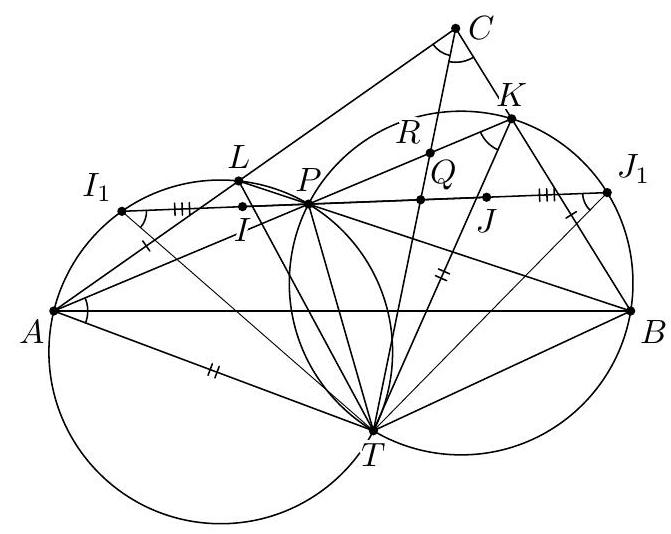
|
| 40 |
+
|
| 41 |
+
Figure 1: image on the median bisector of $I J$.
|
| 42 |
+
|
| 43 |
+
It remains to prove that $T$ lies on the median bisector of $P Q$. Let $R=A K \cap C T$. Then $\angle A R T=\angle R A C+\angle A C R=$ $\angle R A C+\angle A K T=\angle R A C+\angle K A T=\angle L A T=\angle B P T$. Since $P Q$ bisects the angle $R P B, \angle P Q T=\angle P R T+\angle R P Q=$ $\angle P B T+\angle B P J=\angle T P Q$, therefore $T$ belongs to the median bisector of $P Q$ and $I P=J Q$.
|
| 44 |
+
|
| 45 |
+
3. Prove that there exist infinitely many pairs $(m, n)$ of positive integers such that $m+n$ divides $(m!)^{n}+(n!)^{m}+1$.
|
| 46 |
+
|
| 47 |
+
Solution. We shall find a pair such that $m+n=p$ is prime and $n$ is even. Applying Wilson's theorem we have
|
| 48 |
+
|
| 49 |
+
$$
|
| 50 |
+
m!=(p-n)!=\frac{(p-1)!}{(p-n+1) \ldots(p-2)(p-1)} \equiv \frac{-1}{-(n-1) \ldots(-2)(-1)} \equiv \frac{1}{(n-1)!} \equiv \frac{n}{n!} \quad(\bmod p)
|
| 51 |
+
$$
|
| 52 |
+
|
| 53 |
+
It follows from Fermat's Little Theorem that $(n!)^{p} \equiv n!(\bmod p)$, therefore
|
| 54 |
+
|
| 55 |
+
$$
|
| 56 |
+
(m!)^{n}+(n!)^{m}+1 \equiv\left(\frac{n}{n!}\right)^{n}+(n!)^{p-n}+1 \equiv \frac{n^{n}+n!+(n!)^{n}}{(n!)^{n}} \quad(\bmod p)
|
| 57 |
+
$$
|
| 58 |
+
|
| 59 |
+
thus it suffices to prove that the number $n^{n}+n!+(n!)^{n}$ has a prime divisor $p>n$ for infinitely many even $n$.
|
| 60 |
+
|
| 61 |
+
We prove that this condition is satisfied, for instance, by all the numbers of the form $n=2 q$, where $q>2$ is prime. Let $A=(2 q)^{2 q}+(2 q)!+((2 q)!)^{2 q}$. For a prime $p$ and integer $k$ we denote by $v_{p}(k)$ the largest integer $\ell$ such that $p^{\ell}$ divides $k$.
|
| 62 |
+
|
| 63 |
+
If $r<2 q$ is prime and $r \notin\{2, q\}$ then $A \equiv(2 q)^{2 q} \not \equiv 0(\bmod r)$. The largest degree of $q$ dividing $(2 q)!$ is $q^{2}$, while for $(2 q)^{2 q}$ and $((2 q)!)^{2 q}$ it is $2 q$ and $4 q$ respectively, therefore $v_{q}(A)=2$.
|
| 64 |
+
|
| 65 |
+
Finally, $v_{2}((2 q)!)=\left[\frac{2 q}{2}\right]+\left[\frac{2 q}{4}\right]+\left[\frac{2 q}{8}\right]+\cdots<\frac{2 q}{2}+\frac{2 q}{4}+\frac{2 q}{8}+\cdots=2 q$, so $v_{2}((2 q)!)<v_{2}\left((2 q)^{2 q}\right)$ and obviously $v_{2}((2 q)!)<v_{2}\left((2 q)!^{2 q}\right)$, thus $v_{2}(A) \leq 2 q-1$. On the other hand, $A>(2 q)^{2 q}>2^{2 q-1} q^{2}$, therefore $A$ has a prime divisor $p>2 q$, q.e.d.
|
| 66 |
+
|
| 67 |
+
4. The Crocodile thought of four unit squares of a $2018 \times 2018$ forming a rectangle with sides 1 and 4 . The Bear can choose any square formed by 9 unit squares and ask whether it contains at least one of the four Crocodile's squares. What minimum number of questions should he ask to be sure of at least one affirmative answer?
|
| 68 |
+
|
| 69 |
+
The answer is $\frac{673^{2}-1}{2}=226464$.
|
| 70 |
+
|
| 71 |
+
Solution. We call checked any square chosen by the Bear, and all its unit squares. The position of a unit square in the table can be defined by the numbers of its row and column, that is, the square $(x, y)$ is in the $x$-th row and $y$-th column.
|
| 72 |
+
|
| 73 |
+
First we prove that $\frac{673^{2}-1}{2}$ questions is enough even on a $2019 \times 2019$ table. Let us divide this table into $3 \times 3$ squares and apply chess colouring to these large squares so that the corners are white. Thet it is enough to check all the black $3 \times 3$ squares: no row or column contains four consecutive white squares.
|
| 74 |
+
|
| 75 |
+
To prove that we need so many questions, we select all the unit squares with coordinates $(3 m+1,3 n+1)$, where $0 \leqslant m, n \leqslant 672$. A $3 \times 3$ square obviously can not contain two selected unit squares. On the other hand, if two selected squares lie at distance 3 (i.e., one of them is $(x, y)$, and another is $(x, y+3)$ or $(x+3, y)$ ), the Bear must check at least one of these two squares (because if neither is checked, then so are the two unit squares between them, and the Crocodile can place his rectangle on the unchecked squares).
|
| 76 |
+
|
| 77 |
+
Thus it is enough to produce $\frac{673^{2}-1}{2}$ pairs of selected unit squares at distance 3 . One can take pairs $(6 k+1,3 n+1)$, $(6 k+4,3 n+1), 0 \leqslant k \leqslant 335,0 \leqslant n \leqslant 672$, and $(2017,6 n+1),(2017,6 n+4), 0 \leqslant n \leqslant 335$.
|
| 78 |
+
|
| 79 |
+
5. Find all real $a$ for which there exists a function $f: \mathbb{R} \rightarrow \mathbb{R}$ such that $f(x-f(y))=f(x)+a[y]$ for every real $x$ и $y$ ( $[y]$ denotes the integral part of $y$ ).
|
| 80 |
+
|
| 81 |
+
Answer: $a=-n^{2}$ for arbitrary integer $n$.
|
| 82 |
+
|
| 83 |
+
Solution. First note that $a=0$ satisfies the problem condition (for example, the equation is satisfied by the function $f(x) \equiv 0)$.
|
| 84 |
+
|
| 85 |
+
Now suppose $a \neq 0$.
|
| 86 |
+
|
| 87 |
+
Lemma. $f(y)=f(z)$ if and only if $[y]=[z]$.
|
| 88 |
+
|
| 89 |
+
Suppose $f(y)=f(z)$ for some $y, z$. Then the given equation implies $f(x)+a[y]=f(x-f(y))=f(x-f(z))=f(x)+a[z]$ whence $[y]=[z]$. Conversely, if $[y]=[z]$ then $f(x-f(y))=f(x)+a[y]=f(x)+a[z=f(x-f(z))]$. It follows from previous observation that $[x-f(y)]=[x-f(z)]$ for all $x$. Set $x=\frac{f(y)+f(z)}{2}$, then $\left[\frac{f(y)-f(z)}{2}\right]=\left[-\frac{f(y)-f(z)}{2}\right]$, so $f(y)=f(z)$. The lemma is proved.
|
| 90 |
+
|
| 91 |
+
Now we claim that $f(m) \in \mathbb{Z}$ for any $m \in \mathbb{Z}$. Setting $y=m$ in the given equation we obtain $f(x-f(m))=f(x)+$ am for any $m \in \mathbb{Z}, x \in \mathbb{R}$. Suppose that $f(m) \notin \mathbb{Z}$ for some $m \in \mathbb{Z}$. Choose $t \in(0,1)$ such that $[f(m)]=[f(m)+t]$. Then for $x=0$ we have $f(-f(m))=f(0)+$ am and for $x=-t$ we have $f(-t-f(m))=f(-t)+a m$. Using the lemma we have $f(-f(m))=f(-t-f(m))$, so $f(0)=f(-t)=f(-1)$, which contradicts the lemma.
|
| 92 |
+
|
| 93 |
+
From now on we will use in the given equation $f(x-f(y))=f(x)+a y$ (1) only integer numbers $x, y$. Setting $y=1$ in (1) we obtain that $a \in \mathbb{Z}$. Further, for $y=0$ we have $f(x-f(0))=f(x)$ and therefore $x-f(0)=x$ (by lemma), whence $f(0)=0$. Now set $x=f(y)$, then $f(f(y))=-a y$ (2); replacing $y$ by $f(y)$ in (1) we get $f(x+a y)=f(x)+a f(y)$ (3). Denoting $f(1)$ by $n$ and setting $y=1$ in (3) we obtain $f(x+a)=f(x)+a n$ (4). Applying (4) to $x=0$ we get $f(a)=$ an. From (4) we easily conclude that $f(k a)=k a n$ for any $k \in \mathbb{Z}$; in particular $f(a n)=a n^{2}$. Now setting $y=a$ in (2) gives $-a^{2}=f(f(a))=a n^{2}$ as stated.
|
| 94 |
+
|
| 95 |
+
It remains to note that if $a=-n^{2}$ then the function $f(x)=n[x]$ satisfies the given condition: $n[x-n[y]]=n[x]-n^{2}[y]$, which is obvious.
|
| 96 |
+
|
| 97 |
+
6. A convex hexagon $A B C D E F$ is inscribed in a circle with radius $R$. Diagonals $A D$ and $B E, B E$ and $C F, A D$ and $C F$ of the hexagon meet at points $M, N, K$ respectively. Let $r_{1}, r_{2}, r_{3}, r_{4}, r_{5}, r_{6}$ be the inradii of the triangles $A B M$, $B C N, C D K, D E M, E F N, A F K$ respectively. Prove that $r_{1}+r_{2}+r_{3}+r_{4}+r_{5}+r_{6} \leqslant R \sqrt{3}$.
|
| 98 |
+
|
| 99 |
+
## Solution.
|
| 100 |
+
|
| 101 |
+
We start with a lemma.
|
| 102 |
+
|
| 103 |
+
Lemma. Let $R$ be the circumradius of a quadrilateral $X Y Z T$, the diagonals of $X Y Z T$ meet at $U$, and $\varphi=\frac{1}{2} \angle X U Y$. Then the radii $r_{1}$ and $r_{2}$ of the incentres of $X Y U$ and $Z T U$ satisfy
|
| 104 |
+
|
| 105 |
+
$$
|
| 106 |
+
\frac{r_{1}+r_{2}}{R} \leqslant 2 \tan \varphi(1-\sin \varphi)
|
| 107 |
+
$$
|
| 108 |
+
|
| 109 |
+
Indeed, let $\angle U X Y=2 \psi, \angle U Y X=2 \vartheta$, then $\angle U T Z=\angle U X Y=2 \psi, \angle U Z T=\angle U Y X=2 \vartheta$ (and obviously $\left.\psi+\vartheta+\varphi=\frac{\pi}{2}\right)$. We have $X Y+Z T=\left(r_{1}+r_{2}\right)(\cot \psi+\cot \vartheta)=2 R \sin \angle X T Y+2 R \sin (2 \varphi-\angle X T Y)=2 R(\sin \angle X T Y+$ $\sin (2 \varphi-\angle X T Y)=2 R \cdot 2 \sin \varphi \cos (\varphi-\angle X T Y) \leqslant 4 R \sin \varphi$. Therefore
|
| 110 |
+
|
| 111 |
+
$$
|
| 112 |
+
\begin{gathered}
|
| 113 |
+
\frac{r_{1}+r_{2}}{R} \leqslant \frac{4 \sin \varphi}{\cot \psi+\cot \vartheta}=\frac{4 \sin \varphi \sin \psi \sin \vartheta}{\sin (\psi+\vartheta)}=\frac{4 \sin \varphi \sin \psi \sin \vartheta}{\cos \varphi}=4 \tan \varphi \sin \psi \sin \vartheta= \\
|
| 114 |
+
=4 \tan \varphi \cdot \frac{1}{2}(\cos (\psi-\vartheta)-\cos (\psi+\vartheta)) \leqslant 2 \tan \varphi(1-\sin \varphi)
|
| 115 |
+
\end{gathered}
|
| 116 |
+
$$
|
| 117 |
+
|
| 118 |
+
q.e.d.
|
| 119 |
+
|
| 120 |
+
Returning to the problem, let $\angle A M B=2 \alpha, \angle B N C=2 \beta, \angle C K D=2 \gamma$, then $\alpha+\beta+\gamma=\frac{\pi}{2}$.
|
| 121 |
+
|
| 122 |
+
Applying the inequality (1) to the quadrilaterals $A B D E, B C E F$ и $C D F A$ we get
|
| 123 |
+
|
| 124 |
+
$$
|
| 125 |
+
\frac{r_{1}+r_{2}+r_{3}+r_{4}+r_{5}+r_{6}}{R}=\frac{r_{1}+r_{4}}{R}+\frac{r_{2}+r_{5}}{R}+\frac{r_{3}+r_{6}}{R} \leqslant 2 \tan \alpha(1-\sin \alpha)+2 \tan \beta(1-\sin \beta)+2 \tan \gamma(1-\sin \gamma)
|
| 126 |
+
$$
|
| 127 |
+
|
| 128 |
+
We claim that if $\alpha+\beta+\gamma=\frac{\pi}{2}$ then
|
| 129 |
+
|
| 130 |
+
$$
|
| 131 |
+
2 \tan \alpha(1-\sin \alpha)+2 \tan \beta(1-\sin \beta)+2 \tan \gamma(1-\sin \gamma) \leqslant \sqrt{3}
|
| 132 |
+
$$
|
| 133 |
+
|
| 134 |
+
To prove that we consider the function $f(x)=2 \tan x(1-\sin x)$ for $x \in\left(0 ; \frac{\pi}{2}\right)$.
|
| 135 |
+
|
| 136 |
+
Since $f^{\prime \prime}(x)=-2 \frac{(1-\sin x)^{2}+\cos ^{4} x}{\cos ^{3} x}<0$ for $x \in\left(0 ; \frac{\pi}{2}\right)$, it follows from Jensen's inequality that
|
| 137 |
+
|
| 138 |
+
$$
|
| 139 |
+
f(\alpha)+f(\beta)+f(\gamma) \leqslant 3 f\left(\frac{\alpha+\beta+\gamma}{3}\right)=3 f\left(\frac{\pi}{6}\right)=\sqrt{3}
|
| 140 |
+
$$
|
| 141 |
+
|
| 142 |
+
Thus (2) is proved, and $r_{1}+r_{2}+r_{3}+r_{4}+r_{5}+r_{6} \leqslant \sqrt{3} R$.
|
| 143 |
+
|
IZho/md/en-2019_zhautykov_resenja_e.md
ADDED
|
@@ -0,0 +1,118 @@
|
|
|
|
|
|
|
|
|
|
|
|
|
|
|
|
|
|
|
|
|
|
|
|
|
|
|
|
|
|
|
|
|
|
|
|
|
|
|
|
|
|
|
|
|
|
|
|
|
|
|
|
|
|
|
|
|
|
|
|
|
|
|
|
|
|
|
|
|
|
|
|
|
|
|
|
|
|
|
|
|
|
|
|
|
|
|
|
|
|
|
|
|
|
|
|
|
|
|
|
|
|
|
|
|
|
|
|
|
|
|
|
|
|
|
|
|
|
|
|
|
|
|
|
|
|
|
|
|
|
|
|
|
|
|
|
|
|
|
|
|
|
|
|
|
|
|
|
|
|
|
|
|
|
|
|
|
|
|
|
|
|
|
|
|
|
|
|
|
|
|
|
|
|
|
|
|
|
|
|
|
|
|
|
|
|
|
|
|
|
|
|
|
|
|
|
|
|
|
|
|
|
|
|
|
|
|
|
|
|
|
|
|
|
|
|
|
|
|
|
|
|
|
|
|
|
|
|
|
|
|
|
|
|
|
|
|
|
|
|
|
|
|
|
|
|
|
|
|
|
|
|
|
|
|
|
|
|
|
|
|
|
|
|
|
|
|
|
|
|
|
|
|
|
|
|
|
|
|
|
|
|
|
|
|
|
|
|
|
|
|
|
|
|
|
|
|
|
|
|
|
|
|
|
|
|
|
|
|
|
|
|
|
|
|
|
|
|
|
|
|
|
|
|
|
|
|
|
|
|
|
|
|
|
|
|
|
|
|
|
|
|
|
|
|
|
|
|
|
|
|
|
|
|
|
|
|
|
| 1 |
+
# XV International Zhautykov Olympiad in Mathematics <br> Almaty, 2019 <br> January 11, 9.00-13.30
|
| 2 |
+
|
| 3 |
+
№1. Prove that there are at least 100! ways to partition the number 100! into summands from the set $\{1!, 2!, 3!, \ldots, 99$ !\}. (Partitions differing in the order of summands are considered the same; any summand can be taken multiple times. We remind that $n!=1 \cdot 2 \cdot \ldots \cdot n$.)
|
| 4 |
+
|
| 5 |
+
Solution. Let us prove by induction on $n \geqslant 4$ that there are at least $n$ ! ways to partition the number $n$ ! into summands from $\{1!, 2!, \ldots,(n-1)!\}$.
|
| 6 |
+
|
| 7 |
+
For $n=4$, if we use only the summands 1 !, 2 ! there are 13 ways to partition 4 ! as 2 ! can be used from 0 to 12 times. If 3 ! is used 1 time, then $4!-3$ ! = 18 can be partitioned using 1 !, 2 ! in 10 ways. We get at least one more partition if we use 3! two times. So, there are at least 24 such partitions as needed.
|
| 8 |
+
|
| 9 |
+
Suppose now the statement holds for $n$ and let us prove it for $n+1$. To partition $(n+1)$ !, the summand $n$ ! can be used $i$ times for $0 \leqslant i \leqslant n$. By the hypothesis, for every such $i$, the remaining number $(n+1)!-$ $-i \cdot n!=(n+1-i) \cdot n!$ can be partitioned into the summands $\{1!, \ldots,(n-1)!\}$ in at least $n$ ! ways as follows. For any partition of $n$ ! take each summand appearing say $k$ times and write it $(n+1-i) k$ times. Hence we obtain at least $(n+1) \cdot n!=(n+1)$ ! ways to partition the number $(n+1)$ ! as desired. The original problem follows for $n=100$ then.
|
| 10 |
+
|
| 11 |
+
№2. Find the largest real $C$ such that for all pairwise distinct positive real $a_{1}, a_{2}, \ldots, a_{2019}$ the following inequality holds
|
| 12 |
+
|
| 13 |
+
$$
|
| 14 |
+
\frac{a_{1}}{\left|a_{2}-a_{3}\right|}+\frac{a_{2}}{\left|a_{3}-a_{4}\right|}+\ldots+\frac{a_{2018}}{\left|a_{2019}-a_{1}\right|}+\frac{a_{2019}}{\left|a_{1}-a_{2}\right|}>C
|
| 15 |
+
$$
|
| 16 |
+
|
| 17 |
+
2. The answer is 1010 .
|
| 18 |
+
|
| 19 |
+
Solution. Without loss of generality we assume that $\min \left(a_{1}, a_{2}, \ldots, a_{2019}\right)=a_{1}$. Note that if $a, b, c$ $(b \neq c)$ are positive, then $\frac{a}{|b-c|}>\min \left(\frac{a}{b}, \frac{a}{c}\right)$. Hence
|
| 20 |
+
|
| 21 |
+
$$
|
| 22 |
+
S=\frac{a_{1}}{\left|a_{2}-a_{3}\right|}+\cdots+\frac{a_{2019}}{\left|a_{1}-a_{2}\right|}>0+\min \left(\frac{a_{2}}{a_{3}}, \frac{a_{2}}{a_{4}}\right)+\cdots+\min \left(\frac{a_{2017}}{a_{2018}}, \frac{a_{2017}}{a_{2019}}\right)+\frac{a_{2018}}{a_{2019}}+\frac{a_{2019}}{a_{2}}=T
|
| 23 |
+
$$
|
| 24 |
+
|
| 25 |
+
Take $i_{0}=2$ and for each $\ell \geqslant 0$ let $i_{\ell+1}=i_{\ell}+1$ if $a_{i_{\ell}+1}>a_{i_{\ell}+2}$ and $i_{\ell+1}=i_{\ell}+2$ otherwise. There is an integral $k$ such that $i_{k}<2018$ and $i_{k+1} \geqslant 2018$. Then
|
| 26 |
+
|
| 27 |
+
$$
|
| 28 |
+
T \geqslant \frac{a_{2}}{a_{i_{1}}}+\frac{a_{i_{1}}}{a_{i_{2}}}+\cdots+\frac{a_{i_{k}}}{a_{i_{k+1}}}+\frac{a_{2018}}{a_{2019}}+\frac{a_{2019}}{a_{2}}=A
|
| 29 |
+
$$
|
| 30 |
+
|
| 31 |
+
We have $1 \leqslant i_{\ell+1}-i_{\ell} \leqslant 2$, therefore $i_{k+1} \in\{2018,2019\}$.
|
| 32 |
+
|
| 33 |
+
Since
|
| 34 |
+
|
| 35 |
+
$$
|
| 36 |
+
2018 \leqslant i_{k+1}=i_{0}+\left(i_{1}-i_{0}\right)+\cdots+\left(i_{k+1}-i_{k}\right) \leqslant 2(k+2)
|
| 37 |
+
$$
|
| 38 |
+
|
| 39 |
+
it follows that $k \geqslant 1007$. Consider two cases.
|
| 40 |
+
|
| 41 |
+
(i) $k=1007$. Then in the inequality (2) we have equalities everywhere, in particular $i_{k+1}=2018$. Applying AM-GM inequality for $k+3$ numbers to (1) we obtain $A \geqslant k+3 \geqslant 1010$.
|
| 42 |
+
|
| 43 |
+
(ii) $k \geqslant 1008$. If $i_{k+1}=2018$ then we get $A \geqslant k+3 \geqslant 1011$ by the same argument as in the case (i). If $i_{k+1}=2019$ then applying AM-GM inequality to $k+2$ summands in (1) (that is, to all the summands except $\left.\frac{a_{2018}}{a_{2019}}\right)$ we get $A \geqslant k+2 \geqslant 1010$.
|
| 44 |
+
|
| 45 |
+
So we have $S>T \geqslant A \geqslant 1010$. For $a_{1}=1+\varepsilon, a_{2}=\varepsilon, a_{3}=1+2 \varepsilon, a_{4}=2 \varepsilon, \ldots, a_{2016}=1008 \varepsilon, a_{2017}=$ $=1+1009 \varepsilon, a_{2018}=\varepsilon^{2}, a_{2019}=1$ we obtain $S=1009+1008 \varepsilon+\frac{1008 \varepsilon}{1+1009 \varepsilon-\varepsilon^{2}}+\frac{1+1009 \varepsilon}{1-\varepsilon^{2}}$. Then $\lim _{\varepsilon \rightarrow 0} S=1010$, which means that the constant 1010 cannot be increased.
|
| 46 |
+
|
| 47 |
+
№3. The extension of median $C M$ of the triangle $A B C$ intersects its circumcircle $\omega$ at $N$. Let $P$ and $Q$ be the points on the rays $C A$ and $C B$ respectively such that $P M \| B N$ and $Q M \| A N$. Let $X$ and $Y$ be the points on the segments $P M$ and $Q M$ respectively such that $P Y$ and $Q X$ are tangent to $\omega$. The segments $P Y$ and $Q X$ intersect at $Z$. Prove that the quadrilateral $M X Z Y$ is circumscribed.
|
| 48 |
+
|
| 49 |
+
## Solution.
|
| 50 |
+
|
| 51 |
+
Lemma. The points $K$ and $L$ lie on the sides $B C$ and $A C$ of a triangle $A B C$. The segments $A K$ and $B L$ intersect at $D$. Then the quadrilateral $C K D L$ is circumscribed if and only if $A C-B C=A D-B D$.
|
| 52 |
+
|
| 53 |
+
Proof. Let $C K D L$ be circumscribed and its incircle touches $L C, C K, K D, D L$ at $X, Y, Z, T$ respectively (see Fig. 1). Then
|
| 54 |
+
|
| 55 |
+
$$
|
| 56 |
+
A C-B C=A X-B Y=A Z-B T=A D-B D
|
| 57 |
+
$$
|
| 58 |
+
|
| 59 |
+

|
| 60 |
+
|
| 61 |
+
Рис. 1
|
| 62 |
+
|
| 63 |
+

|
| 64 |
+
|
| 65 |
+
Рис. 2
|
| 66 |
+
|
| 67 |
+
Now suppose that $A C-B C=A D-B D$. Let the tangent to the incircle of $B L C$ different from $A C$ meets the segments $B L$ and $B C$ at $D_{1}$ and $K_{1}$ respectively. If $K=K_{1}$ then the lemma is proved. Otherwise $A D_{1}-B D_{1}=A C-B C=A D-B D$ or $A D_{1}-B D_{1}=A D-B D$. In the case when $D$ lies on the segment $B D_{1}$ (see Fig. 2) we have
|
| 68 |
+
|
| 69 |
+
$$
|
| 70 |
+
A D_{1}-B D_{1}=A D-B D \Rightarrow A D_{1}-A D=B D_{1}-B D \Rightarrow A D_{1}-A D=D D_{1}
|
| 71 |
+
$$
|
| 72 |
+
|
| 73 |
+
But the last equation contradicts the triangle inequality, since $A D_{1}-A D<D D_{1}$. The case when $D$ is outside the segment $B D_{1}$ is similar.
|
| 74 |
+
|
| 75 |
+
Back to the solution of the problem, let $P Y$ and $Q X$ touch $\omega$ at $Y_{1}$ and $X_{1}$ respectively. Since $A C B N$ is cyclic and $P M \| B N$ we have $\angle A C N=\angle A B N=\angle A M P$, i. e. the circumcircle of $\triangle A M C$ is tangent to the line $P M$. Thus $P M^{2}=P A \cdot P C$. But $P A \cdot P C=P Y_{1}^{2}$, and therefore $P M=P Y_{1}$. In the same way we have $Q M=Q X_{1}$. Obviously $Z X_{1}=Z Y_{1}$. It remains to note that the desired result follows from the Lemma because
|
| 76 |
+
|
| 77 |
+
$$
|
| 78 |
+
P M-Q M=P Y_{1}-Q X_{1}=\left(P Z+Z Y_{1}\right)-\left(Q Z+Z X_{1}\right)=P Z-Q Z \quad \Rightarrow \quad P M-Q M=P Z-Q Z
|
| 79 |
+
$$
|
| 80 |
+
|
| 81 |
+
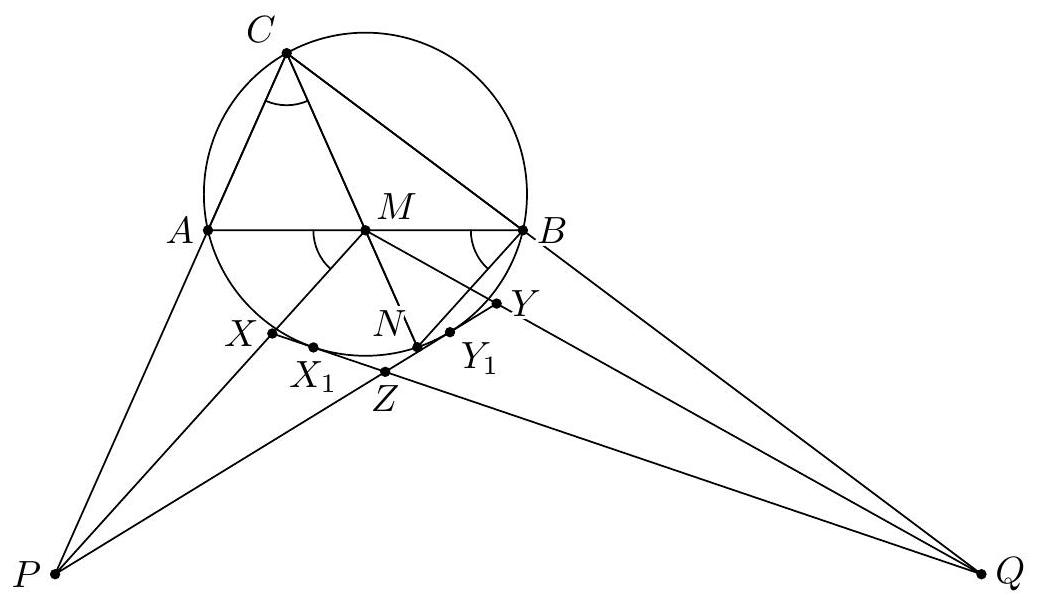
|
| 82 |
+
|
| 83 |
+
Рис. 3
|
| 84 |
+
|
| 85 |
+
Note. This solution does not use the comdition that $M$ is the midpoint of $A B$.
|
| 86 |
+
|
| 87 |
+
## XV International Zhautykov Olympiad in Mathematics
|
| 88 |
+
|
| 89 |
+
Second day. Solutions
|
| 90 |
+
|
| 91 |
+
№4. An isosceles triangle $A B C$ with $A C=B C$ is given. Point $D$ is chosen on the side $A C$. The circle $S_{1}$ of radius $R$ with the center $O_{1}$ touches the segment $A D$ and the extensions of $B A$ and $B D$ over the points $A$ and $D$, respectively. The circle $S_{2}$ of radius $2 R$ with the center $O_{2}$ touches the segment $D C$ and the extensions of $B D$ and $B C$ over the points $D$ and $C$, respectively. Let the tangent to the circumcircle of the triangle $B O_{1} O_{2}$ at the point $O_{2}$ intersect the line $B A$ at point $F$. Prove that $O_{1} F=O_{1} O_{2}$.
|
| 92 |
+
|
| 93 |
+
Solution By condition, in the triangle $A B C$ we have $\angle A=\angle B$. It is evident that $\angle O_{1} B O_{2}=\angle B / 2$. Let $\ell$ be the straight line passing through $O_{2}$ parallel to $A C$. By the problem condition $\ell$ touches $S_{1}$ (say, at a point $N$ ). Let also $K$ be the tangency point of $S_{1}$ and $B A$. Then the clockwise rotation about the point $O_{1}$ through the angle $N O_{1} K$ transposes $\ell$ to $B A$ and thus transposes the point $O_{2}$ to some point $O \in B A$. Hence $O_{1} O=O_{1} O_{2}$ and $\angle O O_{1} O_{2}=\angle N O_{1} K=180^{\circ}-\angle A=180^{\circ}-\angle B$, so $\angle O_{1} O_{2} O=\angle B / 2=\angle O_{1} B O_{2}$. The latter does mean that the line $\mathrm{O}_{2} \mathrm{O}$ is the tangent to the circumcircle of $\triangle B O_{1} O_{2}$. Hence $F=O$, and $O_{1} F=O_{1} O_{2}$, as was to be proved.
|
| 94 |
+
|
| 95 |
+
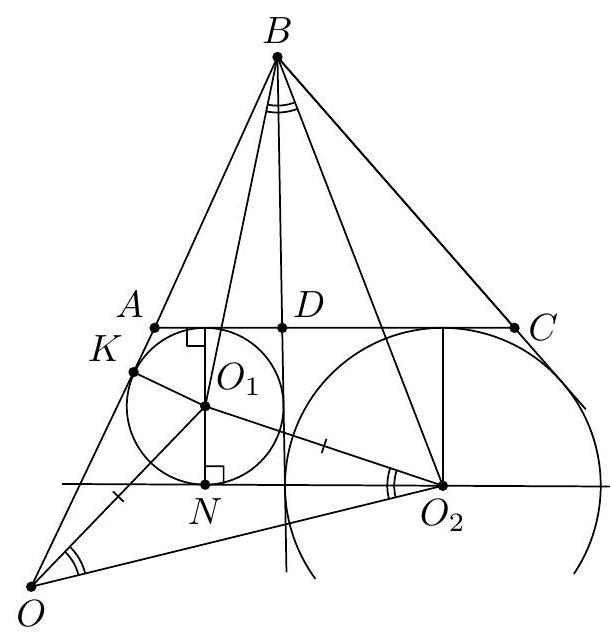
|
| 96 |
+
|
| 97 |
+
Рис. 1
|
| 98 |
+
|
| 99 |
+
№5. Let $n>1$ be a positive integer. A function $f: I \rightarrow \mathbb{Z}$ is given, where $I$ is the set of all integers coprime with $n$. ( $\mathbb{Z}$ is the set of integers). A positive integer $k$ is called a period of the function $f$ if $f(a)=f(b)$ for all $a, b \in I$ such that $a \equiv b(\bmod k)$. It is known that $n$ is a period of $f$. Prove that the minimal period of the function $f$ divides all its periods.
|
| 100 |
+
|
| 101 |
+
Example. For $n=6$, the function $f$ with period 6 is defined entirely by its values $f(1)$ and $f(5)$. If $f(1)=f(5)$, then the function has minimal period $P_{\min }=1$, and if $f(1) \neq f(5)$, then $P_{\min }=3$.
|
| 102 |
+
|
| 103 |
+
№6. On a polynomial of degree three it is allowed to perform the following two operations arbitrarily many times:
|
| 104 |
+
|
| 105 |
+
(i) reverse the order of its coefficients including zeroes (for instance, from the polynomial $x^{3}-2 x^{2}-3$ we can obtain $-3 x^{3}-2 x+1$;
|
| 106 |
+
|
| 107 |
+
(ii) change polynomial $P(x)$ to the polynomial $P(x+1)$.
|
| 108 |
+
|
| 109 |
+
Is it possible to obtain the polynomial $x^{3}-3 x^{2}+3 x-3$ from the polynomial $x^{3}-2$ ?
|
| 110 |
+
|
| 111 |
+
The answer is no.
|
| 112 |
+
|
| 113 |
+
Solution I. The original polynomial $x^{3}-2$ has a unique real root. The two transformations clearly preserve this property. If $\alpha$ is the only real root of $P(x)$, then the first operation produces a polynomial with root $\frac{1}{\alpha}$, and the second operation gives a polynomial with root $\alpha-1$. Since the root of the original polynomial is $\sqrt[3]{2}$, and thar of the resulting polynomial is $1+\sqrt[3]{2}$, the problem is reduced to the question whether it is possible to obtain the latter number from the former by operations $x \mapsto \frac{1}{x}$ and $x \mapsto x-1$. Let us apply one more operation $x \mapsto x-1$ (so as to transform $\sqrt[3]{2}$ to itself) and reverse all the operations. It appears then that the number $\sqrt[3]{2}$ is transformed to itself by several operations of the form $x \mapsto \frac{1}{x}$ and $x \mapsto x+1$. It is easy to see that the composition of any number of such operations is a fractional-linear function $x \mapsto \frac{a x+b}{c x+d}$, where $a, b, c, d$ are non-negative integers and $a d-b c=1$. Each operation $x \mapsto x+1$ increases $a+b+c+d$, and, since we started with this operation, the resulting function is not identical. Thus $\sqrt[3]{2}$ is transformed to itself by some such composition. This means however that $\sqrt[3]{2}$ is a root of non-zero polynomial $x(c x+d)-a x-b$ with integral coefficients and degree at most 2, which is impossible.
|
| 114 |
+
|
| 115 |
+
Solution II. The original polynomial has one real and two conjugate complex roots. We have seen above that under the two operations these roots are subject to transforms $x \mapsto \frac{1}{x}$ and $x \mapsto x-1$. Note that both imaginary roots of the original polynomial have negative real part. It is easy to check that this property is preserved under the two operations. However the real parts of all the roots of the desired polynomial are positive, a contradiction.
|
| 116 |
+
|
| 117 |
+
Solution III. For a polynomial $P(x)=a x^{3}+b x^{2}+c x+d$ we define $\Delta(P)=3 a d-b c$. The first operation transforms $P(x)$ to $d x^{3}+c x^{2}+b x+a$ and does not change $\Delta$. The second operation transforms $P(x)$ to $Q(x)=a x^{3}+(b+3 a) x^{2}+(c+3 a+2 b) x+(d+a+b+c)$, for which $\Delta(Q)=3(d+a+b+c) a-$ $-(b+3 a)(c+3 a+2 b)=\Delta(P)-\left(2 b^{2}+6 a b+6 a^{2}\right)<\Delta(P)$. Thus the permitted operation can not increase $\Delta$. On the other hand, for the original polynomial $\Delta(P)=-6$, and for the resulting polynomial it must be 0 .
|
| 118 |
+
|
IZho/md/en-2020_zhautykov_resenja_e.md
ADDED
|
@@ -0,0 +1,156 @@
|
|
|
|
|
|
|
|
|
|
|
|
|
|
|
|
|
|
|
|
|
|
|
|
|
|
|
|
|
|
|
|
|
|
|
|
|
|
|
|
|
|
|
|
|
|
|
|
|
|
|
|
|
|
|
|
|
|
|
|
|
|
|
|
|
|
|
|
|
|
|
|
|
|
|
|
|
|
|
|
|
|
|
|
|
|
|
|
|
|
|
|
|
|
|
|
|
|
|
|
|
|
|
|
|
|
|
|
|
|
|
|
|
|
|
|
|
|
|
|
|
|
|
|
|
|
|
|
|
|
|
|
|
|
|
|
|
|
|
|
|
|
|
|
|
|
|
|
|
|
|
|
|
|
|
|
|
|
|
|
|
|
|
|
|
|
|
|
|
|
|
|
|
|
|
|
|
|
|
|
|
|
|
|
|
|
|
|
|
|
|
|
|
|
|
|
|
|
|
|
|
|
|
|
|
|
|
|
|
|
|
|
|
|
|
|
|
|
|
|
|
|
|
|
|
|
|
|
|
|
|
|
|
|
|
|
|
|
|
|
|
|
|
|
|
|
|
|
|
|
|
|
|
|
|
|
|
|
|
|
|
|
|
|
|
|
|
|
|
|
|
|
|
|
|
|
|
|
|
|
|
|
|
|
|
|
|
|
|
|
|
|
|
|
|
|
|
|
|
|
|
|
|
|
|
|
|
|
|
|
|
|
|
|
|
|
|
|
|
|
|
|
|
|
|
|
|
|
|
|
|
|
|
|
|
|
|
|
|
|
|
|
|
|
|
|
|
|
|
|
|
|
|
|
|
|
|
|
|
|
|
|
|
|
|
|
|
|
|
|
|
|
|
|
|
|
|
|
|
|
|
|
|
|
|
|
|
|
|
|
|
|
|
|
|
|
|
|
|
|
|
|
|
|
|
|
|
|
|
|
|
|
|
|
|
|
|
|
|
|
|
|
|
|
|
|
|
|
|
|
|
|
|
|
|
|
|
|
|
|
|
|
|
|
|
|
|
|
|
|
|
|
|
|
|
|
|
|
|
|
|
|
|
|
|
|
|
|
|
|
|
|
| 1 |
+
# XIV International Zhautykov Olympiad in Mathematics
|
| 2 |
+
|
| 3 |
+
Almaty, 2020
|
| 4 |
+
|
| 5 |
+
## January 10, 9.00-13.30
|
| 6 |
+
|
| 7 |
+
First day
|
| 8 |
+
|
| 9 |
+
(Each problem is worth 7 points)
|
| 10 |
+
|
| 11 |
+
1. A positive integer $n$ does not divide $2^{a} 3^{b}+1$ for any positive integers $a$ and $b$. Prove that $n$ does not divide $2^{c}+3^{d}$ for any positive integers $c$ and $d$.
|
| 12 |
+
|
| 13 |
+
Solution. Assume the contrary: $n$ divides $2^{c}+3^{d}$. Clearly $n$ is not divisible by 3 ; therefore $n$ divides $3^{k}-1$ for some $k$. Choosing $s$ so that $k s>d$ we see that $n$ divides $3^{k s-d}\left(2^{c}+3^{d}\right)=2^{c} 3^{k s-d}+3^{k s}$. Then $n$ also divides $2^{c} 3^{k s-d}+1=2^{c} 3^{k s-d}+3^{k s}-\left(3^{k s}-1\right)$, a contradiction.
|
| 14 |
+
|
| 15 |
+
2. In a set of 20 elements there are $2 k+1$ different subsets of 7 elements such that each of these subsets intersects exactly $k$ other subsets. Find the maximum $k$ for which this is possible.
|
| 16 |
+
|
| 17 |
+
The answer is $k=2$.
|
| 18 |
+
|
| 19 |
+
Solution. Let $M$ be the set of residues mod20. An example is given by the sets $A_{i}=\{4 i+1,4 i+$ $2,4 i+3,4 i+4,4 i+5,4 i+6,4 i+7\} \subset M, i=0,1,2,3,4$.
|
| 20 |
+
|
| 21 |
+
Let $k \geq 2$. Obviously among any three 7-element subsets there are two intersecting subsets.
|
| 22 |
+
|
| 23 |
+
Let $A$ be any of the $2 k+1$ subsets. It intersects $k$ other subsets $B_{1}, \ldots, B_{k}$. The remaining subsets $C_{1}$, $\ldots, C_{k}$ do not intersect $A$ and are therefore pairwise intersecting. Since each $C_{i}$ intersects $k$ other subsets, it intersects exactly one $B_{j}$. This $B_{j}$ can not be the same for all $C_{i}$ because $B_{j}$ can not intersect $k+1$ subsets.
|
| 24 |
+
|
| 25 |
+
Thus there are two different $C_{i}$ intersecting different $B_{j}$; let $C_{1}$ intersect $B_{1}$ and $C_{2}$ intersect $B_{2}$. All the subsets that do not intersect $C_{1}$ must intersect each other; there is $A$ among them, therefore they are $A$ and all $B_{i}, i \neq 1$. Hence every $B_{j}$ and $B_{j}, i \neq 1, j \neq 1$, intersect. Applying the same argument to $C_{2}$ we see that any $B_{i}$ and $B_{j}, i \neq 2, j \neq 2$, intersect. We see that the family $A, B_{1}, \ldots, B_{k}$ contains only one pair, $B_{1}$ and $B_{2}$, of non-untersecting subsets, while $B_{1}$ intersects $C_{1}$ and $B_{2}$ intersects $C_{2}$. For each $i$ this list contains $k$ subsets intersecting $B_{i}$. It follows that no $C_{i}$ with $i>2$ intersects any $B_{j}$, that is, there are no such $C_{i}$, and $k \leq 2$.
|
| 26 |
+
|
| 27 |
+
3. A convex hexagon $A B C D E F$ is inscribed in a circle. Prove the inequality
|
| 28 |
+
|
| 29 |
+
$$
|
| 30 |
+
A C \cdot B D \cdot C E \cdot D F \cdot A E \cdot B F \geq 27 A B \cdot B C \cdot C D \cdot D E \cdot E F \cdot F A
|
| 31 |
+
$$
|
| 32 |
+
|
| 33 |
+
Solution. Let
|
| 34 |
+
|
| 35 |
+
$$
|
| 36 |
+
d_{1}=A B \cdot B C \cdot C D \cdot D E \cdot E F \cdot F A, d_{2}=A C \cdot B D \cdot C E \cdot D F \cdot A E \cdot B F, d_{3}=A D \cdot B E \cdot C F
|
| 37 |
+
$$
|
| 38 |
+
|
| 39 |
+
Applying Ptolemy's theorem to quadrilaterals $A B C D, B C D E, C D E F, D E F A, E F A B, F A B C$, we obtain six equations $A C \cdot B D-A B \cdot C D=B C \cdot A D, \ldots, F B \cdot A C-F A \cdot B C=A B \cdot F C$. Putting these equations in the well-known inequality
|
| 40 |
+
|
| 41 |
+
$$
|
| 42 |
+
\sqrt[6]{\left(a_{1}-b_{1}\right)\left(a_{2}-b_{2}\right) \cdot \ldots \cdot\left(a_{6}-b_{6}\right)} \leq \sqrt[6]{a_{1} a_{2} \ldots a_{6}}-\sqrt[6]{b_{1} b_{2} \ldots b_{6}}\left(a_{i} \geq b_{i}>0, i=1, \ldots, 6\right)
|
| 43 |
+
$$
|
| 44 |
+
|
| 45 |
+
we get
|
| 46 |
+
|
| 47 |
+
$$
|
| 48 |
+
\sqrt[3]{d_{3}} \sqrt[6]{d_{1}} \leq \sqrt[3]{d_{2}}-\sqrt[3]{d_{1}}
|
| 49 |
+
$$
|
| 50 |
+
|
| 51 |
+
Applying Ptolemy's theorem to quadrilaterals $A C D F, A B D E$ и $B C E F$, we obtain three equations $A D \cdot C F=A C \cdot D F+A F \cdot C D, A D \cdot B E=B D \cdot A E+A B \cdot D E, B E \cdot C F=B F \cdot C E+B C \cdot E F$. Putting these equations in the well-known inequality
|
| 52 |
+
|
| 53 |
+
$$
|
| 54 |
+
\sqrt[3]{\left(a_{1}+b_{1}\right)\left(a_{2}+b_{2}\right)\left(a_{3}+b_{3}\right)} \geq \sqrt[3]{a_{1} a_{2} a_{3}}+\sqrt[3]{b_{1} b_{2} b_{3}}\left(a_{i}>0, b_{i}>0, i=1,2,3\right)
|
| 55 |
+
$$
|
| 56 |
+
|
| 57 |
+
we get
|
| 58 |
+
|
| 59 |
+
$$
|
| 60 |
+
\sqrt[3]{d_{3}^{2}} \geq \sqrt[3]{d_{2}}+\sqrt[3]{d_{1}}
|
| 61 |
+
$$
|
| 62 |
+
|
| 63 |
+
It follows from (1) and (2) that $\left(\sqrt[3]{d_{2}}-\sqrt[3]{d_{1}}\right)^{2} \geq \sqrt[3]{d_{1}}\left(\sqrt[3]{d_{2}}+\sqrt[3]{d_{1}}\right)$, that is, $\sqrt[3]{d_{2}} \geq 3 \sqrt[3]{d_{1}}$ and $d_{2} \geq 27 d_{1}$, q.e.d.
|
| 64 |
+
|
| 65 |
+
## XVI International Zhautykov Olympiad in Mathematics Solutions of the second day
|
| 66 |
+
|
| 67 |
+
№4. In a scalene triangle $A B C \quad I$ is the incenter and $C N$ is the bisector of angle $C$. The line $C N$ meets the circumcircle of $A B C$ again at $M$. The line $\ell$ is parallel to $A B$ and touches the incircle of $A B C$. The point $R$ on $\ell$ is such that $C I \perp I R$. The circumcircle of $M N R$ meets the line $I R$ again at $S$. Prove that $A S=B S$.
|
| 68 |
+
|
| 69 |
+
Solution. In this solution we make use of directed angles. A directed angle $\angle(n, m)$ between lines $n$ and $m$ is the angle of counterclockwise rotation transforming $n$ into a line parallel to $m$.
|
| 70 |
+
|
| 71 |
+
Let $d$ be the tangent to the circumcircle of $\triangle A B C$ containing $N$ and different from $A B$. Then $\angle(\ell, C I)=\angle(N B, N I)=\angle(N I, d)$. Since $C I \perp I R$, the line $d$ contains $R$ because of symmetry with respect to $I R$.
|
| 72 |
+
|
| 73 |
+
Let $T$ be the common point of $M S$ and $\ell$. We have $\angle(M N, M S)=\angle(R N, R S)=\angle(R S, R T)$, that is, $R, T, I, M$ are concyclic. Therefore $\angle(R T, M T)=\angle(R I, M I)=90^{\circ}$. It follows that $M S \perp A B$. But $M$ belongs to the perpendicular bisector of $A B$, and so does $S$. Thus $A S=B S$, q.e.d.
|
| 74 |
+
|
| 75 |
+
№5. Find all the functions $f: \mathbb{Z} \rightarrow \mathbb{Z}$ such that $f(4 x+3 y)=f(3 x+$ $+y)+f(x+2 y)$ for all integers $x$ and $y$.
|
| 76 |
+
|
| 77 |
+
Answer: $f(x)=\frac{a x}{5}$ for $x$ divisible by 5 and $f(x)=b x$ for $x$ not
|
| 78 |
+
|
| 79 |
+
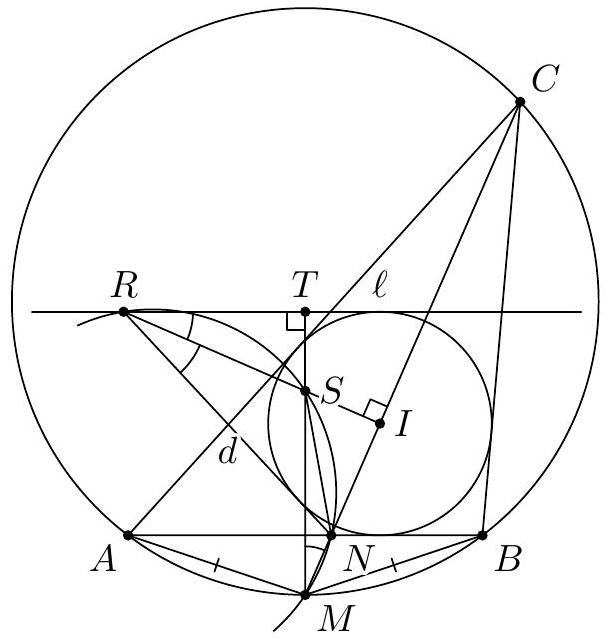
|
| 80 |
+
|
| 81 |
+
Рис. 1 divisible by 5 , where $a$ and $b$ are arbitrary integers.
|
| 82 |
+
|
| 83 |
+
Solution. Putting $x=0$ in the original equation
|
| 84 |
+
|
| 85 |
+
$$
|
| 86 |
+
f(4 x+3 y)=f(3 x+y)+f(x+2 y)
|
| 87 |
+
$$
|
| 88 |
+
|
| 89 |
+
we get
|
| 90 |
+
|
| 91 |
+
$$
|
| 92 |
+
f(3 y)=f(y)+f(2 y)
|
| 93 |
+
$$
|
| 94 |
+
|
| 95 |
+
Next, (1) for $y=-2 x$ gives us $f(-2 x)=f(x)+f(-3 x)=f(x)+f(-x)+f(-2 x)$ (in view of (2)). It follows that
|
| 96 |
+
|
| 97 |
+
$$
|
| 98 |
+
f(-x)=-f(x)
|
| 99 |
+
$$
|
| 100 |
+
|
| 101 |
+
Now, let $x=2 z-v, y=3 v-z$ in (1). Then
|
| 102 |
+
|
| 103 |
+
$$
|
| 104 |
+
f(5 z+5 v)=f(5 z)+f(5 v)
|
| 105 |
+
$$
|
| 106 |
+
|
| 107 |
+
for all $z, v \in \mathbb{Z}$. It follows immediately that $f(5 t)=t f(5)$ for $t \in \mathbb{Z}$, or $f(x)=\frac{a x}{5}$ for any $x$ divisible by 5 , where $f(5)=a$.
|
| 108 |
+
|
| 109 |
+
Further, we claim that
|
| 110 |
+
|
| 111 |
+
$$
|
| 112 |
+
f(x)=b x
|
| 113 |
+
$$
|
| 114 |
+
|
| 115 |
+
where $b=f(1)$, for all $x$ not divisible by 5 . In view of (3) it suffices to prove the claim for $x>0$. We use induction in $k$ where $x=5 k+r, k \in \mathbb{Z}, 0<r<5$. For $x=1$ (5) is obvious. Putting $x=1, y=-1$ in (1) gives $f(1)=f(2)+f(-1)$ whence $f(2)=f(1)-f(-1)=2 f(1)=2 b$. Then $f(3)=f(1)+f(2)=3 b$ by (2). Finally, (1) with $x=1, y=0$ gives $f(4)=f(3)+f(1)=3 b+b=4 b$. Thus the induction base is verified.
|
| 116 |
+
|
| 117 |
+
Now suppose (5) is true for $x<5 k$. We have $f(5 k+1)=f(4(2 k-2)+3(3-k))=f(3(2 k-2)+(3-$ $-k))+f((2 k-2)+2(3-k))=f(5 k-3)+f(4)=(5 k-3) b+4 b=(5 k+1) b ; f(5 k+2)=f(4(2 k-1)+$ $+3(2-k))=f(3(2 k-1)+(2-k))+f((2 k-1)+2(2-k))=f(5 k-1)+f(3)=(5 k-1) b+3 b=(5 k+2) b$; $f(5 k+3)=f(4 \cdot 2 k+3(1-k))=f(3 \cdot 2 k+(1-k))+f(2 k+2(1-k))=f(5 k+1)+f(2)=(5 k+1) b+$ $+2 b=(5 k+3) b ; f(5 k+4)=f(4(2 k+1)+3(-k))=f(3(2 k+1)+(-k))+f((2 k+1)+2(-k))=f(5 k+$ $+3)+f(1)=(5 k+3) b+b=(5 k+4) b$. Thus (5) is proved.
|
| 118 |
+
|
| 119 |
+
It remains to check that the function $f(x)=\frac{a x}{5}$ for $x$ divisible by $5, f(x)=b x$ for $x$ not divisible by 5 satisfies (1). It is sufficient to note that 5 either divides all the numbers $4 x+3 y, 3 x+y, x+2 y$ or does not divide any of these numbers (since $3 x+y=5(x+y)-2(x+2 y)=2(4 x+3 y)-5(x+y)$ ).
|
| 120 |
+
|
| 121 |
+
№6. Some squares of a $n \times n$ table $(n>2)$ are black, the rest are white. In every white square we write the number of all the black squares having at least one common vertex with it. Find the maximum possible sum of all these numbers.
|
| 122 |
+
|
| 123 |
+
The answer is $3 n^{2}-5 n+2$.
|
| 124 |
+
|
| 125 |
+
Solution. The sum attains this value when all squares in even rows are black and the rest are white. It remains to prove that this is the maximum value.
|
| 126 |
+
|
| 127 |
+
The sum in question is the number of pairs of differently coloured squares sharing at least one vertex. There are two kinds of such pairs: sharing a side and sharing only one vertex. Let us count the number of these pairs in another way.
|
| 128 |
+
|
| 129 |
+
We start with zeroes in all the vertices. Then for each pair of the second kind we add 1 to the (only) common vertex of this pair, and for each pair of the first kind we add $\frac{1}{2}$ to each of the two common vertices of its squares. For each pair the sum of all the numbers increases by 1 , therefore in the end it is equal to the number of pairs.
|
| 130 |
+
|
| 131 |
+
Simple casework shows that
|
| 132 |
+
|
| 133 |
+
(i) 3 is written in an internal vertex if and only if this vertex belongs to two black squares sharing a side and two white squares sharing a side;
|
| 134 |
+
|
| 135 |
+
(ii) the numbers in all the other internal vertices do not exceed 2 ;
|
| 136 |
+
|
| 137 |
+
(iii) a border vertex is marked with $\frac{1}{2}$ if it belongs to two squares of different colours, and 0 otherwise; (iv) all the corners are marked with 0 .
|
| 138 |
+
|
| 139 |
+
Note: we have already proved that the sum in question does not exceed $3 \times(n-1)^{2}+\frac{1}{2}(4 n-4)=$ $=3 n^{2}-4 n+1$. This estimate is valuable in itself.
|
| 140 |
+
|
| 141 |
+
Now we prove that the numbers in all the vertices can not be maximum possible simultaneously. To be more precise we need some definitions.
|
| 142 |
+
|
| 143 |
+
Definition. The number in a vertex is maximum if the vertex is internal and the number is 3 , or the vertex is on the border and the number is $\frac{1}{2}$.
|
| 144 |
+
|
| 145 |
+
Definition. A path - is a sequence of vertices such that every two consecutive vertices are one square side away.
|
| 146 |
+
|
| 147 |
+
Lemma. In each colouring of the table every path that starts on a horizontal side, ends on a vertical side and does not pass through corners, contains a number which is not maximum.
|
| 148 |
+
|
| 149 |
+
Proof. Assume the contrary. Then if the colour of any square containing the initial vertex is chosen, the colours of all the other squares containing the vertices of the path is uniquely defined, and the number in the last vertex is 0 .
|
| 150 |
+
|
| 151 |
+
Now we can prove that the sum of the numbers in any colouring does not exceed the sum of all the maximum numbers minus quarter of the number of all border vertices (not including corners). Consider the squares $1 \times 1,2 \times 2, \ldots,(N-1) \times(N-1)$ with a vertex in the lower left corner of the table. The right side and the upper side of such square form a path satisfying the conditions of the Lemma. Similar set of $N-1$ paths is produced by the squares $1 \times 1,2 \times 2, \ldots,(N-1) \times(N-1)$ with a vertex in the upper right corner of the table. Each border vertex is covered by one of these $2 n-2$ paths, and each internal vertex by two.
|
| 152 |
+
|
| 153 |
+
In any colouring of the table each of these paths contains a number which is not maximum. If this number is on the border, it is smaller than the maximum by (at least) $\frac{1}{2}$ and does not belong to any other path. If this number is in an internal vertex, it belongs to two paths and is smaller than the maximum at least by 1. Thus the contribution of each path in the sum in question is less than the maximum possible at least by $\frac{1}{2}$, q.e.d.
|
| 154 |
+
|
| 155 |
+
An interesting question: is it possible to count all the colourings with maximum sum using this argument?
|
| 156 |
+
|
IZho/md/en-2021_zhautykov_resenja_e.md
ADDED
|
@@ -0,0 +1,266 @@
|
|
|
|
|
|
|
|
|
|
|
|
|
|
|
|
|
|
|
|
|
|
|
|
|
|
|
|
|
|
|
|
|
|
|
|
|
|
|
|
|
|
|
|
|
|
|
|
|
|
|
|
|
|
|
|
|
|
|
|
|
|
|
|
|
|
|
|
|
|
|
|
|
|
|
|
|
|
|
|
|
|
|
|
|
|
|
|
|
|
|
|
|
|
|
|
|
|
|
|
|
|
|
|
|
|
|
|
|
|
|
|
|
|
|
|
|
|
|
|
|
|
|
|
|
|
|
|
|
|
|
|
|
|
|
|
|
|
|
|
|
|
|
|
|
|
|
|
|
|
|
|
|
|
|
|
|
|
|
|
|
|
|
|
|
|
|
|
|
|
|
|
|
|
|
|
|
|
|
|
|
|
|
|
|
|
|
|
|
|
|
|
|
|
|
|
|
|
|
|
|
|
|
|
|
|
|
|
|
|
|
|
|
|
|
|
|
|
|
|
|
|
|
|
|
|
|
|
|
|
|
|
|
|
|
|
|
|
|
|
|
|
|
|
|
|
|
|
|
|
|
|
|
|
|
|
|
|
|
|
|
|
|
|
|
|
|
|
|
|
|
|
|
|
|
|
|
|
|
|
|
|
|
|
|
|
|
|
|
|
|
|
|
|
|
|
|
|
|
|
|
|
|
|
|
|
|
|
|
|
|
|
|
|
|
|
|
|
|
|
|
|
|
|
|
|
|
|
|
|
|
|
|
|
|
|
|
|
|
|
|
|
|
|
|
|
|
|
|
|
|
|
|
|
|
|
|
|
|
|
|
|
|
|
|
|
|
|
|
|
|
|
|
|
|
|
|
|
|
|
|
|
|
|
|
|
|
|
|
|
|
|
|
|
|
|
|
|
|
|
|
|
|
|
|
|
|
|
|
|
|
|
|
|
|
|
|
|
|
|
|
|
|
|
|
|
|
|
|
|
|
|
|
|
|
|
|
|
|
|
|
|
|
|
|
|
|
|
|
|
|
|
|
|
|
|
|
|
|
|
|
|
|
|
|
|
|
|
|
|
|
|
|
|
|
|
|
|
|
|
|
|
|
|
|
|
|
|
|
|
|
|
|
|
|
|
|
|
|
|
|
|
|
|
|
|
|
|
|
|
|
|
|
|
|
|
|
|
|
|
|
|
|
|
|
|
|
|
|
|
|
|
|
|
|
|
|
|
|
|
|
|
|
|
|
|
|
|
|
|
|
|
|
|
|
|
|
|
|
|
|
|
|
|
|
|
|
|
|
|
|
|
|
|
|
|
|
|
|
|
|
|
|
|
|
|
|
|
|
|
|
|
|
|
|
|
|
|
|
|
|
|
|
|
|
|
|
|
|
|
|
|
|
|
|
|
|
|
|
|
|
|
|
|
|
|
|
|
|
|
|
|
|
|
|
|
|
|
|
|
|
|
|
|
|
|
|
|
|
|
|
|
|
|
|
|
|
|
|
|
|
|
|
|
|
|
|
|
|
|
|
|
|
|
|
|
|
|
|
|
|
|
|
|
|
|
|
|
|
|
|
|
|
|
|
|
|
|
|
|
|
|
|
|
|
|
|
|
|
|
|
|
|
|
|
|
|
|
|
|
|
|
|
|
|
|
|
|
|
|
|
|
|
|
|
|
|
|
|
|
|
|
|
|
|
|
|
|
|
|
|
|
|
|
|
|
|
|
|
|
|
|
|
|
|
|
|
|
|
|
|
|
|
|
|
|
|
|
|
|
|
|
|
|
|
|
|
|
|
|
|
|
|
|
|
|
|
|
|
|
|
|
| 1 |
+
№1. Prove that for some positive integer $n$ the remainder of $3^{n}$ when divided by $2^{n}$ is greater than $10^{2021}$.
|
| 2 |
+
|
| 3 |
+
Solution I. We choose a positive integer $M$ such that $2^{M}>10^{2022}$, and consider the remainder of $3^{M}$ when divided by $2^{M}$ :
|
| 4 |
+
|
| 5 |
+
$$
|
| 6 |
+
3^{M} \equiv r \quad\left(\bmod 2^{M}\right), 0<r<2^{M}
|
| 7 |
+
$$
|
| 8 |
+
|
| 9 |
+
If $r>10^{2021}$, then $M$ is the desired number. Otherwise we choose the smallest integer $k$ for which $3^{k} r>$ $>10^{2021}$. Then $3^{k} r<10^{2022}<2^{M}$. Since $3^{k+M} \equiv 3^{k} r\left(\bmod 2^{M}\right)$, the remainder of $3^{k+M}$ when divided by $2^{k+M}$ has the form $3^{k} r+2^{M} s$ with some positive integer $s$, and is therefore greater than $10^{2021}$.
|
| 10 |
+
|
| 11 |
+
Solution II. We choose a positive integer $k$ such that $2^{k+2}>10^{2021}$. We are going to determine $v_{2}\left(3^{2^{k}}-1\right)$, i. e. the largest $m$ such that $2^{m}$ divides $3^{2^{k}}-1$. According to well-known lifting the exponent lemma,
|
| 12 |
+
|
| 13 |
+
$$
|
| 14 |
+
v_{2}\left(3^{2^{k}}-1\right)=v_{2}\left(3^{2}-1\right)+k-1=k+2
|
| 15 |
+
$$
|
| 16 |
+
|
| 17 |
+
Then the number $n=2^{k}$ satisfies the condition, Indeed, if $r$ is the remainder when $3^{n}$ is divided by $2^{n}$, then $r \equiv 3^{2^{k}}\left(\bmod 2^{2^{k}}\right)$ and therefore $r \equiv 3^{2^{k}}\left(\bmod 2^{k+3}\right)$ (we use the fact that $\left.2^{k} \geq k+3\right)$. Since $2^{k+2}$ divides $r-1$ and $2^{k+3}$ does not, $r \equiv 1+2^{k+2}\left(\bmod 2^{k+3}\right)$, thus $r \geq 1+2^{k+2}>10^{2021}$.
|
| 18 |
+
|
| 19 |
+
Solution III. Choose a positive integer $k$ such that $3^{k}>10^{2021}$, and a positive integer $m$ such that $2^{m}>3^{k}$. There exists a positive integer $T$ such that $3^{T} \equiv 1\left(\bmod 2^{m}\right)$ (we may take, for instance, $T=$ $=2^{m-2}$ ). Then for all positive integral $s$
|
| 20 |
+
|
| 21 |
+
$$
|
| 22 |
+
3^{k+s T} \equiv 3^{k} \quad\left(\bmod 2^{m}\right)
|
| 23 |
+
$$
|
| 24 |
+
|
| 25 |
+
that is, $3^{k+s T}$ leaves the remainder $3^{k}$ after division by $2^{m}$ and, therefore, a remainder not less than $3^{k}>10^{2021}$ after division by any higher power of 2 . Now we can take $n=k+s T$ such that $k+s T>m$.
|
| 26 |
+
|
| 27 |
+
№2. In a convex cyclic hexagon $A B C D E F \quad B C=E F$ and $C D=A F$. Diagonals $A C$ and $B F$ intersect at point $Q$, and diagonals $E C$ and $D F$ intersect at point $P$. Points $R$ and $S$ are marked on the segments $D F$ and $B F$ respectively so that $F R=P D$ and $B Q=F S$. The segments $R Q$ and $P S$ intersect at point $T$. Prove that the line $T C$ bisects the diagonal $D B$.
|
| 28 |
+
|
| 29 |
+
First solution. It follows obviously that $B F \| C E$ and $A C \| D F$. We denote the circumcircles of $\triangle A B Q$ and $\triangle D E P$ by $\omega_{1}$ and $\omega_{2}$, respectively. Note that the lines $A D$ and $B E$ are internal common tangents to $\omega_{1}$ and $\omega_{2}$. Indeed, $\angle B A Q=\angle B E C=\angle E B Q$, i. e., $E B$ is tangent to $\omega_{1}$; the other tangencies are established similarly. Note that $C P F Q$ is a parallelogram. Then $C Q=F P=R D$, that is, $C Q R D$ is also a parallelogram as well as $C P S B$. The lines $B C$ and $D C$ are not parallel to $B D$. Therefore $R Q$ and $P S$ intersect the line $B D$; we denote the intersections by $X$ and $Y$ respectively. It follows that $X$ lies on $\omega_{1}$, since $\angle Q A B=\angle C D B=\angle B X Q$. Similarly, $Y$ lies on $\omega_{2}$. Thus
|
| 30 |
+
|
| 31 |
+
$$
|
| 32 |
+
D B \cdot D X=D A^{2}=B E^{2}=B D \cdot B Y
|
| 33 |
+
$$
|
| 34 |
+
|
| 35 |
+
hence $D X=B Y$, or $B X=D Y$. Let $T C$ and $B D$ meet at $Z$. Then it follows from $T X \| C D$ and $T Y \| B C$ that
|
| 36 |
+
|
| 37 |
+
$$
|
| 38 |
+
\frac{D Z}{D X}=\frac{C Z}{C T}=\frac{B Z}{B Y}
|
| 39 |
+
$$
|
| 40 |
+
|
| 41 |
+
which immediately gives $D Z=B Z$.
|
| 42 |
+
|
| 43 |
+
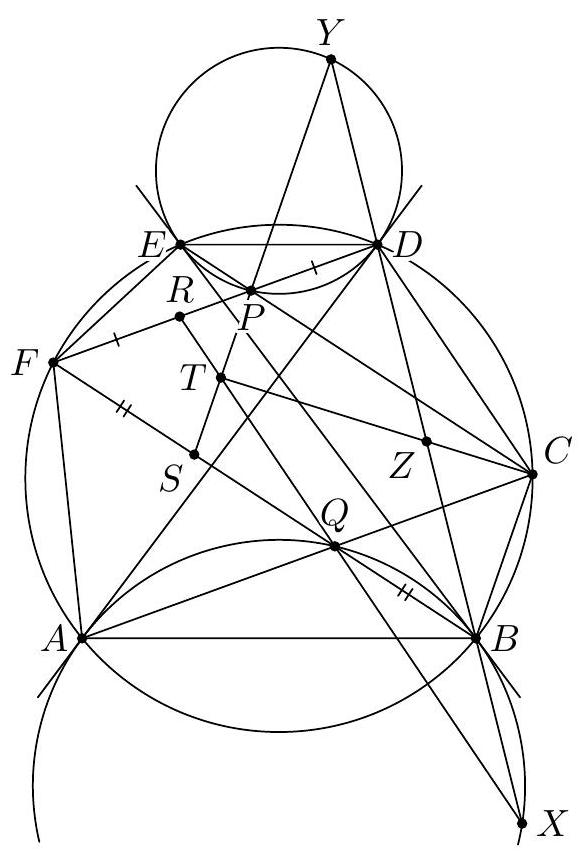
|
| 44 |
+
|
| 45 |
+
Note. The equality $B X=D Y$ can be also proved by applying Menelaus theorem to $\triangle B D F$ and the lines $R-Q-X$ and $S-P-Y$.
|
| 46 |
+
|
| 47 |
+
Second solution. We follow the first solution, using $B F \| C E$ and $A C \| D F$ to note that $C P F Q$, $C Q R D$, and $C P S B$ are parallelograms.
|
| 48 |
+
|
| 49 |
+
Let $N$ and $M$ be points on the segments $C Q$ and $R N$ respectively such that $F R N Q$ and $F R M S$ are parallelograms. Then $S M=F R=P D$ and $S M \| P D$, that is, $S M D P$ is also a parallelogram, hence $D M=P S=C B$ and $D M \| C B$, therefore $D M B C$ is a parallelogram, and $C M$ bisects $B D$. It remains to prove that $T, M, C$ are collinear.
|
| 50 |
+
|
| 51 |
+
Applying Menelaus theorem to $\triangle F R Q$ and the line $P-T-S$ (and bearing in mind the parallelograms found above) we have
|
| 52 |
+
|
| 53 |
+
$$
|
| 54 |
+
1=\frac{F P}{P R} \cdot \frac{R T}{T Q} \cdot \frac{Q S}{S F}=\frac{Q C}{C N} \cdot \frac{R T}{T Q} \cdot \frac{N M}{M R}
|
| 55 |
+
$$
|
| 56 |
+
|
| 57 |
+
that is,
|
| 58 |
+
|
| 59 |
+
$$
|
| 60 |
+
\frac{Q C}{C N} \cdot \frac{R T}{T Q} \cdot \frac{N M}{M R}=1
|
| 61 |
+
$$
|
| 62 |
+
|
| 63 |
+
The collinearity $T, M, C$ follows from (1) immediately by converse Menelaus theorem for $\triangle Q N R$.
|
| 64 |
+
|
| 65 |
+
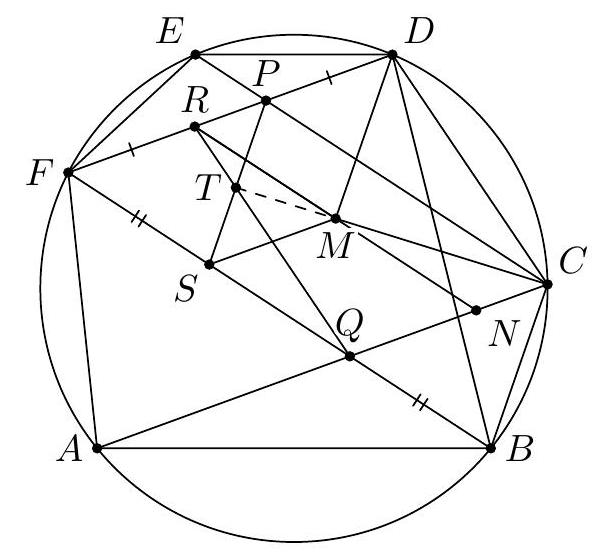
|
| 66 |
+
|
| 67 |
+
№3. Let $n \geq 2$ be an integer. Elwyn is given an $n \times n$ table filled with real numbers (each cell of the table contains exactly one number). We define a rook set as a set of $n$ cells of the table situated in $n$ distinct rows as well as in $n$ distinct columns. Assume that, for every rook set, the sum of $n$ numbers in the cells forming the set is nonnegative.
|
| 68 |
+
|
| 69 |
+
By a move, Elwyn chooses a row, a column, and a real number $a$, and then he adds $a$ to each number in the chosen row, and subtracts $a$ from each number in the chosen column (thus, the number at the intersection of the chosen row and column does not change). Prove that Elwyn can perform a sequence of moves so that all numbers in the table become nonnegative.
|
| 70 |
+
|
| 71 |
+
Common remarks. We collect here several definitions and easy observations which will be used in the solutions.
|
| 72 |
+
|
| 73 |
+
A rook set is nonnegative (resp., vanishing) if the sum of the numbers in its cells is nonnegative (resp., zero). An $n \times n$ table filled with real numbers is good (resp., balanced) if every rook set is nonnegative (resp., vanishing).
|
| 74 |
+
|
| 75 |
+
Notice that the sum of numbers in any rook set does not change during Elwyn's moves, so good (balanced) tables remain such after any sequence of moves. Also, notice that the rows and/or columns of the table can be permuted with no effect on the condition of the problem, as well as on the desired result.
|
| 76 |
+
|
| 77 |
+
The proofs of the following two easy propositions can be found in the addendum after Solution 2 .
|
| 78 |
+
|
| 79 |
+
Proposition 1. Assume that $a_{1}, a_{2}, \ldots, a_{n}$ and $b_{1}, b_{2}, \ldots, b_{n}$ are two sequences of real numbers with equal sums. Then Elwyn can perform a sequence of moves resulting in adding $a_{i}$ to all cells in the $i$ th row, and subtracting $b_{j}$ from all numbers in the $j$ th column, for all $i, j=1,2, \ldots, n$.
|
| 80 |
+
|
| 81 |
+
Proposition 2. If an $n \times n$ table $B$ is balanced, then Elwyn can perform several moves on that table getting a table filled with zeros.
|
| 82 |
+
|
| 83 |
+
Solution 1. We start with the following known consequence of Hall's lemma.
|
| 84 |
+
|
| 85 |
+
Lemma. Let $G=(U \sqcup V, E)$ be a bipartite multigraph with parts $U$ and $V$, both of size $n$. Assume that each vertex has degree $k$; then the edges can be partitioned into $k$ perfect matchings.
|
| 86 |
+
|
| 87 |
+
Proof. Induction on $k$; the base case $k=1$ is trivial. To perform the step, it suffices to find one perfect matching in the graph: removing the edges of that matching, we obtain a graph with all degrees equal to $k-1$.
|
| 88 |
+
|
| 89 |
+
The existence of such matching is guaranteed by Hall's lemma. Indeed, let $U^{\prime}$ be any subset of $U$, and let $V^{\prime}$ be the set of vertices adjacent to $U^{\prime}$. Put $u=\left|U^{\prime}\right|$ and $v=\left|V^{\prime}\right|$. The total degree of vertices in $U^{\prime}$ is $k u$. so the total degree of vertices in $V^{\prime}$ is at least $k u$; hence $k u \leq k v$ and therefore $u \leq v$, which establishes the conditions of Hall's lemma.
|
| 90 |
+
|
| 91 |
+
The following claim is the principal step in this solution.
|
| 92 |
+
|
| 93 |
+
Claim. In any good table, one can decrease some numbers so that the table becomes balanced.
|
| 94 |
+
|
| 95 |
+
Proof. Say that a cell in a good table is blocked if it is contained in a vanishing rook set (so, decreasing the number in the cell would break goodness of the table). First, we show that in any good table one can decrease several numbers so that the table remains good, and all its cells become blocked.
|
| 96 |
+
|
| 97 |
+
Consider any cell $c$; let $\epsilon$ be the minimal sum in a rook set containing that cell. Decrease the number in $c$ by $\epsilon$; the obtained table is still good, but now $c$ is blocked. Apply such operation to all cells in the table consecutively; we arrive at a good table all whose cells are blocked. We claim that, in fact, this table is balanced.
|
| 98 |
+
|
| 99 |
+
In the sequel, we use the following correspondence. Let $R$ and $C$ be the sets of rows and columns of the table, respectively. Then each cell corresponds to a pair of the row and the column it is situated in; this pair may be regarded as an edge of a bipartite (multi)graph with parts $R$ and $C$. This way, any rook set corresponds to a perfect matching between those parts.
|
| 100 |
+
|
| 101 |
+
Arguing indirectly, assume that there is a non-vanishing rook set $S=\left\{s_{1}, s_{2}, \ldots, s_{n}\right\}$. Each cell $s_{i}$ is contained in some vanishing rook set $V_{i}$. Now construct a bipartite multigraph $G=(R \sqcup C, E)$, introducing, for each set $V_{i}, n$ edges corresponding to its cells (thus, $G$ contains $n^{2}$ edges some of which may be parallel).
|
| 102 |
+
|
| 103 |
+
Mark each edge with the number in the corresponding cell. Since the sets $V_{i}$ are all vanishing, the sum of all $n^{2}$ marks is zero.
|
| 104 |
+
|
| 105 |
+
Now, remove $n$ edges corresponding to the cells of $S$, to obtain a graph $G^{\prime}$. Since the sum of numbers in the cells of $S$ is positive, the sum of the marks in $G^{\prime}$ is negative. On the other hand, the degree of every vertex in $G^{\prime}$ is $n-1$, so by the Lemma its edges can be partitioned into $n-1$ perfect matchings. At least one of the obtained matchings has negative sum of marks; so this matching corresponds to a rook set with a negative sum. This is impossible in a good table; this contradiction finishes the proof.
|
| 106 |
+
|
| 107 |
+
Back to the problem, let $T$ be Elwyn's table. Applying the Claim, decrease some numbers in it to get a balanced table $B$. By Proposition 2, Elwyn can perform some moves on table $B$ so as to get a table filled with zeros. Applying the same moves to $T$, Elwyn gets a table where all numbers are nonnegative, as required.
|
| 108 |
+
|
| 109 |
+
Solution 2. Say that the badness of a table is the sum of absolute values of all its negative entries. In Step 1, we will show that, whenever the badness of a good table is nonzero, Elwyn can make some moves decreasing the badness. In a (technical) Step 2, we will show that this claim yields the required result.
|
| 110 |
+
|
| 111 |
+
Step 1. Let $r$ be a row containing some negative number. Mark all cells in row $r$ containing negative numbers, and mark all cells in other rows containing nonpositive numbers. Then there is no rook set consisting of marked cells, since that set would not be nonnegative.
|
| 112 |
+
|
| 113 |
+
By König's theorem (which is equivalent to Hall's lemma), for some $a$ and $b$ with $a+b<n$, one can choose $a$ rows and $b$ columns such that their union contains all marked cells; fix such a choice. Number the rows from top to bottom, and the columns from left to right. We distinguish two cases.
|
| 114 |
+
|
| 115 |
+
Case 1: Row $r$ is among the a chosen rows.
|
| 116 |
+
|
| 117 |
+
Permute the rows and columns so that the top $a$ rows and the right $b$ columns are chosen. Next, if row $r$ contains a negative number in some of the $a$ leftmost entries, swap the column containing that entry with the $(n-b)$ th one (recall that $n-b>a$ ). As a result, there exists $x>a$ such that the $x$ th left entry in row $r$ is negative (while the chosen columns are still the $b$ rightmost ones).
|
| 118 |
+
|
| 119 |
+
Now, rectangle $P$ formed by the bottom $n-a$ rows and the left $a$ columns contains only positive numbers, as it contains no marked cells, as well as no cells from row $r$. Let $m$ be the minimal number in that rectangle.
|
| 120 |
+
|
| 121 |
+
Let Elwyn add $m$ to all numbers in the first $a$ rows, and subtract $m$ from all numbers in the first $a$ columns. All numbers which decrease after this operation are situated in $P$, so there appear no new cell containing a negative number, and no negative number decreases. Moreover, by our choice, at least one negative number (situated in row $r$ and column $x$ ) increases. Thus, the badness decreases, as desired.
|
| 122 |
+
|
| 123 |
+
Case 2: Row $r$ is not among the a chosen rows.
|
| 124 |
+
|
| 125 |
+
Add row $r$ to the $a$ chosen rows, and increase $a$ by 1 . Notice that the negative numbers in row $r$ are covered by the $b$ chosen columns. As in the previous case, we permute the rows and columns so that the top $a$ rows and the tight $b$ columns are chosen. All negative numbers in row $r$ automatically come to the right $b$ columns. Now the above argument applies verbatim.
|
| 126 |
+
|
| 127 |
+
Step 2. We show that among the tables which Elwyn can obtain (call such tables reachable), there exists a table with the smallest badness. Applying the argument in Step 1 to that table, we get that its badness is zero, which proves the claim of the problem.
|
| 128 |
+
|
| 129 |
+
Notice that the effect of any sequence of Elwyn's moves has the form described in Proposition 1. Moreover, subtraction of some number $\epsilon$ from all the $a_{i}$ and the $b_{i}$ provides no effect on the result. Hence, we may assume that the sums of the $a_{i}$ and of the $b_{i}$ are both zero.
|
| 130 |
+
|
| 131 |
+
Let $t_{i j}$ denote the $(i, j)$ th entry of the initial table $T$. For any two sequences $\mathbf{a}=\left(a_{1}, \ldots, a_{n}\right)$ and $\mathbf{b}=\left(b_{1}, \ldots, b_{n}\right)$ both summing up to zero, denote by $T(\mathbf{a}, \mathbf{b})$ the table obtained from $T$ by adding $a_{i}$ to all numbers in the $i$ th row, and subtracting $b_{j}$ from all numbers in the $j$ th column, for all $i, j=1,2, \ldots, n$; in particular, $T=T(\mathbf{0}, \mathbf{0})$, where $\mathbf{0}=(0,0, \ldots, 0)$. Let $f(\mathbf{a}, \mathbf{b})$ denote the badness of $T(\mathbf{a}, \mathbf{b})$. Clearly, function $f$ is continuous. Now we intend to bound the set of values that make sense to put in sequences a and $\mathbf{b}$.
|
| 132 |
+
|
| 133 |
+
Let $m$ be the maximal number in $T$. Take any $\mathbf{a}$ and $\mathbf{b}$ summing up to zero, such that some $a_{i}$ is smaller than $-M=-(m+b)$. Then there exists an index $j$ with $b_{j} \geq 0$; hence the entry $(i, j)$ in $T(\mathbf{a}, \mathbf{b})$ is $t_{i j}+a_{i}-b_{j}<m-M+0=-b$, so $f(\mathbf{a}, \mathbf{b})>b=f(\mathbf{0}, \mathbf{0})$.
|
| 134 |
+
|
| 135 |
+
So, all pairs of sequences $\mathbf{a}$ and $\mathbf{b}$ satisfying $f(\mathbf{a}, \mathbf{b}) \leq b$ should also satisfy $a_{i} \geq-M$ and $b_{j} \geq-M$, and hence $a_{i} \leq n M$ and $b_{j} \leq n M$ as well (since each of the sequences sums up to zero). Thus, in order to minimize $f(\mathbf{a}, \mathbf{b})$, it suffices to consider only those $\mathbf{a}$ and $\mathbf{b}$ whose entries lie in $[-M, n M]$. Those values form a compact set, so the continuous function $f$ attains the smallest value on that set.
|
| 136 |
+
|
| 137 |
+
Addendum. Say that the price of Elwyn's move is the number $a$ chosen on that move.
|
| 138 |
+
|
| 139 |
+
Proof of Proposition 1. Let Elwyn perform a move of price $a$ to row $i$ and column $j$, and then a move of price $-a$ to row $i^{\prime}$ and the same column $j$. The result will consist in adding $a$ to row $i$ and subtracting $a$ from row $i^{\prime}$. Similar actions can be performed with columns.
|
| 140 |
+
|
| 141 |
+
So, Elwyn may add $\Sigma=a_{1}+\cdots+a_{n}$ to the numbers in the first row and subtract $\Sigma$ from those in the first column, and then distribute those increments and decrements among the rows and columns, using the above argument.
|
| 142 |
+
|
| 143 |
+
Proof of Proposition 2. It is easy to see, using Proposition 1, that Elwyn can vanish all numbers in the first column, as well as all numbers in the first row, except for the last its entry.
|
| 144 |
+
|
| 145 |
+
The resulting table is also balanced; denote the number in its cell $(i, j)$ by $d_{i j}$. For any $i, j>1$ with $j<n$, there are two rook sets $R$ and $R^{\prime}$, one containing cells $(1,1)$ and $(i, j)$, and the other obtained by replacing those by cells $(1, j)$ and $(i, 1)$. The sums in those two sets are both zero, so
|
| 146 |
+
|
| 147 |
+
$$
|
| 148 |
+
d_{i j}=d_{i 1}+d_{1 j}-d_{11}=0
|
| 149 |
+
$$
|
| 150 |
+
|
| 151 |
+
Hence, only the $n$th column of the obtained table might contain nonzero numbers. But, since each entry in the $n$th column is contained in some (vanishing) rook set, that entry is also zero.
|
| 152 |
+
|
| 153 |
+
Solution 3 (sketch). We implement some tools from multi-dimensional convex geometry.
|
| 154 |
+
|
| 155 |
+
Each table can be regarded as a point in $\mathbb{R}^{n \times n}$. The set $G$ of good tables is a convex cone determined by $n$ ! non-strict inequalities (claiming that the rook sets are nonnegative). Thus this cone is closed.
|
| 156 |
+
|
| 157 |
+
The set $T$ of tables which can be transformed, by a sequence of Elwyn's moves, into a table with nonnegative entries, is also a convex cone. This cone is the Minkowski sum of the (closed) cone $N$ of all tables with nonnegative entries and the linear subspace $V$ of all tables Elwyn can add by a sequence of moves. Such sum is always closed (a pedestrian version of such argument is presented in Step 2 of Solution 2).
|
| 158 |
+
|
| 159 |
+
It is easy to see that $T \subseteq G$; we need to show that $T=G$. Arguing indirectly, assume that there is some table $t \in G \backslash T$. Then there exists a linear function $f$ separating $t$ and $T$, that is $-f$ takes nonnegative values on $T$ but a negative value on $t$.
|
| 160 |
+
|
| 161 |
+
This function $f$ has the following form: Let $x \in \mathbb{R}^{n \times n}$ be a table, and denote by $x_{i j}$ its $(i, j)$ th entry. Then
|
| 162 |
+
|
| 163 |
+
$$
|
| 164 |
+
f(x)=\sum_{i, j=1}^{n} f_{i j} x_{i j}
|
| 165 |
+
$$
|
| 166 |
+
|
| 167 |
+
where $f_{i j}$ are some real constants. Form a table $F$ whose $(i, j)$ th entry is $f_{i j}$.
|
| 168 |
+
|
| 169 |
+
Since $f(x) \geq 0$ for all tables in $N$ having only one nonnegative entry, we have $f_{i j} \geq 0$ for all $i$ and $j$. Moreover, $f$ must vanish on all tables in the subspace $V$, in particular - on each table having 1 in some row, -1 in some column, and 0 elsewhere (the intersection of the row and the column also contains 0 ). This means that the sum of numbers in any row in $F$ is equal to the sum of the numbers in any its column.
|
| 170 |
+
|
| 171 |
+
Now it remains to show that $F$ is the sum of several rook tables which contain some nonnegative number $p$ at the cells of some rook set, while all other entries are zero; this will yield $f(t) \geq 0$ which is not the case. In other words, it suffices to prove that one can subtract from $F$ several rook tables to make it vanish. This can be done by means of Hall's lemma again: if the table is still nonzero, it contains $n$ positive entries forming a rook set, and one may make one of them vanish, keeping the other entries nonnegative, by subtracting a rook table.
|
| 172 |
+
|
| 173 |
+
№4. A circle with radius $r$ is inscribed in the triangle $A B C$. Circles with radii $r_{1}, r_{2}, r_{3}\left(r_{1}, r_{2}, r_{3}<r\right)$ are inscribed in the angles $A, B, C$ so that each touches the incircle externally. Prove that $r_{1}+r_{2}+r_{3} \geq r$.
|
| 174 |
+
|
| 175 |
+
First solution. Let $\omega$ be the incircle of $\triangle A B C, I$ its center, and $p=(A B+B C+A C) / 2$ its semiperimeter. We denote the tangency points of the sides $B C, A C, A B$ with $\omega$ by $A_{0}, B_{0}, C_{0}$ respectively. Let the circle of radius $r_{1}$ touches $\omega$ at $A_{1}$.
|
| 176 |
+
|
| 177 |
+
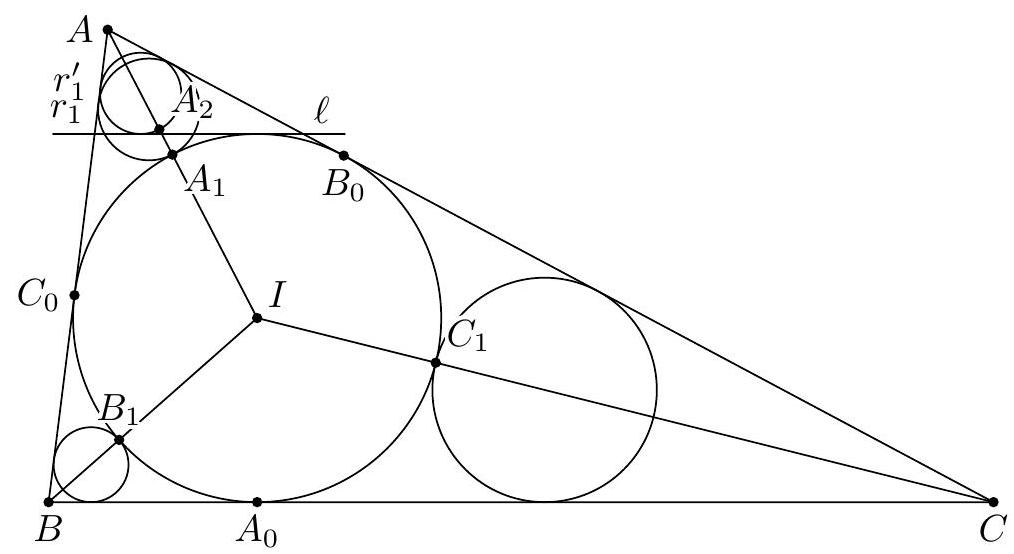
|
| 178 |
+
|
| 179 |
+
We draw a tangent $\ell$ to $\omega$ such that $\ell \| B C$. Let $r_{1}^{\prime}$ be the inradius of the triangle formed by the lines $A B, A C, \ell$. The line $A I$ intersects the circle of radius $r_{1}^{\prime}$ at two points. From these two points let $A_{2}$ be closest to $I$. Then $\frac{r_{1}}{r_{1}^{\prime}}=\frac{A A_{1}}{A A_{2}} \geq 1$ and $\frac{r_{1}^{\prime}}{r}=\frac{A B_{0}}{p}$ (here we use that the semiperimeter of the triangle formed by the lines $A B, A C, \ell$ equals $A B_{0}$ and that this triangle is similar to $\triangle A B C$ ). Applying the same argument to the circles of raidii $r_{2}^{\prime}$ and $r_{3}^{\prime}$ and adding the obtained inequalities, we get
|
| 180 |
+
|
| 181 |
+
$$
|
| 182 |
+
r_{1}+r_{2}+r_{3} \geq r_{1}^{\prime}+r_{2}^{\prime}+r_{3}^{\prime}=r\left(\frac{A B_{0}}{p}+\frac{B C_{0}}{p}+\frac{C B_{0}}{p}\right)=r
|
| 183 |
+
$$
|
| 184 |
+
|
| 185 |
+
Second solution. Let $A_{0}, B_{0}, C_{0}, A_{1}, B_{1}, C_{1}$ retain the meaning they had in the first solution. We have $\angle B_{1} I C_{1}=90^{\circ}+\frac{\angle A}{2}, \angle A_{1} I C_{1}=90^{\circ}+\frac{\angle B}{2}, \angle A_{1} I B_{1}=90^{\circ}+\frac{\angle C}{2}$. Obviously
|
| 186 |
+
|
| 187 |
+
$$
|
| 188 |
+
\left(\overrightarrow{I A_{1}}+\overrightarrow{I B_{1}}+\overrightarrow{I C_{1}}\right)^{2} \geq 0
|
| 189 |
+
$$
|
| 190 |
+
|
| 191 |
+
It follows from (1) that
|
| 192 |
+
|
| 193 |
+
$$
|
| 194 |
+
\begin{array}{r}
|
| 195 |
+
r^{2}+r^{2}+r^{2}+2 r^{2} \cos \left(90^{\circ}+\frac{\angle A}{2}\right)+2 r^{2} \cos \left(90^{\circ}+\frac{\angle B}{2}\right)+2 r^{2} \cos \left(90^{\circ}+\frac{\angle C}{2}\right) \geq 0 \Leftrightarrow \\
|
| 196 |
+
\Leftrightarrow \sin \left(\frac{\angle A}{2}\right)+\sin \left(\frac{\angle B}{2}\right)+\sin \left(\frac{\angle C}{2}\right) \leq \frac{3}{2}
|
| 197 |
+
\end{array}
|
| 198 |
+
$$
|
| 199 |
+
|
| 200 |
+
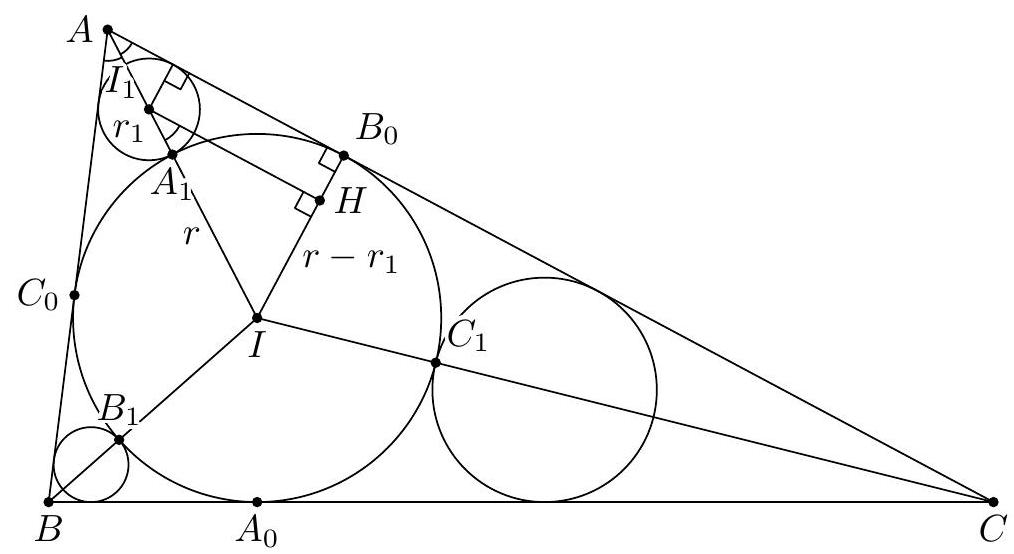
|
| 201 |
+
|
| 202 |
+
Let $I_{1}$ be the centre of the circle of radius $r_{1}$. Draw the perpendicular $I_{1} H$ from $I_{1}$ onto $I B_{0}$. One of the acute angles in the right triangle $I I_{1} H$ is $\frac{\angle A}{2}$, the leg opposite this angle is $r-r_{1}$, and the hypotenuse
|
| 203 |
+
is $r+r_{1}$. Therefore $\sin \left(\frac{\angle A}{2}\right)=\frac{r-r_{1}}{r+r_{1}}$. Similarly $\sin \left(\frac{\angle B}{2}\right)=\frac{r-r_{2}}{r+r_{2}}$ and $\sin \left(\frac{\angle C}{2}\right)=\frac{r-r_{3}}{r+r_{3}}$. According to (2)
|
| 204 |
+
|
| 205 |
+
$$
|
| 206 |
+
\frac{r-r_{1}}{r+r_{1}}+\frac{r-r_{2}}{r+r_{2}}+\frac{r-r_{3}}{r+r_{3}} \leq \frac{3}{2} \Leftrightarrow \frac{2 r}{r+r_{1}}+\frac{2 r}{r+r_{2}}+\frac{2 r}{r+r_{3}} \leq \frac{9}{2}
|
| 207 |
+
$$
|
| 208 |
+
|
| 209 |
+
Applying Cauchy-Schwarz inequality we have
|
| 210 |
+
|
| 211 |
+
$$
|
| 212 |
+
\frac{1}{r+r_{1}}+\frac{1}{r+r_{2}}+\frac{1}{r+r_{3}} \geq \frac{9}{r+r_{1}+r+r_{2}+r+r_{3}}
|
| 213 |
+
$$
|
| 214 |
+
|
| 215 |
+
thus, (3) and (4) give $\frac{9}{2} \geq \frac{18 r}{3 r+r_{1}+r_{2}+r_{3}} \Leftrightarrow r_{1}+r_{2}+r_{3} \geq r$.
|
| 216 |
+
|
| 217 |
+
№5. On a party with 99 guests, hosts Ann and Bob play a game (the hosts are not regarded as guests). There are 99 chairs arranged in a circle; initially, all guests hang around those chairs. The hosts take turns alternately. By a turn, a host orders any standing guest to sit on an unoccupied chair $c$. If some chair adjacent to $c$ is already occupied, the same host orders one guest on such chair to stand up (if both chairs adjacent to $c$ are occupied, the host chooses exactly one of them). All orders are carried out immediately. Ann makes the first move; her goal is to fulfill, after some move of hers, that at least $k$ chairs are occupied. Determine the largest $k$ for which Ann can reach the goal, regardless of Bob's play.
|
| 218 |
+
|
| 219 |
+
Answer. $k=34$.
|
| 220 |
+
|
| 221 |
+
Solution. Preliminary notes. Let $F$ denote the number of occupied chairs at the current position in the game. Notice that, on any turn, $F$ does not decrease. Thus, we need to determine the maximal value of $F$ Ann can guarantee after an arbitrary move (either hers or her opponent's).
|
| 222 |
+
|
| 223 |
+
Say that the situation in the game is stable if every unoccupied chair is adjacent to an occupied one. In a stable situation, we have $F \geq 33$, since at most $3 F$ chairs are either occupied or adjacent to such. Moreover, the same argument shows that there is a unique (up to rotation) stable situation with $F=33$, in which exactly every third chair is occupied; call such stable situation bad.
|
| 224 |
+
|
| 225 |
+
If the situation after Bob's move is stable, then Bob can act so as to preserve the current value of $F$ indefinitely. Namely, if $A$ puts some guest on chair $a$, she must free some chair $b$ adjacent to $a$. Then Bob merely puts a guest on $b$ and frees $a$, returning to the same stable position.
|
| 226 |
+
|
| 227 |
+
On the other hand, if the situation after Bob's move is unstable, then Ann may increase $F$ in her turn by putting a guest on a chair having no adjacent occupied chairs.
|
| 228 |
+
|
| 229 |
+
Strategy for Ann, if $k \leq 34$. In short, Ann's strategy is to increase $F$ avoiding appearance of a bad situation after Bob's move (conversely, Ann creates a bad situation in her turn, if she can).
|
| 230 |
+
|
| 231 |
+
So, on each her turn, Ann takes an arbitrary turn increasing $F$ if there is no danger that Bob reaches a bad situation in the next turn (thus, Ann always avoids forcing any guest to stand up). The exceptional cases are listed below.
|
| 232 |
+
|
| 233 |
+
Case 1. After possible Ann's move (consisting in putting a guest on chair $a$ ), we have $F=32$, and Bob can reach a bad situation by putting a guest on some chair. This means that, after Ann's move, every third chair would be occupied, with one exception. But this means that, by her move, Ann could put a guest on a chair adjacent to $a$, avoiding the danger.
|
| 234 |
+
|
| 235 |
+
Case 2. After possible Ann's move (by putting a guest on chair $a$ ), we have $F=33$, and Bob can reach a stable situation by putting a guest on some chair $b$ and freeing an adjacent chair $c$. If $a=c$, then Ann could put her guest on $b$ to create a stable situation after her turn; that enforces Bob to break stability in his turn. Otherwise, as in the previous case, Ann could put a guest on some chair adjacent to $a$, still increasing the value of $F$, but with no danger of bad situation arising.
|
| 236 |
+
|
| 237 |
+
So, acting as described, Ann increases the value of $F$ on each turn of hers whenever $F \leq 33$. Thus, she reaches $F=34$ after some her turn.
|
| 238 |
+
|
| 239 |
+
Strategy for Bob, if $k \geq 35$. Split all chairs into 33 groups each consisting of three consecutive chairs, and number the groups by $1,2, \ldots, 33$ so that Ann's first turn uses a chair from group 1. In short, Bob's strategy is to ensure, after each his turn, that
|
| 240 |
+
|
| 241 |
+
$(*)$ In group 1, at most two chairs are occupied; in every other group, only the central chair may be occupied.
|
| 242 |
+
|
| 243 |
+
If $(*)$ is satisfied after Bob's turn, then $F \leq 34<k$; thus, property $(*)$ ensures that Bob will not lose. It remains to show that Bob can always preserve $(*)$. after any his turn. Clearly, he can do that oat the first turn.
|
| 244 |
+
|
| 245 |
+
Suppose first that Ann, in her turn, puts a guest on chair $a$ and frees an adjacent chair $b$, then Bob may revert her turn by putting a guest on chair $b$ and freeing chair $a$.
|
| 246 |
+
|
| 247 |
+
Suppose now that Ann just puts a guest on some chair $a$, and the chairs adjacent to $a$ are unoccupied. In particular, group 1 still contains at most two occupied chairs. If the obtained situation satisfies (*), then Bob just makes a turn by putting a guest into group 1 (preferably, on its central chair), and, possibly, removing another guest from that group. Otherwise, $a$ is a non-central chair in some group $i \geq 2$; in this case Bob puts a guest to the central chair in group $i$ and frees chair $a$.
|
| 248 |
+
|
| 249 |
+
So Bob indeed can always preserve (*).
|
| 250 |
+
|
| 251 |
+
№6. Let $P(x)$ be a nonconstant polynomial of degree $n$ with rational coefficients which can not be presented as a product of two nonconstant polynomials with rational coefficients. Prove that the number of polynomials $Q(x)$ of degree less than $n$ with rational coefficients such that $P(x)$ divides $P(Q(x))$
|
| 252 |
+
|
| 253 |
+
a) is finite;
|
| 254 |
+
|
| 255 |
+
b) does not exceed $n$.
|
| 256 |
+
|
| 257 |
+
Solution. It is known that an irreducible polynomial $P(x)$ of degree $n$ with rational coefficients has $n$ different complex roots which we denote by $\alpha_{1}, \alpha_{2}, \ldots, \alpha_{n}$.
|
| 258 |
+
|
| 259 |
+
a) If $P(x)$ divides $P(Q(x))$, then $Q\left(\alpha_{k}\right)$ is also a root of $P(x)$ for each $k \leq n$. It follows that the values of $Q$ at $\alpha_{1}, \alpha_{2}, \ldots, \alpha_{n}$ form a sequence $\alpha_{i_{1}}, \alpha_{i_{2}}, \ldots, \alpha_{i_{n}}$, where all terms are roots of $P$, not necessarily different. The number of such sequences is $n^{n}$, and for each sequence there exists at most one polynomial $Q$ such that $Q\left(\alpha_{k}\right)=\alpha_{i_{k}}$ (since two polynomials of degree less than $n$ with equal values at $n$ points must coincide).
|
| 260 |
+
|
| 261 |
+
Thus the number of possible polynomials $Q(x)$ does not exceed $n^{n}$.
|
| 262 |
+
|
| 263 |
+
b) For each polynomial $Q$ satisfying the condition, $Q\left(\alpha_{1}\right)$ equals one of the roots $\alpha_{i}$. However, there is at most one polynomial $Q$ of degree less than $n$ with rational coefficients such that $Q\left(\alpha_{1}\right)=\alpha_{i}$, Indeed, if $Q_{1}\left(\alpha_{1}\right)=Q_{2}\left(\alpha_{1}\right)=\alpha_{i}$, then $\alpha_{1}$ is a root of the polynomial $Q_{1}-Q_{2}$ with rational coefficients and degree less than $n$. If this polynomial is not identically zero, its greatest common divisor with $P$ is a nonconstant divisor of $P$ with rational coefficients and degree less than $n$, a contradiction.
|
| 264 |
+
|
| 265 |
+
Thus the number of possible polynomials $Q(x)$ does not exceed $n$.
|
| 266 |
+
|
IZho/raw/en-2014_zhautykov_resenja_e.pdf
ADDED
|
@@ -0,0 +1,3 @@
|
|
|
|
|
|
|
|
|
|
|
|
|
| 1 |
+
version https://git-lfs.github.com/spec/v1
|
| 2 |
+
oid sha256:7cb86efe576c7bb03bcd056b4871ec9ca17e436f60fce2e1d1a919d63a64e730
|
| 3 |
+
size 191636
|
IZho/raw/en-2015_zhautykov_resenja_e.pdf
ADDED
|
@@ -0,0 +1,3 @@
|
|
|
|
|
|
|
|
|
|
|
|
|
| 1 |
+
version https://git-lfs.github.com/spec/v1
|
| 2 |
+
oid sha256:fd661529656eff058c31ebbc5109e94e3a6fcdca79b3520acdbc1c840170ef72
|
| 3 |
+
size 178992
|
IZho/raw/en-2018_zhautykov_resenja_e.pdf
ADDED
|
@@ -0,0 +1,3 @@
|
|
|
|
|
|
|
|
|
|
|
|
|
| 1 |
+
version https://git-lfs.github.com/spec/v1
|
| 2 |
+
oid sha256:400cba150d2e3ffa6fe6982e1ddaf93377c07854ca495977068560f8bfeaab30
|
| 3 |
+
size 213873
|
IZho/raw/en-2019_zhautykov_resenja_e.pdf
ADDED
|
@@ -0,0 +1,3 @@
|
|
|
|
|
|
|
|
|
|
|
|
|
| 1 |
+
version https://git-lfs.github.com/spec/v1
|
| 2 |
+
oid sha256:fd432464097387f34fd378944469e4460e4dd93d6d4179c4e67da80948797456
|
| 3 |
+
size 335940
|
IZho/raw/en-2020_zhautykov_resenja_e.pdf
ADDED
|
@@ -0,0 +1,3 @@
|
|
|
|
|
|
|
|
|
|
|
|
|
| 1 |
+
version https://git-lfs.github.com/spec/v1
|
| 2 |
+
oid sha256:9a9a7f952a3f45a18494bdaaa45a3b787d8bbe20391c070fc39f2369ce14099a
|
| 3 |
+
size 199345
|
IZho/raw/en-2021_zhautykov_resenja_e.pdf
ADDED
|
@@ -0,0 +1,3 @@
|
|
|
|
|
|
|
|
|
|
|
|
|
| 1 |
+
version https://git-lfs.github.com/spec/v1
|
| 2 |
+
oid sha256:e6bdbed1df31008e78681113fe961f422f832b0faa7ef0ca6ba13f6e45b1c0c5
|
| 3 |
+
size 310742
|
IZho/segment_script/segment.py
ADDED
|
@@ -0,0 +1,152 @@
|
|
|
|
|
|
|
|
|
|
|
|
|
|
|
|
|
|
|
|
|
|
|
|
|
|
|
|
|
|
|
|
|
|
|
|
|
|
|
|
|
|
|
|
|
|
|
|
|
|
|
|
|
|
|
|
|
|
|
|
|
|
|
|
|
|
|
|
|
|
|
|
|
|
|
|
|
|
|
|
|
|
|
|
|
|
|
|
|
|
|
|
|
|
|
|
|
|
|
|
|
|
|
|
|
|
|
|
|
|
|
|
|
|
|
|
|
|
|
|
|
|
|
|
|
|
|
|
|
|
|
|
|
|
|
|
|
|
|
|
|
|
|
|
|
|
|
|
|
|
|
|
|
|
|
|
|
|
|
|
|
|
|
|
|
|
|
|
|
|
|
|
|
|
|
|
|
|
|
|
|
|
|
|
|
|
|
|
|
|
|
|
|
|
|
|
|
|
|
|
|
|
|
|
|
|
|
|
|
|
|
|
|
|
|
|
|
|
|
|
|
|
|
|
|
|
|
|
|
|
|
|
|
|
|
|
|
|
|
|
|
|
|
|
|
|
|
|
|
|
|
|
|
|
|
|
|
|
|
|
|
|
|
|
|
|
|
|
|
|
|
|
|
|
|
|
|
|
|
|
|
|
|
|
|
|
|
|
|
|
|
|
|
|
|
|
|
|
|
|
|
|
|
|
|
|
|
|
|
|
|
|
|
|
|
|
|
|
|
|
|
|
|
|
|
|
|
|
|
|
|
|
|
|
|
|
|
|
|
|
|
|
|
|
|
|
|
|
|
|
|
|
|
|
|
|
|
|
|
|
|
|
|
|
|
|
|
|
|
|
|
|
|
|
|
|
|
|
|
|
|
|
|
|
|
|
|
|
|
|
|
|
|
|
|
|
|
|
|
|
|
|
|
|
|
|
|
|
|
|
|
|
|
|
|
|
|
|
|
|
|
|
|
|
|
|
|
|
|
|
|
|
|
|
|
|
|
|
|
|
|
|
|
|
|
|
|
|
|
|
|
|
|
|
|
|
|
|
|
|
| 1 |
+
import os
|
| 2 |
+
import re
|
| 3 |
+
import json
|
| 4 |
+
|
| 5 |
+
from tqdm import tqdm
|
| 6 |
+
from loguru import logger
|
| 7 |
+
|
| 8 |
+
from pathlib import Path
|
| 9 |
+
from typing import Tuple, List
|
| 10 |
+
|
| 11 |
+
|
| 12 |
+
project_root = Path(__file__).parent.parent.parent
|
| 13 |
+
|
| 14 |
+
problem_tag = 'Problem'
|
| 15 |
+
solution_tag = 'Solution'
|
| 16 |
+
|
| 17 |
+
|
| 18 |
+
def find_problem_with_solution(
|
| 19 |
+
text: str,
|
| 20 |
+
problem_parttern: re.Pattern,
|
| 21 |
+
solution_pattern: re.Pattern
|
| 22 |
+
) -> int:
|
| 23 |
+
"""
|
| 24 |
+
Find the problem with solution start position in the text.
|
| 25 |
+
|
| 26 |
+
Args:
|
| 27 |
+
text (str): The text to search.
|
| 28 |
+
|
| 29 |
+
Returns:
|
| 30 |
+
int: The start position of the problem with solution.
|
| 31 |
+
"""
|
| 32 |
+
matchs = list(problem_parttern.finditer(text))
|
| 33 |
+
|
| 34 |
+
for index, match in enumerate(matchs):
|
| 35 |
+
section_end_position = matchs[index + 1].start() if index + 1 < len(matchs) else len(text)
|
| 36 |
+
if solution_pattern.search(text[match.start():section_end_position]):
|
| 37 |
+
return match.start()
|
| 38 |
+
|
| 39 |
+
|
| 40 |
+
def analyze(text: str) -> Tuple[List, int]:
|
| 41 |
+
"""
|
| 42 |
+
Analyze the text and return the tags and problem number.
|
| 43 |
+
|
| 44 |
+
Args:
|
| 45 |
+
text (str): The markdown text to analyze.
|
| 46 |
+
|
| 47 |
+
Returns:
|
| 48 |
+
Tuple[List, int]: A tuple containing the tags and problem number.
|
| 49 |
+
"""
|
| 50 |
+
problem_pattern = re.compile(r'(?:\n|##* )(?:Problem (\d+)\.|№(\d+)\.|(\d+)\.)', re.IGNORECASE)
|
| 51 |
+
solution_pattern = re.compile(r'(?:\n|##* )(?:Solution( \d+)?\.|Alternative solution\.|Solution I*\.|Official Solution\.|Solution By condition\,|Example\.|First solution\.|Second solution\.)', re.IGNORECASE)
|
| 52 |
+
|
| 53 |
+
start_position = find_problem_with_solution(text, problem_pattern, solution_pattern)
|
| 54 |
+
|
| 55 |
+
tags = []
|
| 56 |
+
tags.extend([(x, problem_tag) for x in problem_pattern.finditer(text, start_position)])
|
| 57 |
+
problem_num = len(tags)
|
| 58 |
+
|
| 59 |
+
tags.extend([(x, solution_tag) for x in solution_pattern.finditer(text, start_position)])
|
| 60 |
+
tags.sort(key=lambda x: x[0].start())
|
| 61 |
+
return tags, problem_num
|
| 62 |
+
|
| 63 |
+
|
| 64 |
+
def segment(text: str, tags):
|
| 65 |
+
starts = []
|
| 66 |
+
ends = []
|
| 67 |
+
|
| 68 |
+
for i in range(len(tags)):
|
| 69 |
+
starts.append(tags[i][0].end())
|
| 70 |
+
if i + 1 < len(tags):
|
| 71 |
+
ends.append(tags[i + 1][0].start())
|
| 72 |
+
else:
|
| 73 |
+
ends.append(len(text))
|
| 74 |
+
|
| 75 |
+
return [text[start:end].strip().strip('#').strip() for start, end in zip(starts, ends)]
|
| 76 |
+
|
| 77 |
+
|
| 78 |
+
def join(tags, segments):
|
| 79 |
+
problem, solution = '', ''
|
| 80 |
+
problem_label, problem_match, solution_match = '', '', ''
|
| 81 |
+
pairs = []
|
| 82 |
+
|
| 83 |
+
for tag, segment in zip(tags, segments):
|
| 84 |
+
if tag[1] == problem_tag:
|
| 85 |
+
problem = segment
|
| 86 |
+
problem_match = tag[0].group(0)
|
| 87 |
+
problem_label = tag[0].group(1) or tag[0].group(2) or tag[0].group(3)
|
| 88 |
+
else:
|
| 89 |
+
solution = segment
|
| 90 |
+
solution_match = tag[0].group(0)
|
| 91 |
+
pairs.append((problem, solution, problem_label, problem_match, solution_match))
|
| 92 |
+
|
| 93 |
+
return pairs
|
| 94 |
+
|
| 95 |
+
|
| 96 |
+
def write_pairs(output_file: Path, pairs):
|
| 97 |
+
year = re.search(r'(\d{4})', output_file.stem).group(1)
|
| 98 |
+
|
| 99 |
+
output_jsonl_text = ""
|
| 100 |
+
for problem, solution, problem_label, problem_match, solution_match in pairs:
|
| 101 |
+
output_jsonl_text += json.dumps(
|
| 102 |
+
{
|
| 103 |
+
'year': year,
|
| 104 |
+
'tier': "T1",
|
| 105 |
+
'problem_label': problem_label,
|
| 106 |
+
'problem_type': None,
|
| 107 |
+
'problem': problem,
|
| 108 |
+
'solution': solution,
|
| 109 |
+
'metadata': {
|
| 110 |
+
'resource_path': output_file.relative_to(project_root).as_posix(),
|
| 111 |
+
'problem_match': problem_match,
|
| 112 |
+
'solution_match': solution_match
|
| 113 |
+
}
|
| 114 |
+
},
|
| 115 |
+
ensure_ascii=False
|
| 116 |
+
) + '\n'
|
| 117 |
+
|
| 118 |
+
output_file.write_text(output_jsonl_text, encoding="utf-8")
|
| 119 |
+
|
| 120 |
+
|
| 121 |
+
def main():
|
| 122 |
+
compet_base_path = Path(__file__).resolve().parent.parent
|
| 123 |
+
compet_md_path = compet_base_path / "md"
|
| 124 |
+
seg_output_path = compet_base_path / "segmented"
|
| 125 |
+
|
| 126 |
+
total_problem_count = 0
|
| 127 |
+
total_solution_count = 0
|
| 128 |
+
|
| 129 |
+
for izho_md in tqdm(list(compet_md_path.glob('**/*.md')), desc='Segmenting'):
|
| 130 |
+
output_file = seg_output_path / izho_md.relative_to(compet_md_path).with_suffix('.jsonl')
|
| 131 |
+
output_file.parent.mkdir(parents=True, exist_ok=True)
|
| 132 |
+
|
| 133 |
+
text = '\n' + izho_md.read_text(encoding="utf-8")
|
| 134 |
+
|
| 135 |
+
tags, problem_num = analyze(text)
|
| 136 |
+
|
| 137 |
+
segments = segment(text, tags)
|
| 138 |
+
pairs = join(tags, segments)
|
| 139 |
+
if pairs and problem_num > 0:
|
| 140 |
+
write_pairs(output_file, pairs)
|
| 141 |
+
|
| 142 |
+
total_problem_count += problem_num
|
| 143 |
+
total_solution_count += len(pairs)
|
| 144 |
+
else:
|
| 145 |
+
logger.warning(f"No problem found in {izho_md}")
|
| 146 |
+
|
| 147 |
+
logger.info(f"Total problem count: {total_problem_count}")
|
| 148 |
+
logger.info(f"Total solution count: {total_solution_count}")
|
| 149 |
+
|
| 150 |
+
|
| 151 |
+
if __name__ == '__main__':
|
| 152 |
+
main()
|
IZho/segmented/en-2014_zhautykov_resenja_e.jsonl
ADDED
|
@@ -0,0 +1,6 @@
|
|
|
|
|
|
|
|
|
|
|
|
|
|
|
|
|
|
|
|
|
|
| 1 |
+
{"year": "2014", "tier": "T1", "problem_label": "1", "problem_type": null, "problem": "Points $M, N, K$ lie on the sides $B C, C A, A B$ respectively, of a triangle $A B C$, and are different from its vertices. The triangle $M N K$ is called beautiful if the triangles $M N K$ and $A B C$ are similar (with the vertices respectively in this order). Show that if in the triangle $A B C$ there are two beautiful triangles with a common vertex, then $\\triangle A B C$ is right-angled.", "solution": "(L. Ploscaru) Say $M N_{1} K_{1}$ and $M N_{2} K_{2}$ are such two beautiful triangles. Let $T=N_{1} K_{1} \\cap N_{2} K_{2} ; T$ exists, and belongs to the interior of $\\triangle A B C$, since angles at $M$ are equal to $\\angle A$. Then $\\angle N_{1} M N_{2}=\\angle K_{1} M K_{2}$. We then have $\\angle M N_{1} T=\\angle M N_{2} T=\\angle B$ and $\\angle M K_{1} T=\\angle M K_{2} T=\\angle C$. It follows that $M N_{2} N_{1} T$ and $M K_{1} K_{2} T$ are cyclic quadrilaterals.\n\nSo $\\angle K_{2} K_{1} T=\\angle K_{2} M T$ and $\\angle A N_{1} T=\\pi-\\angle N_{2} N_{1} T=\\angle N_{2} M T$, whence $\\pi-\\angle A=\\angle A K_{1} N_{1}+\\angle A N_{1} K_{1}=\\angle K_{2} M N_{2}=\\angle A$, yielding $\\pi-\\angle A=\\angle A$, so $\\angle A=\\pi / 2$. Moreover, notice it forces $M$ to be the midpoint $M_{0}$ of $B C$; conversely then, all triangles $M_{0} N K$ with $\\angle K M_{0} N=\\pi / 2$ are beautiful.\n\nComentarii. Ceea ce se numeste, în \"English mathematical parlance\", \"simple angle chasing\". Reciproca merita şi ea a fi remarcată.", "metadata": {"resource_path": "IZho/segmented/en-2014_zhautykov_resenja_e.jsonl", "problem_match": "\nProblem 1.", "solution_match": "\nSolution."}}
|
| 2 |
+
{"year": "2014", "tier": "T1", "problem_label": "2", "problem_type": null, "problem": "Do there exist? functions $f: \\mathbb{R} \\rightarrow \\mathbb{R}$ such that\na) $f$ is a surjective function; and\nb) $f(f(x))=(x-1) f(x)+2$ for all $x$ real.", "solution": "We have $f(f(f(x)))=f(f(f(x)))=f((x-1) f(x)+2)$ and also $f(f(f(x)))=(f(x)-1) f(f(x))+2=(f(x)-1)((x-1) f(x)+2)+2=$ $(f(x)-1)(x-1) f(x)+2(f(x)-1)+2=f(x)((f(x)-1)(x-1)+2)$, so\n\n$$\nf((x-1) f(x)+2)=f(x)((x-1) f(x)+2-(x-1))\n$$\n\nLet $f(a)=0$; then for $x=a$ we get $f(0)=2$, and then for $x=0$ we get $f(2)=0$. Now for $x=1$ we get $f(1)=0$. Taking $f(b)=1$ leads us to $b=-1$, and then to $f(-1)=1$. Finally, taking $f(c)=-1$ leads to $c=2$, but that means $0=f(2)=-1$, absurd. Thus the answer is No.\n\nComentarii. Jonglerii cu valori particulare (mici), până la obţinerea unei contradicţii ... Important este că undeva pe parcurs trebuie exprimat $f(f(f(z)))$ în două feluri diferite, ceea ce este tipic pentru ecuaţii funcţionale conţinând iterata functुiei.\n\nAr fi interesant de văzut în ce măsură putem relaxa condiţile, sau ce fenomen se ascunde aici!?! Fără condiţia a) de surjectivitate, o soluţie banală este $f(0)=2, f(x)=0$ pentru $x \\neq 0$. Putem oare găsi toate soluţiile?", "metadata": {"resource_path": "IZho/segmented/en-2014_zhautykov_resenja_e.jsonl", "problem_match": "\nProblem 2.", "solution_match": "\nSolution."}}
|
| 3 |
+
{"year": "2014", "tier": "T1", "problem_label": "3", "problem_type": null, "problem": "There are given 100 distinct positive integers. We call a pair of integers among them good if the ratio of its elements is either 2 or 3 . What is the maximum number $g$ of good pairs that these 100 numbers can form? (A same number can be used in several pairs.)", "solution": "Like so often in Russian problems, numbers are used instead of generic symbols. Let us therefore denote $10=n>1,2=k>1,3=\\ell>1$, with the extra condition both $k$ and $\\ell$ aren't powers of a same number. Consider the digraph $G$ whose set of vertices $V(G)$ is made of $v=n^{2}$ distinct positive integers, and whose set of edges $E(G)$ is made by the pairs $(a, b) \\in V(G) \\times V(G)$ with $a \\mid b$. For each positive integer $m$ consider now the (not induced) spanning subdigraph $G_{m}$ of $G$ (with $V\\left(G_{m}\\right)=V(G)$ and so $v_{m}=v=n^{2}$ vertices), and whose edges are the pairs $(a, b) \\in G \\times G$ with $b=m a$. Moreover, it is clear that $E\\left(G_{m^{\\prime}}\\right) \\cap E\\left(G_{m^{\\prime \\prime}}\\right)=\\emptyset$ for $m^{\\prime} \\neq m^{\\prime \\prime}$ (since if $(a, b) \\in E(G)$ then $(a, b) \\in E\\left(G_{b / a}\\right)$ only), and also $\\bigcup_{m \\geq 1} E\\left(G_{m}\\right)=E(G)$ (but that is irrelevant). Since the good pairs are precisely the edges of $G_{k}$ and $G_{\\ell}$ together, we need to maximize their number $g$.\n\nA digraph $G_{m}$ is clearly a union of some $n_{m}$ disjoint (directed) paths $P_{m, i}$, with lengths $\\lambda\\left(P_{m, i}\\right)=\\lambda_{m, i}, 0 \\leq \\lambda_{m, i} \\leq n^{2}-1$, such that $\\sum_{i=1}^{n_{m}}\\left(\\lambda_{m, i}+1\\right)=n^{2}$, and containing $e_{m}=\\sum_{i=1}^{n_{m}} \\lambda_{m, i}$ edges (zero-length paths, i.e. isolated vertices, are possible, allowed, and duly considered). The defect of the graph $G_{m}$ is taken to be $v-e_{m}=n_{m}$. We therefore need to maximize $g=e_{k}+e_{\\ell}$, or equivalently, to minimize the defect $\\delta=n_{k}+n_{\\ell}$.\n\nUsing the model $V(G)=V_{x}=\\left\\{k^{i-1} \\ell^{j-1} x \\mid 1 \\leq i, j \\leq n\\right\\}$, we have $n_{k}=n_{\\ell}=n$, therefore $\\delta=2 n$, so $g=2 n(n-1)$. To prove value $2 n$ is a minimum for $\\delta$ is almost obvious. We have $\\lambda_{k, i} \\leq n_{\\ell}-1$ for all $1 \\leq i \\leq n_{k}$ (by the condition on $k$ and $\\ell$, we have $\\left|P_{k, i} \\cap P_{\\ell, j}\\right| \\leq 1$ for all $1 \\leq i \\leq n_{k}$ and $\\left.1 \\leq j \\leq n_{\\ell}\\right),{ }^{2}$ so $n^{2}-n_{k}=e_{k}=\\sum_{i=1}^{n_{k}} \\lambda_{k, i} \\leq \\sum_{i=1}^{n_{k}}\\left(n_{\\ell}-1\\right)=n_{k} n_{\\ell}-n_{k}$, therefore $n^{2} \\leq n_{k} n_{\\ell}$, and so $\\delta=n_{k}+n_{\\ell} \\geq 2 \\sqrt{n_{k} n_{\\ell}}=2 n$. Moreover, we see equality occurs if and only if $n_{k}=n_{\\ell}=n$ and $\\lambda_{k, i}=\\lambda_{\\ell, i}=n-1$ for all $1 \\leq i \\leq n$, thus only for the sets $V_{x}$ described above. Răspunsul este deci $g=180$.\n\nComentarii. Odată ce ideea vine, problema este aproape trivială, cu detaliile tehnice fiind aproape \"forţate\". Valorile particulare folosite aruncă doar un văl de umbră asupra situaţiei de fapt (mai ales ocultul $100=10^{2}$ )! Laticea de divizibilitate a celor $n^{2}$ numere este considerată în mod natural, şi conduce la facila numărătoare de mai sus.[^1]\n\n## Second Day - Solutions", "metadata": {"resource_path": "IZho/segmented/en-2014_zhautykov_resenja_e.jsonl", "problem_match": "\nProblem 3.", "solution_match": "\nSolution."}}
|
| 4 |
+
{"year": "2014", "tier": "T1", "problem_label": "4", "problem_type": null, "problem": "Does it exist? a polynomial $P(x)$ with integer coefficients, such that $P(1+\\sqrt{3})=2+\\sqrt{3}$ and $P(3+\\sqrt{5})=3+\\sqrt{5}$.", "solution": "The answer is No. The polynomial $P(x)-x$ has root $3+\\sqrt{5}$, and since it has integer coefficients, it also has root $3-\\sqrt{5}$. The quadratic having these two roots is $x^{2}-6 x+4$. Therefore $P(x)-x=\\left(x^{2}-6 x+4\\right) Q(x)$ for some polynomial $Q(x)$ with integer coefficients. Plugging in $x=1+\\sqrt{3}$ we find $1=(2-4 \\sqrt{3}) Q(1+\\sqrt{3})$. From known conjugates properties we also do have $1=(2+4 \\sqrt{3}) Q(1-\\sqrt{3})$, so (multiply) $1=-44 Q(1+\\sqrt{3}) Q(1-\\sqrt{3})$, impossible, since again by the properties of conjugates\n\n$$\nQ(1+\\sqrt{3}) Q(1-\\sqrt{3})=Q(1+\\sqrt{3}) Q(\\overline{1+\\sqrt{3}})=Q(1+\\sqrt{3}) \\overline{Q(1+\\sqrt{3})}\n$$\n\nmust be some integer $k$, and we cannot have $1=-44 k$.\n\nComentarii. Simple consideraţii legate de rădăcinile conjugate ale unor iraţionale pătratice pentru un polinom cu coeficienţi întregi. Multiple soluţii, bazate toate pe aceste proprietăţi, sunt posibile, iar problema este de o tehnicalitate elementară şi artificială.", "metadata": {"resource_path": "IZho/segmented/en-2014_zhautykov_resenja_e.jsonl", "problem_match": "\nProblem 4.", "solution_match": "\nSolution."}}
|
| 5 |
+
{"year": "2014", "tier": "T1", "problem_label": "5", "problem_type": null, "problem": "Let $U=\\{1,2,3, \\ldots, 2014\\}$. For all $a, b, c \\in \\mathbb{N}$ let $f(a, b, c)$ be the number of ordered sextuplets $\\left(X_{1}, X_{2}, X_{3}, Y_{1}, Y_{2}, Y_{3}\\right)$ of subsets of $U$, satisfying the following conditions\n\n(i) $Y_{1} \\subseteq X_{1} \\subseteq U$ and $\\left|X_{1}\\right|=a$;\n\n(ii) $Y_{2} \\subseteq X_{2} \\subseteq U \\backslash Y_{1}$ and $\\left|X_{2}\\right|=b$;\n\n(iii) $Y_{3} \\subseteq X_{3} \\subseteq U \\backslash\\left(Y_{1} \\cup Y_{2}\\right)$ and $\\left|X_{3}\\right|=c$.\n\nProve $f(\\sigma(a), \\sigma(b), \\sigma(c))$ does not change, for permutations $\\sigma$ of $a, b, c$.", "solution": "In order to avoid any confusion between the letters $a, b, c$ and their numerical values (as cardinalities of sets), the most convenient way will be to denote by $|\\ell|$ the cardinality symbolized by any such letter $\\ell$. We can now consider the true 3 -element set $\\{a, b, c\\}$, and the canonical bijection $\\phi:\\{1,2,3\\} \\rightarrow\\{a, b, c\\}$ given by $\\phi(1)=a, \\phi(2)=b, \\phi(3)=c$.\n\nLet us now consider any permutation $\\sigma$ of $\\{a, b, c\\}$. We will denote by $\\mathcal{F}_{\\sigma}$ the family of ordered sextuplets $\\left(X_{1}, X_{2}, X_{3}, Y_{1}, Y_{2}, Y_{3}\\right)$ of subsets of $U$ satisfying the conditions of the statement but, under our notations, having $\\left|X_{1}\\right|=|\\sigma(a)|,\\left|X_{2}\\right|=|\\sigma(b)|,\\left|X_{3}\\right|=|\\sigma(c)|$. We will also denote by $\\mathcal{F}$ the family of doubletons $\\left\\{\\left(X_{a}, X_{b}, X_{c}\\right), Y\\right\\}$, with $X_{a}, X_{b}, X_{c}$ subsets of $U$ having $\\left|X_{a}\\right|=|a|,\\left|X_{b}\\right|=|b|,\\left|X_{c}\\right|=|c|$, and $\\emptyset \\subseteq Y \\subseteq X=X_{a} \\cup X_{b} \\cup X_{c}$. The set $Y$ uniquely partitions into 7 classes (some of them maybe empty), indexed by the non-empty subsets $S$ of $\\{a, b, c\\}$ via $Y_{S}=Y \\cap\\left(\\bigcap_{\\ell \\in S} X_{\\ell}\\right) \\cap\\left(\\bigcap_{\\ell \\notin S}\\left(U \\backslash X_{\\ell}\\right)\\right)$.\n\nWe will now establish a bijection between $\\mathcal{F}$ and $\\mathcal{F}_{\\sigma}$. This will show that $f(\\sigma(a), \\sigma(b), \\sigma(c))=|\\mathcal{F}|$ is constant over all permutations $\\sigma$. We send an element $\\left\\{\\left(X_{a}, X_{b}, X_{c}\\right), Y\\right\\} \\in \\mathcal{F}$ into the sextuplet $\\left(X_{1}, X_{2}, X_{3}, Y_{1}, Y_{2}, Y_{3}\\right)$ given by, and easily verified it actually belongs to $\\mathcal{F}_{\\sigma}$,\n\n- $X_{1}=X_{\\sigma(a)}, X_{2}=X_{\\sigma(b)}, X_{3}=X_{\\sigma(c)}$ (i.e. $X_{i}=X_{\\sigma(\\phi(i))}$ for $\\left.i \\in\\{1,2,3\\}\\right)$,\n- $Y_{1}=Y_{\\{\\sigma(a)\\}}$,\n- $Y_{2}=Y_{\\{\\sigma(b)\\}} \\cup Y_{\\{\\sigma(a), \\sigma(b)\\}}$,\n- $Y_{3}=Y_{\\{\\sigma(c)\\}} \\cup Y_{\\{\\sigma(a), \\sigma(c)\\}} \\cup Y_{\\{\\sigma(b), \\sigma(c)\\}} \\cup Y_{\\{\\sigma(a), \\sigma(b), \\sigma(c)\\}}$.\n\nWe also send an element $\\left(X_{1}, X_{2}, X_{3}, Y_{1}, Y_{2}, Y_{3}\\right) \\in \\mathcal{F}_{\\sigma}$ into the doubleton $\\left\\{\\left(X_{a}, X_{b}, X_{c}\\right), Y\\right\\}$ given by, and easily verified it actually belongs to $\\mathcal{F}$, with $\\tau$ the permutation of $\\{1,2,3\\}$ induced by $\\sigma$ via $\\tau(i)=\\phi^{-1}(\\sigma(\\phi(i)))$ for all $i \\in\\{1,2,3\\}$,\n\n- $X_{a}=X_{\\tau(1)}, X_{b}=X_{\\tau(2)}, X_{c}=X_{\\tau(3)}$ (i.e. $X_{\\phi(i)}=X_{\\tau(i)}$ for $\\left.i \\in\\{1,2,3\\}\\right)$, - $Y=Y_{1} \\cup Y_{2} \\cup Y_{3}$.\n\nIt is immediate to see this mapping is a bijection, due to the unicity of the partitioning described in the above. Visualizing the Venn diagrams should tremendously help in understanding our considerations. The only difficulty resides in providing a luminous write-up of the argumentation, the underlying phenomenon being in fact almost trivial. The key element of this solution is to consider the unique partitioning of the set $Y=Y_{1} \\cup Y_{2} \\cup Y_{3}$ induced by the three sets of cardinalities $a, b, c$.\n\nComentarii. Pouah ... ce urâţenie de enunţ! Iar cerinţa este aproape evidentă, doar că soluţia este cam lung de scris, formalizat, şi explicat. Evident, valoarea 2014 nu joacă niciun rol.", "metadata": {"resource_path": "IZho/segmented/en-2014_zhautykov_resenja_e.jsonl", "problem_match": "\nProblem 5.", "solution_match": "\nSolution."}}
|
| 6 |
+
{"year": "2014", "tier": "T1", "problem_label": "6", "problem_type": null, "problem": "Let $A B C D$ be a convex quadrilateral, partitioned by four lines as in the picture below, such that the meeting points of these lines all lie on the diagonals of $A B C D$. Prove that if the corner quadrilaterals 1, 2,3 and the center quadrilateral 4 are all tangential, then the corner quadrilateral 5 is also tangential.\n\n", "solution": "It seems the corner quadrilateral 5 is tangential if and only if quadrilateral $A B C D$ is itself tangential; but no progress is thus yet made. Not being a geometer, I will wait for a decent solution to present itself (and it did! - see the presentation on the last page).", "metadata": {"resource_path": "IZho/segmented/en-2014_zhautykov_resenja_e.jsonl", "problem_match": "\nProblem 6.", "solution_match": "\nSolution."}}
|
IZho/segmented/en-2015_zhautykov_resenja_e.jsonl
ADDED
|
@@ -0,0 +1,7 @@
|
|
|
|
|
|
|
|
|
|
|
|
|
|
|
|
|
|
|
|
|
|
|
|
|
| 1 |
+
{"year": "2015", "tier": "T1", "problem_label": "1", "problem_type": null, "problem": "Each point with integral coordinates in the plane is coloured white or blue. Prove that one can choose a colour so that for every positive integer $n$ there exists a triangle of area $n$ having its vertices of the chosen colour.", "solution": "If there exists some $c$-monochromatic horizontal row $y=k$, then if both rows $y=k-1$ and $y=k+1$ are $\\bar{c}$-monochromatic we can find $\\bar{c}$-monochromatic triangles of any positive integer area, otherwise they must contain at least a $c$-point, and we can find $c$-monochromatic triangles of any positive integer area. So assume there exists no monochromatic horizontal row. Consider the horizontal row $y=0$. If it contains two $c$-points at distance 1 , then for any positive integer $n$, together with a $c$-point on row $y=2 n$ they will make a $c$-monochromatic triangle of area $n$. Otherwise it will contain two $\\bar{c}$-points at distance 2 , which for any positive integer $n$, together with a $\\bar{c}$-point on row $y=n$ will make a $\\bar{c}$-monochromatic triangle of area $n$.\n\nComentarii. Extrem de puţin din întreaga diversitate de colorări este utilizat, ceea ce face problema oarecum trivială ... De remarcat că nu este adevărat că se pot întotdeauna obţine triunghiuri monocromatice de orice arie $n / 2$; de exemplu pentru colorarea \"în tablă de şah\" nu se vor obţine triunghiuri monocromatice de arie $1 / 2$. Iar dacă mărim numărul de culori la trei, există o (simplă) colorare fără triunghiuri monocromatice de arie 1. Presupun că întrebări mult mai interesante şi dificile pot fi imaginate ...", "metadata": {"resource_path": "IZho/segmented/en-2015_zhautykov_resenja_e.jsonl", "problem_match": "\nProblem 1.", "solution_match": "\nSolution."}}
|
| 2 |
+
{"year": "2015", "tier": "T1", "problem_label": "2", "problem_type": null, "problem": "Inside the triangle $A B C$ a point $M$ is given. The line $B M$ meets the side $A C$ at $N$. The point $K$ is symmetrical to $M$ with respect to $A C$. The line $B K$ meets $A C$ at $P$. If $\\angle A M P=\\angle C M N$, prove that $\\angle A B P=\\angle C B N$.", "solution": "(AoPS - user TelvCohl) Let $M^{*}$ be the isogonal conjugate of $M$ with respect to $\\triangle A B C$.\n\nLEMMA. Let $\\ell$ be the isogonal conjugate of $A M$ with respect to $\\angle B M C$, and let $\\ell^{*}$ be the isogonal conjugate of $A M^{*}$ with respect to $\\angle B M^{*} C$. The lines $\\ell, \\ell^{*}$ meet on $B C$ and are symmetrical with respect to $B C$.\n\nProof. Let $X$ be the meeting point of $B M^{*}$ and $C M$. Let $Y \\in B C$ be a point such that $X A, X Y$ are isogonal conjugate with respect to $\\angle B X C$.\n\nSince $C A, C Y$ are isogonal conjugate with respect to $\\angle M^{*} C M$, so $A$ and $Y$ are isogonal conjugate with respect to $\\triangle C X M^{*}$, it follows that $M^{*} Y$, $M^{*} A$ are isogonal conjugate with respect to $\\angle B M^{*} C$. Similarly, we can prove $M Y, M A$ are isogonal conjugate with respect to $\\angle B M C$.\n\nBy easy angle chasing we get $\\angle M Y B=\\angle C Y M^{*}$, thus $M Y \\equiv \\ell$ and $M^{*} Y \\equiv \\ell^{*}$ are symmetrical with respect to $B C$.\n\nFrom the LemmA we now get that $P K$ is the isogonal conjugate of $B M^{*}$ with respect to $\\angle A M^{*} C$, thus from $B \\in P K$ we get $P K$ to be the angle bisector of $\\angle A M^{*} C$ and $M^{*} \\in B K$, therefore $\\angle A B P=\\angle C B N$.", "metadata": {"resource_path": "IZho/segmented/en-2015_zhautykov_resenja_e.jsonl", "problem_match": "\nProblem 2.", "solution_match": "\nSolution."}}
|
| 3 |
+
{"year": "2015", "tier": "T1", "problem_label": "2", "problem_type": null, "problem": "Inside the triangle $A B C$ a point $M$ is given. The line $B M$ meets the side $A C$ at $N$. The point $K$ is symmetrical to $M$ with respect to $A C$. The line $B K$ meets $A C$ at $P$. If $\\angle A M P=\\angle C M N$, prove that $\\angle A B P=\\angle C B N$.", "solution": "(Ştefan Tudose on AoPS) Notice that the thesis is equivalent (by Steiner's theorem) with $\\frac{B C}{B A}=\\frac{M C}{M A}$; stated in other words, that $B$ lies on the $M$-Apollonius circle of $\\triangle M C A$.\n\nLet $F$ be the foot of the angle bisector of $\\angle C M A$. By dint of the above observation, it is enough to prove that $B \\in \\odot(M F K)$, which is trivial by simple angle chasing; suppose wlog that $M A>M C$, it then follows $\\angle M F K=\\pi+\\angle M A C-\\angle M C A=\\pi-\\angle K B M$.", "metadata": {"resource_path": "IZho/segmented/en-2015_zhautykov_resenja_e.jsonl", "problem_match": "\nProblem 2.", "solution_match": "\nAlternative Solution."}}
|
| 4 |
+
{"year": "2015", "tier": "T1", "problem_label": "3", "problem_type": null, "problem": "Determine all functions $f: \\mathbb{R} \\rightarrow \\mathbb{R}$ such that\n\n$$\nf\\left(x^{3}+y^{3}+x y\\right)=x^{2} f(x)+y^{2} f(y)+f(x y)\n$$\n\nfor all $x, y \\in \\mathbb{R}$.", "solution": "(Ştefan Tudose on AoPS) Let $P(x, y)$ be the assertion that $f\\left(x^{3}+y^{3}+x y\\right)=x^{2} f(x)+y^{2} f(y)+f(x y)$. From $P(1,0)$ we get that $f(0)=0$, hence from $P(x, 0)$ we get $f\\left(x^{3}\\right)=x^{2} f(x) . P(x,-x)$ yields $f(x)=-f(-x)$.\n\nFrom $P(x, y)-P(x,-y)$ we get\n\n$$\nf\\left(y^{3}\\right)+f(x y)=\\frac{1}{2}\\left(f\\left(x^{3}+y^{3}+x y\\right)+f\\left(y^{3}+x y-x^{3}\\right)\\right)\n$$\n\nSubstituting back into $P(x, y)$ we get that\n\n$$\nf\\left(x^{3}+y^{3}+x y\\right)=2 f\\left(x^{3}\\right)+f\\left(y^{3}+x y-x^{3}\\right)\n$$\n\nLet $a, b$ be real numbers, and let $x=\\sqrt[3]{a}$. The polynomial $P_{b}(\\alpha)=\\alpha^{3}+x \\alpha-b$ has odd degree, hence at least one real root. Let $y$ be one of the real roots. Plugging $x$ and $y$ in $(*)$, we get that $f(a+b)=2 f(a)+f(b-a)$ for all $a, b \\in \\mathbb{R}$. Taking $a=b$, we get $f(2 a)=2 f(a)$, so\n\n$$\nf(x+y)=f(x)+f(y) \\text { for all } x, y \\in \\mathbb{R}\n$$\n\nSo $f(x+y)=f(x)+f(y)$ and\n\n$$\nf\\left(x^{3}\\right)=x^{2} f(x) \\quad(* *)\n$$\n\nTaking $x+1$ and $x-1$ in $(* *)$ and summing up the two relations we get that $2 x^{2} f(x)+6 f(x)=f(x)\\left(2 x^{2}+2\\right)+4 x f(1)$, i.e. $f(x)=x f(1)$.", "metadata": {"resource_path": "IZho/segmented/en-2015_zhautykov_resenja_e.jsonl", "problem_match": "\nProblem 3.", "solution_match": "\nSolution."}}
|
| 5 |
+
{"year": "2015", "tier": "T1", "problem_label": "3", "problem_type": null, "problem": "Determine all functions $f: \\mathbb{R} \\rightarrow \\mathbb{R}$ such that\n\n$$\nf\\left(x^{3}+y^{3}+x y\\right)=x^{2} f(x)+y^{2} f(y)+f(x y)\n$$\n\nfor all $x, y \\in \\mathbb{R}$.", "solution": "(AoPS - user pco) Under the notations of above we similarly get $f(0)=0, f\\left(x^{3}\\right)=x^{2} f(x)$, and $f(x)$ odd.\n\nLet then $u, v$ be such that $u+v \\leq 0$. It's easy to see that the system $x^{3}+y^{3}+x y=u,-x^{3}-y^{3}+x y=v$ always has a solution, and then\n\n$$\n\\begin{aligned}\n& P(x, y) \\text { yields } f(u)=x^{2} f(x)+y^{2} f(y)+f\\left(\\frac{u+v}{2}\\right) \\\\\n& P(-x,-y) \\text { yields } f(v)=-x^{2} f(x)-y^{2} f(y)+f\\left(\\frac{u+v}{2}\\right)\n\\end{aligned}\n$$\n\nJust adding the two lines above gives $f\\left(\\frac{u+v}{2}\\right)=\\frac{f(u)+f(v)}{2}$ for all $u, v$ such that $u+v \\leq 0$. If $u+v \\geq 0$, we then have $-u-v \\leq 0$ and so $f\\left(\\frac{-u-v}{2}\\right)=\\frac{f(-u)+f(-v)}{2}$ and, since the function $f(x)$ is odd, we also have $f\\left(\\frac{u+v}{2}\\right)=\\frac{f(u)+f(v)}{2}$ for all $u, v$ such that $u+v \\geq 0$.\n\nThen $f\\left(\\frac{2 u+0}{2}\\right)=\\frac{f(2 u)+f(0)}{2}$, and so $f(2 u)=2 f(u)$. Therefore $f\\left(\\frac{2 u+2 v}{2}\\right)=\\frac{f(2 u)+f(2 v)}{2}=f(u)+f(v)$, i.e. $f(x)$ is additive.\n\nLet then be $n \\in \\mathbb{N} ; P(x+n, 0)$ yields $f\\left((x+n)^{3}\\right)=(x+n)^{2} f(x+n)$, whence $n(2 f(x)-2 x f(1))=-3 f\\left(x^{2}\\right)+2 x f(x)+x^{2} f(1)$ for all $n \\in \\mathbb{N}$. So $f(x)=x f(1)$ for all $x$, and so $f(x)=a x$ for all $x$, which indeed is a solution, whatever $a \\in \\mathbb{R}$.\n\n## Second Day - Solutions", "metadata": {"resource_path": "IZho/segmented/en-2015_zhautykov_resenja_e.jsonl", "problem_match": "\nProblem 3.", "solution_match": "\nAlternative Solution."}}
|
| 6 |
+
{"year": "2015", "tier": "T1", "problem_label": "4", "problem_type": null, "problem": "Determine the maximum integer $n$ with the property that for each positive integer $k \\leq \\frac{n}{2}$ there exist two positive divisors of $n$ with difference $k$.", "solution": "If there exists a positive integer $p \\leq\\lfloor n / 6\\rfloor$ such that $p \\nmid n$, then we have $\\lfloor n / 2\\rfloor>\\lfloor n / 6\\rfloor$, and taking $k=\\lfloor n / 2\\rfloor-p \\geq 2$ and two positive divisors $d, d+k$ of $n$, we need $d+(\\lfloor n / 2\\rfloor-p)$ to divide $n$. But $d+(\\lfloor n / 2\\rfloor-p) \\geq d+\\lfloor n / 2\\rfloor-\\lfloor n / 6\\rfloor>d+(n / 2-1)-n / 6 \\geq n / 3$, so $d+(\\lfloor n / 2\\rfloor-p) \\in\\{n / 2, n\\}$, the only possible divisors of $n$ larger than $n / 3$. However, $d+(\\lfloor n / 2\\rfloor-p)=n / 2$ yields $d=p$, absurd (since $d \\mid n$ but $p \\nmid n$ ), while $d+(\\lfloor n / 2\\rfloor-p)=n$ yields $d>n / 2$, thus $d=n$ (since $d \\mid n$ ), forcing $p=\\lfloor n / 2\\rfloor>\\lfloor n / 6\\rfloor$, again absurd. Therefore all positive integers not larger than $\\lfloor n / 6\\rfloor$ must divide $n$.\n\nDenote $u=\\lfloor n / 6\\rfloor$. Since $\\operatorname{gcd}(u, u-1)=1$, it follows $u(u-1) \\mid n$, so $u(u-1) \\leq n=6(n / 6)<6(u+1)$, forcing $u \\leq 7$. For $u \\geq 4$ we need $\\operatorname{lcm}[1,2,3,4]=12 \\mid n$, and we can see that $n=24$ satisfies, and moreover is an acceptable value. For $n=36$ we get $u=6$, but $\\operatorname{lcm}[1,2,3,4,5,6]=60 \\nmid n$. And for $n \\geq 48$ we have $u \\geq 8$, not acceptable. Thus the answer is $n=24$.\n\nWe may in fact quite easily exhibit the full set $\\{1,2,4,6,8,12,18,24\\}$ of such positive integers $n$ (for $n=1$ the condition is vacuously fulfilled). The related question of which are the positive integers satisfying the above property for all $1 \\leq k \\leq n-1$ can also easily be answered; the full set is $\\{1,2,4,6\\}$.\n\nComentarii. O problemă extrem de drăguţă, şi nu tocmai simplă dacă ne străduim să evităm discutarea a prea multe cazuri. Analiza numerelor $n$ mici ne sugerează imediat că $n>1$ nu poate să fie impar (ceea ce este trivial), şi prin faptul că singurul $k$ defect pentru $n=36$ este $k=13$, ideea pentru soluţia dată mai sus. Oricum, o idee proaspătă, şi care se implementează elegant şi cu calcule minime.", "metadata": {"resource_path": "IZho/segmented/en-2015_zhautykov_resenja_e.jsonl", "problem_match": "\nProblem 4.", "solution_match": "\nSolution."}}
|
| 7 |
+
{"year": "2015", "tier": "T1", "problem_label": "5", "problem_type": null, "problem": "Let $A_{n}$ be the set of partitions of the sequence $(1,2, \\ldots, n)$ into several subsequences such that every two neighbouring terms of each subsequence have different parity, and let $B_{n}$ be the set of partitions of the sequence $(1,2, \\ldots, n)$ into several subsequences such that all the terms of each subsequence have the same parity. 2\n\nProve that for every positive integer $n$ the sets $A_{n}$ and $B_{n+1}$ contain the same number of elements.", "solution": "For each partition $\\pi$ of $\\{1,2, \\ldots, n\\}$, with the elements within each block written in ascending order, denote by $k(\\pi)$ the number of blocks of $\\pi$ ending in an even number and by $\\ell(\\pi)$ the number of blocks of $\\pi$ ending in an odd number.\n\nAlso denote $f_{n}(x, y)=\\sum_{\\pi \\in A_{n}} x^{k(\\pi)} y^{\\ell(\\pi)}$ and $g_{n}(x, y)=\\sum_{\\pi \\in B_{n}} x^{k(\\pi)} y^{\\ell(\\pi)}$.\n\nWe will have $\\left|A_{n}\\right|=f_{n}(1,1)$.\n\nFor example\n\n$$\n\\begin{aligned}\n& f_{1}(x, y)=y \\\\\n& f_{2}(x, y)=x(y+1) \\\\\n& f_{3}(x, y)=y(x y+y+x+1) \\\\\n& f_{4}(x, y)=x\\left(x y^{2}+y^{2}+3 x y+3 y+x+1\\right)\n\\end{aligned}\n$$\n\nA moment of reflection will show us that\n\n$$\n\\begin{aligned}\n& f_{n+1}(x, y)=y\\left(f_{n}(x, y)+\\frac{\\mathrm{d}}{\\mathrm{d} x} f_{n}(x, y)\\right) \\text { for even } n \\\\\n& f_{n+1}(x, y)=x\\left(f_{n}(x, y)+\\frac{\\mathrm{d}}{\\mathrm{d} y} f_{n}(x, y)\\right) \\text { for odd } n\n\\end{aligned}\n$$\n\nThis comes from considering where the element $n+1$ may go, and how this affects the number of blocks.\n\nWe will also have $\\left|B_{n}\\right|=g_{n}(1,1) 3^{3}$[^1]\n\nFor example\n\n$$\n\\begin{aligned}\n& g_{1}(x, y)=y \\\\\n& g_{2}(x, y)=x y \\\\\n& g_{3}(x, y)=y x(y+1) \\\\\n& g_{4}(x, y)=x y(x y+y+x+1) \\\\\n& g_{5}(x, y)=y x\\left(x y^{2}+y^{2}+3 x y+3 y+x+1\\right)\n\\end{aligned}\n$$\n\nAnother moment of reflection will show us that\n\n$$\n\\begin{aligned}\n& g_{n+1}(x, y)=y\\left(g_{n}(x, y)+\\frac{\\mathrm{d}}{\\mathrm{d} y} g_{n}(x, y)\\right) \\text { for even } n \\\\\n& g_{n+1}(x, y)=x\\left(g_{n}(x, y)+\\frac{\\mathrm{d}}{\\mathrm{d} x} g_{n}(x, y)\\right) \\text { for odd } n\n\\end{aligned}\n$$\n\nThis also comes from considering where the element $n+1$ may go, and how this affects the number of blocks.\n\nIt is not hard to check that $g_{n+1}(x, y)=y f_{n}(x, y)$ for even $n$ and that $g_{n+1}(x, y)=x f_{n}(x, y)$ for odd $n$. This is seen to hold true for small values of $n$. Henceforth, for even $n, g_{n+1}(x, y)=y\\left(g_{n}(x, y)+\\frac{\\mathrm{d}}{\\mathrm{d} y} g_{n}(x, y)\\right)=$ $y x f_{n-1}(x, y)+y x \\frac{\\mathrm{d}}{\\mathrm{d} y} f_{n-1}(x, y)$ by induction step on $g_{n}(x, y)=x f_{n-1}(x, y)$, while $y f_{n}(x, y)=y x\\left(f_{n-1}(x, y)+\\frac{\\mathrm{d}}{\\mathrm{d} y} f_{n-1}(x, y)\\right)$. Alike computation holds for odd $n$. So $g_{n+1}(1,1)=f_{n}(1,1)$ in all cases, and so $\\left|B_{n+1}\\right|=\\left|A_{n}\\right|$.\n\nComentarii. De fapt o partiţie de unul din cele două tipuri poate fi privită şi ca scrierea în cicluri disjuncte a unei permutări convenabile din $\\mathcal{S}_{n}$. Odată ce ideea (folosirea unui fel de funcţii generatoare) se iveşte, problema devine aproape trivială. Consideraţii asupra acestor partiţii din $A_{n}$, numite parity-alternating, sunt numeroase, relativ şi la numerele Stirling de a doua speţă $\\left\\{\\begin{array}{l}n \\\\ k\\end{array}\\right\\}$, legate de numerele Bell $\\beta_{n}$ prin relaţia $\\beta_{n}=\\sum_{k=1}^{n}\\left\\{\\begin{array}{l}n \\\\ k\\end{array}\\right\\}$; de exemplu http://www.sciencedirect.com/science/article/pii/S0024379513004758", "metadata": {"resource_path": "IZho/segmented/en-2015_zhautykov_resenja_e.jsonl", "problem_match": "\nProblem 5.", "solution_match": "\nSolution."}}
|
IZho/segmented/en-2018_zhautykov_resenja_e.jsonl
ADDED
|
@@ -0,0 +1,6 @@
|
|
|
|
|
|
|
|
|
|
|
|
|
|
|
|
|
|
|
|
|
|
| 1 |
+
{"year": "2018", "tier": "T1", "problem_label": "1", "problem_type": null, "problem": "Let $\\alpha, \\beta, \\gamma$ be the angles of a triangle opposite to the sides $a, b, c$ respectively. Prove the inequality\n\n$$\n2\\left(\\cos ^{2} \\alpha+\\cos ^{2} \\beta+\\cos ^{2} \\gamma\\right) \\geq \\frac{a^{2}}{b^{2}+c^{2}}+\\frac{b^{2}}{a^{2}+c^{2}}+\\frac{c^{2}}{a^{2}+b^{2}}\n$$", "solution": "By the Law of Sines, RHS equals $\\frac{\\sin ^{2} \\alpha}{\\sin ^{2} \\beta+\\sin ^{2} \\gamma}+\\frac{\\sin ^{2} \\beta}{\\sin ^{2} \\alpha+\\sin ^{2} \\gamma}+\\frac{\\sin ^{2} \\gamma}{\\sin ^{2} \\alpha+\\sin ^{2} \\beta}$. Applying Cauchy-Bunyakowski inequality we have\n\n$$\n\\sin ^{2} \\alpha=\\sin ^{2}(\\beta+\\gamma)=(\\sin \\beta \\cos \\gamma+\\sin \\gamma \\cos \\beta)^{2} \\leq\\left(\\sin ^{2} \\beta+\\sin ^{2} \\gamma\\right)\\left(\\cos ^{2} \\gamma+\\cos ^{2} \\beta\\right)\n$$\n\ntherefore $\\cos ^{2} \\beta+\\cos ^{2} \\gamma \\geq \\frac{\\sin ^{2} \\alpha}{\\sin ^{2} \\beta+\\sin ^{2} \\gamma}$.\n\nAdding similar inequalities for $\\cos ^{2} \\gamma+\\cos ^{2} \\alpha$ and $\\cos ^{2} \\alpha+\\cos ^{2} \\beta$ we get the desired result.", "metadata": {"resource_path": "IZho/segmented/en-2018_zhautykov_resenja_e.jsonl", "problem_match": "\n1.", "solution_match": "\nSolution."}}
|
| 2 |
+
{"year": "2018", "tier": "T1", "problem_label": "2", "problem_type": null, "problem": "Points $N, K, L$ lie on the sides $A B, B C, C A$ of a triangle $A B C$ respectively so that $A L=B K$ and $C N$ is the bisector of the angle $C$. The segments $A K$ and $B L$ meet at the point $P$. Let $I$ and $J$ be the incentres of the triangles $A P L$ and $B P K$ respectively. The lines $C N$ and $I J$ meet at point $Q$. Prove that $I P=J Q$.", "solution": "The case $C A=C B$ is trivial. If $C A \\neq C B$, we may suppose, without loss of generality, that $C N$ meets the segment $P K$.\n\nLet the circumcircles $\\omega_{1}$ and $\\omega_{2}$ of the triangles $A P L$ and $B P K$ respectively meet again at point $T$. Then\n\n$$\n\\angle L A T=\\angle T P B=\\angle T K B\n$$\n\nand $\\angle A L T=\\angle A P T=\\angle T B K$, that is, $\\triangle A L T=\\triangle K B T$, hence\n\n$$\nA T=T K\n$$\n\nIt follows from (1) that the quadrilateral $A C K T$ is cyclic; together with (2) this means that $\\angle A C T=\\angle T C K$, i.e. $T$ lies on the bisector of $C N$.\n\nLet $I J$ meet $\\omega_{1}$ and $\\omega_{2}$ at $I_{1}$ and $J_{1}$ respectively. Since $\\omega_{1}$ and $\\omega_{2}$ have equal radii and $A L=B K$, the triangles $A L I_{1}$ and $B K J_{1}$ are equal. We use Mansion's lemma: the midpoint of arc $X Y$ of the circumcircle of $X Y Z$ lies at equal distances from the ends of this arc and the incentre. It follows from this lemma that $I_{1} I=I_{1} L=J_{1} K=J_{1} J$. Moreover, $\\angle P I_{1} T=\\angle P A T=\\angle P K T=$ $\\angle P J_{1} T$, therefore, $I_{1} T=J_{1} T$. Thus $T$ lies on the median bisector of $I_{1} J_{1}$ and\n\n\n\nFigure 1: image on the median bisector of $I J$.\n\nIt remains to prove that $T$ lies on the median bisector of $P Q$. Let $R=A K \\cap C T$. Then $\\angle A R T=\\angle R A C+\\angle A C R=$ $\\angle R A C+\\angle A K T=\\angle R A C+\\angle K A T=\\angle L A T=\\angle B P T$. Since $P Q$ bisects the angle $R P B, \\angle P Q T=\\angle P R T+\\angle R P Q=$ $\\angle P B T+\\angle B P J=\\angle T P Q$, therefore $T$ belongs to the median bisector of $P Q$ and $I P=J Q$.", "metadata": {"resource_path": "IZho/segmented/en-2018_zhautykov_resenja_e.jsonl", "problem_match": "\n2.", "solution_match": "\nSolution."}}
|
| 3 |
+
{"year": "2018", "tier": "T1", "problem_label": "3", "problem_type": null, "problem": "Prove that there exist infinitely many pairs $(m, n)$ of positive integers such that $m+n$ divides $(m!)^{n}+(n!)^{m}+1$.", "solution": "We shall find a pair such that $m+n=p$ is prime and $n$ is even. Applying Wilson's theorem we have\n\n$$\nm!=(p-n)!=\\frac{(p-1)!}{(p-n+1) \\ldots(p-2)(p-1)} \\equiv \\frac{-1}{-(n-1) \\ldots(-2)(-1)} \\equiv \\frac{1}{(n-1)!} \\equiv \\frac{n}{n!} \\quad(\\bmod p)\n$$\n\nIt follows from Fermat's Little Theorem that $(n!)^{p} \\equiv n!(\\bmod p)$, therefore\n\n$$\n(m!)^{n}+(n!)^{m}+1 \\equiv\\left(\\frac{n}{n!}\\right)^{n}+(n!)^{p-n}+1 \\equiv \\frac{n^{n}+n!+(n!)^{n}}{(n!)^{n}} \\quad(\\bmod p)\n$$\n\nthus it suffices to prove that the number $n^{n}+n!+(n!)^{n}$ has a prime divisor $p>n$ for infinitely many even $n$.\n\nWe prove that this condition is satisfied, for instance, by all the numbers of the form $n=2 q$, where $q>2$ is prime. Let $A=(2 q)^{2 q}+(2 q)!+((2 q)!)^{2 q}$. For a prime $p$ and integer $k$ we denote by $v_{p}(k)$ the largest integer $\\ell$ such that $p^{\\ell}$ divides $k$.\n\nIf $r<2 q$ is prime and $r \\notin\\{2, q\\}$ then $A \\equiv(2 q)^{2 q} \\not \\equiv 0(\\bmod r)$. The largest degree of $q$ dividing $(2 q)!$ is $q^{2}$, while for $(2 q)^{2 q}$ and $((2 q)!)^{2 q}$ it is $2 q$ and $4 q$ respectively, therefore $v_{q}(A)=2$.\n\nFinally, $v_{2}((2 q)!)=\\left[\\frac{2 q}{2}\\right]+\\left[\\frac{2 q}{4}\\right]+\\left[\\frac{2 q}{8}\\right]+\\cdots<\\frac{2 q}{2}+\\frac{2 q}{4}+\\frac{2 q}{8}+\\cdots=2 q$, so $v_{2}((2 q)!)<v_{2}\\left((2 q)^{2 q}\\right)$ and obviously $v_{2}((2 q)!)<v_{2}\\left((2 q)!^{2 q}\\right)$, thus $v_{2}(A) \\leq 2 q-1$. On the other hand, $A>(2 q)^{2 q}>2^{2 q-1} q^{2}$, therefore $A$ has a prime divisor $p>2 q$, q.e.d.", "metadata": {"resource_path": "IZho/segmented/en-2018_zhautykov_resenja_e.jsonl", "problem_match": "\n3.", "solution_match": "\nSolution."}}
|
| 4 |
+
{"year": "2018", "tier": "T1", "problem_label": "4", "problem_type": null, "problem": "The Crocodile thought of four unit squares of a $2018 \\times 2018$ forming a rectangle with sides 1 and 4 . The Bear can choose any square formed by 9 unit squares and ask whether it contains at least one of the four Crocodile's squares. What minimum number of questions should he ask to be sure of at least one affirmative answer?\n\nThe answer is $\\frac{673^{2}-1}{2}=226464$.", "solution": "We call checked any square chosen by the Bear, and all its unit squares. The position of a unit square in the table can be defined by the numbers of its row and column, that is, the square $(x, y)$ is in the $x$-th row and $y$-th column.\n\nFirst we prove that $\\frac{673^{2}-1}{2}$ questions is enough even on a $2019 \\times 2019$ table. Let us divide this table into $3 \\times 3$ squares and apply chess colouring to these large squares so that the corners are white. Thet it is enough to check all the black $3 \\times 3$ squares: no row or column contains four consecutive white squares.\n\nTo prove that we need so many questions, we select all the unit squares with coordinates $(3 m+1,3 n+1)$, where $0 \\leqslant m, n \\leqslant 672$. A $3 \\times 3$ square obviously can not contain two selected unit squares. On the other hand, if two selected squares lie at distance 3 (i.e., one of them is $(x, y)$, and another is $(x, y+3)$ or $(x+3, y)$ ), the Bear must check at least one of these two squares (because if neither is checked, then so are the two unit squares between them, and the Crocodile can place his rectangle on the unchecked squares).\n\nThus it is enough to produce $\\frac{673^{2}-1}{2}$ pairs of selected unit squares at distance 3 . One can take pairs $(6 k+1,3 n+1)$, $(6 k+4,3 n+1), 0 \\leqslant k \\leqslant 335,0 \\leqslant n \\leqslant 672$, and $(2017,6 n+1),(2017,6 n+4), 0 \\leqslant n \\leqslant 335$.", "metadata": {"resource_path": "IZho/segmented/en-2018_zhautykov_resenja_e.jsonl", "problem_match": "\n4.", "solution_match": "\nSolution."}}
|
| 5 |
+
{"year": "2018", "tier": "T1", "problem_label": "5", "problem_type": null, "problem": "Find all real $a$ for which there exists a function $f: \\mathbb{R} \\rightarrow \\mathbb{R}$ such that $f(x-f(y))=f(x)+a[y]$ for every real $x$ и $y$ ( $[y]$ denotes the integral part of $y$ ).\n\nAnswer: $a=-n^{2}$ for arbitrary integer $n$.", "solution": "First note that $a=0$ satisfies the problem condition (for example, the equation is satisfied by the function $f(x) \\equiv 0)$.\n\nNow suppose $a \\neq 0$.\n\nLemma. $f(y)=f(z)$ if and only if $[y]=[z]$.\n\nSuppose $f(y)=f(z)$ for some $y, z$. Then the given equation implies $f(x)+a[y]=f(x-f(y))=f(x-f(z))=f(x)+a[z]$ whence $[y]=[z]$. Conversely, if $[y]=[z]$ then $f(x-f(y))=f(x)+a[y]=f(x)+a[z=f(x-f(z))]$. It follows from previous observation that $[x-f(y)]=[x-f(z)]$ for all $x$. Set $x=\\frac{f(y)+f(z)}{2}$, then $\\left[\\frac{f(y)-f(z)}{2}\\right]=\\left[-\\frac{f(y)-f(z)}{2}\\right]$, so $f(y)=f(z)$. The lemma is proved.\n\nNow we claim that $f(m) \\in \\mathbb{Z}$ for any $m \\in \\mathbb{Z}$. Setting $y=m$ in the given equation we obtain $f(x-f(m))=f(x)+$ am for any $m \\in \\mathbb{Z}, x \\in \\mathbb{R}$. Suppose that $f(m) \\notin \\mathbb{Z}$ for some $m \\in \\mathbb{Z}$. Choose $t \\in(0,1)$ such that $[f(m)]=[f(m)+t]$. Then for $x=0$ we have $f(-f(m))=f(0)+$ am and for $x=-t$ we have $f(-t-f(m))=f(-t)+a m$. Using the lemma we have $f(-f(m))=f(-t-f(m))$, so $f(0)=f(-t)=f(-1)$, which contradicts the lemma.\n\nFrom now on we will use in the given equation $f(x-f(y))=f(x)+a y$ (1) only integer numbers $x, y$. Setting $y=1$ in (1) we obtain that $a \\in \\mathbb{Z}$. Further, for $y=0$ we have $f(x-f(0))=f(x)$ and therefore $x-f(0)=x$ (by lemma), whence $f(0)=0$. Now set $x=f(y)$, then $f(f(y))=-a y$ (2); replacing $y$ by $f(y)$ in (1) we get $f(x+a y)=f(x)+a f(y)$ (3). Denoting $f(1)$ by $n$ and setting $y=1$ in (3) we obtain $f(x+a)=f(x)+a n$ (4). Applying (4) to $x=0$ we get $f(a)=$ an. From (4) we easily conclude that $f(k a)=k a n$ for any $k \\in \\mathbb{Z}$; in particular $f(a n)=a n^{2}$. Now setting $y=a$ in (2) gives $-a^{2}=f(f(a))=a n^{2}$ as stated.\n\nIt remains to note that if $a=-n^{2}$ then the function $f(x)=n[x]$ satisfies the given condition: $n[x-n[y]]=n[x]-n^{2}[y]$, which is obvious.", "metadata": {"resource_path": "IZho/segmented/en-2018_zhautykov_resenja_e.jsonl", "problem_match": "\n5.", "solution_match": "\nSolution."}}
|
| 6 |
+
{"year": "2018", "tier": "T1", "problem_label": "6", "problem_type": null, "problem": "A convex hexagon $A B C D E F$ is inscribed in a circle with radius $R$. Diagonals $A D$ and $B E, B E$ and $C F, A D$ and $C F$ of the hexagon meet at points $M, N, K$ respectively. Let $r_{1}, r_{2}, r_{3}, r_{4}, r_{5}, r_{6}$ be the inradii of the triangles $A B M$, $B C N, C D K, D E M, E F N, A F K$ respectively. Prove that $r_{1}+r_{2}+r_{3}+r_{4}+r_{5}+r_{6} \\leqslant R \\sqrt{3}$.", "solution": "We start with a lemma.\n\nLemma. Let $R$ be the circumradius of a quadrilateral $X Y Z T$, the diagonals of $X Y Z T$ meet at $U$, and $\\varphi=\\frac{1}{2} \\angle X U Y$. Then the radii $r_{1}$ and $r_{2}$ of the incentres of $X Y U$ and $Z T U$ satisfy\n\n$$\n\\frac{r_{1}+r_{2}}{R} \\leqslant 2 \\tan \\varphi(1-\\sin \\varphi)\n$$\n\nIndeed, let $\\angle U X Y=2 \\psi, \\angle U Y X=2 \\vartheta$, then $\\angle U T Z=\\angle U X Y=2 \\psi, \\angle U Z T=\\angle U Y X=2 \\vartheta$ (and obviously $\\left.\\psi+\\vartheta+\\varphi=\\frac{\\pi}{2}\\right)$. We have $X Y+Z T=\\left(r_{1}+r_{2}\\right)(\\cot \\psi+\\cot \\vartheta)=2 R \\sin \\angle X T Y+2 R \\sin (2 \\varphi-\\angle X T Y)=2 R(\\sin \\angle X T Y+$ $\\sin (2 \\varphi-\\angle X T Y)=2 R \\cdot 2 \\sin \\varphi \\cos (\\varphi-\\angle X T Y) \\leqslant 4 R \\sin \\varphi$. Therefore\n\n$$\n\\begin{gathered}\n\\frac{r_{1}+r_{2}}{R} \\leqslant \\frac{4 \\sin \\varphi}{\\cot \\psi+\\cot \\vartheta}=\\frac{4 \\sin \\varphi \\sin \\psi \\sin \\vartheta}{\\sin (\\psi+\\vartheta)}=\\frac{4 \\sin \\varphi \\sin \\psi \\sin \\vartheta}{\\cos \\varphi}=4 \\tan \\varphi \\sin \\psi \\sin \\vartheta= \\\\\n=4 \\tan \\varphi \\cdot \\frac{1}{2}(\\cos (\\psi-\\vartheta)-\\cos (\\psi+\\vartheta)) \\leqslant 2 \\tan \\varphi(1-\\sin \\varphi)\n\\end{gathered}\n$$\n\nq.e.d.\n\nReturning to the problem, let $\\angle A M B=2 \\alpha, \\angle B N C=2 \\beta, \\angle C K D=2 \\gamma$, then $\\alpha+\\beta+\\gamma=\\frac{\\pi}{2}$.\n\nApplying the inequality (1) to the quadrilaterals $A B D E, B C E F$ и $C D F A$ we get\n\n$$\n\\frac{r_{1}+r_{2}+r_{3}+r_{4}+r_{5}+r_{6}}{R}=\\frac{r_{1}+r_{4}}{R}+\\frac{r_{2}+r_{5}}{R}+\\frac{r_{3}+r_{6}}{R} \\leqslant 2 \\tan \\alpha(1-\\sin \\alpha)+2 \\tan \\beta(1-\\sin \\beta)+2 \\tan \\gamma(1-\\sin \\gamma)\n$$\n\nWe claim that if $\\alpha+\\beta+\\gamma=\\frac{\\pi}{2}$ then\n\n$$\n2 \\tan \\alpha(1-\\sin \\alpha)+2 \\tan \\beta(1-\\sin \\beta)+2 \\tan \\gamma(1-\\sin \\gamma) \\leqslant \\sqrt{3}\n$$\n\nTo prove that we consider the function $f(x)=2 \\tan x(1-\\sin x)$ for $x \\in\\left(0 ; \\frac{\\pi}{2}\\right)$.\n\nSince $f^{\\prime \\prime}(x)=-2 \\frac{(1-\\sin x)^{2}+\\cos ^{4} x}{\\cos ^{3} x}<0$ for $x \\in\\left(0 ; \\frac{\\pi}{2}\\right)$, it follows from Jensen's inequality that\n\n$$\nf(\\alpha)+f(\\beta)+f(\\gamma) \\leqslant 3 f\\left(\\frac{\\alpha+\\beta+\\gamma}{3}\\right)=3 f\\left(\\frac{\\pi}{6}\\right)=\\sqrt{3}\n$$\n\nThus (2) is proved, and $r_{1}+r_{2}+r_{3}+r_{4}+r_{5}+r_{6} \\leqslant \\sqrt{3} R$.", "metadata": {"resource_path": "IZho/segmented/en-2018_zhautykov_resenja_e.jsonl", "problem_match": "\n6.", "solution_match": "## Solution."}}
|
IZho/segmented/en-2019_zhautykov_resenja_e.jsonl
ADDED
|
@@ -0,0 +1,8 @@
|
|
|
|
|
|
|
|
|
|
|
|
|
|
|
|
|
|
|
|
|
|
|
|
|
|
|
|
| 1 |
+
{"year": "2019", "tier": "T1", "problem_label": "1", "problem_type": null, "problem": "Prove that there are at least 100! ways to partition the number 100! into summands from the set $\\{1!, 2!, 3!, \\ldots, 99$ !\\}. (Partitions differing in the order of summands are considered the same; any summand can be taken multiple times. We remind that $n!=1 \\cdot 2 \\cdot \\ldots \\cdot n$.)", "solution": "Let us prove by induction on $n \\geqslant 4$ that there are at least $n$ ! ways to partition the number $n$ ! into summands from $\\{1!, 2!, \\ldots,(n-1)!\\}$.\n\nFor $n=4$, if we use only the summands 1 !, 2 ! there are 13 ways to partition 4 ! as 2 ! can be used from 0 to 12 times. If 3 ! is used 1 time, then $4!-3$ ! = 18 can be partitioned using 1 !, 2 ! in 10 ways. We get at least one more partition if we use 3! two times. So, there are at least 24 such partitions as needed.\n\nSuppose now the statement holds for $n$ and let us prove it for $n+1$. To partition $(n+1)$ !, the summand $n$ ! can be used $i$ times for $0 \\leqslant i \\leqslant n$. By the hypothesis, for every such $i$, the remaining number $(n+1)!-$ $-i \\cdot n!=(n+1-i) \\cdot n!$ can be partitioned into the summands $\\{1!, \\ldots,(n-1)!\\}$ in at least $n$ ! ways as follows. For any partition of $n$ ! take each summand appearing say $k$ times and write it $(n+1-i) k$ times. Hence we obtain at least $(n+1) \\cdot n!=(n+1)$ ! ways to partition the number $(n+1)$ ! as desired. The original problem follows for $n=100$ then.", "metadata": {"resource_path": "IZho/segmented/en-2019_zhautykov_resenja_e.jsonl", "problem_match": "\n№1.", "solution_match": "\nSolution."}}
|
| 2 |
+
{"year": "2019", "tier": "T1", "problem_label": "2", "problem_type": null, "problem": "The answer is 1010 .", "solution": "Without loss of generality we assume that $\\min \\left(a_{1}, a_{2}, \\ldots, a_{2019}\\right)=a_{1}$. Note that if $a, b, c$ $(b \\neq c)$ are positive, then $\\frac{a}{|b-c|}>\\min \\left(\\frac{a}{b}, \\frac{a}{c}\\right)$. Hence\n\n$$\nS=\\frac{a_{1}}{\\left|a_{2}-a_{3}\\right|}+\\cdots+\\frac{a_{2019}}{\\left|a_{1}-a_{2}\\right|}>0+\\min \\left(\\frac{a_{2}}{a_{3}}, \\frac{a_{2}}{a_{4}}\\right)+\\cdots+\\min \\left(\\frac{a_{2017}}{a_{2018}}, \\frac{a_{2017}}{a_{2019}}\\right)+\\frac{a_{2018}}{a_{2019}}+\\frac{a_{2019}}{a_{2}}=T\n$$\n\nTake $i_{0}=2$ and for each $\\ell \\geqslant 0$ let $i_{\\ell+1}=i_{\\ell}+1$ if $a_{i_{\\ell}+1}>a_{i_{\\ell}+2}$ and $i_{\\ell+1}=i_{\\ell}+2$ otherwise. There is an integral $k$ such that $i_{k}<2018$ and $i_{k+1} \\geqslant 2018$. Then\n\n$$\nT \\geqslant \\frac{a_{2}}{a_{i_{1}}}+\\frac{a_{i_{1}}}{a_{i_{2}}}+\\cdots+\\frac{a_{i_{k}}}{a_{i_{k+1}}}+\\frac{a_{2018}}{a_{2019}}+\\frac{a_{2019}}{a_{2}}=A\n$$\n\nWe have $1 \\leqslant i_{\\ell+1}-i_{\\ell} \\leqslant 2$, therefore $i_{k+1} \\in\\{2018,2019\\}$.\n\nSince\n\n$$\n2018 \\leqslant i_{k+1}=i_{0}+\\left(i_{1}-i_{0}\\right)+\\cdots+\\left(i_{k+1}-i_{k}\\right) \\leqslant 2(k+2)\n$$\n\nit follows that $k \\geqslant 1007$. Consider two cases.\n\n(i) $k=1007$. Then in the inequality (2) we have equalities everywhere, in particular $i_{k+1}=2018$. Applying AM-GM inequality for $k+3$ numbers to (1) we obtain $A \\geqslant k+3 \\geqslant 1010$.\n\n(ii) $k \\geqslant 1008$. If $i_{k+1}=2018$ then we get $A \\geqslant k+3 \\geqslant 1011$ by the same argument as in the case (i). If $i_{k+1}=2019$ then applying AM-GM inequality to $k+2$ summands in (1) (that is, to all the summands except $\\left.\\frac{a_{2018}}{a_{2019}}\\right)$ we get $A \\geqslant k+2 \\geqslant 1010$.\n\nSo we have $S>T \\geqslant A \\geqslant 1010$. For $a_{1}=1+\\varepsilon, a_{2}=\\varepsilon, a_{3}=1+2 \\varepsilon, a_{4}=2 \\varepsilon, \\ldots, a_{2016}=1008 \\varepsilon, a_{2017}=$ $=1+1009 \\varepsilon, a_{2018}=\\varepsilon^{2}, a_{2019}=1$ we obtain $S=1009+1008 \\varepsilon+\\frac{1008 \\varepsilon}{1+1009 \\varepsilon-\\varepsilon^{2}}+\\frac{1+1009 \\varepsilon}{1-\\varepsilon^{2}}$. Then $\\lim _{\\varepsilon \\rightarrow 0} S=1010$, which means that the constant 1010 cannot be increased.", "metadata": {"resource_path": "IZho/segmented/en-2019_zhautykov_resenja_e.jsonl", "problem_match": "\n2.", "solution_match": "\nSolution."}}
|
| 3 |
+
{"year": "2019", "tier": "T1", "problem_label": "3", "problem_type": null, "problem": "The extension of median $C M$ of the triangle $A B C$ intersects its circumcircle $\\omega$ at $N$. Let $P$ and $Q$ be the points on the rays $C A$ and $C B$ respectively such that $P M \\| B N$ and $Q M \\| A N$. Let $X$ and $Y$ be the points on the segments $P M$ and $Q M$ respectively such that $P Y$ and $Q X$ are tangent to $\\omega$. The segments $P Y$ and $Q X$ intersect at $Z$. Prove that the quadrilateral $M X Z Y$ is circumscribed.", "solution": "Lemma. The points $K$ and $L$ lie on the sides $B C$ and $A C$ of a triangle $A B C$. The segments $A K$ and $B L$ intersect at $D$. Then the quadrilateral $C K D L$ is circumscribed if and only if $A C-B C=A D-B D$.\n\nProof. Let $C K D L$ be circumscribed and its incircle touches $L C, C K, K D, D L$ at $X, Y, Z, T$ respectively (see Fig. 1). Then\n\n$$\nA C-B C=A X-B Y=A Z-B T=A D-B D\n$$\n\n\n\nРис. 1\n\n\n\nРис. 2\n\nNow suppose that $A C-B C=A D-B D$. Let the tangent to the incircle of $B L C$ different from $A C$ meets the segments $B L$ and $B C$ at $D_{1}$ and $K_{1}$ respectively. If $K=K_{1}$ then the lemma is proved. Otherwise $A D_{1}-B D_{1}=A C-B C=A D-B D$ or $A D_{1}-B D_{1}=A D-B D$. In the case when $D$ lies on the segment $B D_{1}$ (see Fig. 2) we have\n\n$$\nA D_{1}-B D_{1}=A D-B D \\Rightarrow A D_{1}-A D=B D_{1}-B D \\Rightarrow A D_{1}-A D=D D_{1}\n$$\n\nBut the last equation contradicts the triangle inequality, since $A D_{1}-A D<D D_{1}$. The case when $D$ is outside the segment $B D_{1}$ is similar.\n\nBack to the solution of the problem, let $P Y$ and $Q X$ touch $\\omega$ at $Y_{1}$ and $X_{1}$ respectively. Since $A C B N$ is cyclic and $P M \\| B N$ we have $\\angle A C N=\\angle A B N=\\angle A M P$, i. e. the circumcircle of $\\triangle A M C$ is tangent to the line $P M$. Thus $P M^{2}=P A \\cdot P C$. But $P A \\cdot P C=P Y_{1}^{2}$, and therefore $P M=P Y_{1}$. In the same way we have $Q M=Q X_{1}$. Obviously $Z X_{1}=Z Y_{1}$. It remains to note that the desired result follows from the Lemma because\n\n$$\nP M-Q M=P Y_{1}-Q X_{1}=\\left(P Z+Z Y_{1}\\right)-\\left(Q Z+Z X_{1}\\right)=P Z-Q Z \\quad \\Rightarrow \\quad P M-Q M=P Z-Q Z\n$$\n\n\n\nРис. 3\n\nNote. This solution does not use the comdition that $M$ is the midpoint of $A B$.\n\n## XV International Zhautykov Olympiad in Mathematics\n\nSecond day. Solutions", "metadata": {"resource_path": "IZho/segmented/en-2019_zhautykov_resenja_e.jsonl", "problem_match": "\n№3.", "solution_match": "## Solution."}}
|
| 4 |
+
{"year": "2019", "tier": "T1", "problem_label": "4", "problem_type": null, "problem": "An isosceles triangle $A B C$ with $A C=B C$ is given. Point $D$ is chosen on the side $A C$. The circle $S_{1}$ of radius $R$ with the center $O_{1}$ touches the segment $A D$ and the extensions of $B A$ and $B D$ over the points $A$ and $D$, respectively. The circle $S_{2}$ of radius $2 R$ with the center $O_{2}$ touches the segment $D C$ and the extensions of $B D$ and $B C$ over the points $D$ and $C$, respectively. Let the tangent to the circumcircle of the triangle $B O_{1} O_{2}$ at the point $O_{2}$ intersect the line $B A$ at point $F$. Prove that $O_{1} F=O_{1} O_{2}$.", "solution": "in the triangle $A B C$ we have $\\angle A=\\angle B$. It is evident that $\\angle O_{1} B O_{2}=\\angle B / 2$. Let $\\ell$ be the straight line passing through $O_{2}$ parallel to $A C$. By the problem condition $\\ell$ touches $S_{1}$ (say, at a point $N$ ). Let also $K$ be the tangency point of $S_{1}$ and $B A$. Then the clockwise rotation about the point $O_{1}$ through the angle $N O_{1} K$ transposes $\\ell$ to $B A$ and thus transposes the point $O_{2}$ to some point $O \\in B A$. Hence $O_{1} O=O_{1} O_{2}$ and $\\angle O O_{1} O_{2}=\\angle N O_{1} K=180^{\\circ}-\\angle A=180^{\\circ}-\\angle B$, so $\\angle O_{1} O_{2} O=\\angle B / 2=\\angle O_{1} B O_{2}$. The latter does mean that the line $\\mathrm{O}_{2} \\mathrm{O}$ is the tangent to the circumcircle of $\\triangle B O_{1} O_{2}$. Hence $F=O$, and $O_{1} F=O_{1} O_{2}$, as was to be proved.\n\n\n\nРис. 1", "metadata": {"resource_path": "IZho/segmented/en-2019_zhautykov_resenja_e.jsonl", "problem_match": "\n№4.", "solution_match": "\nSolution By condition,"}}
|
| 5 |
+
{"year": "2019", "tier": "T1", "problem_label": "5", "problem_type": null, "problem": "Let $n>1$ be a positive integer. A function $f: I \\rightarrow \\mathbb{Z}$ is given, where $I$ is the set of all integers coprime with $n$. ( $\\mathbb{Z}$ is the set of integers). A positive integer $k$ is called a period of the function $f$ if $f(a)=f(b)$ for all $a, b \\in I$ such that $a \\equiv b(\\bmod k)$. It is known that $n$ is a period of $f$. Prove that the minimal period of the function $f$ divides all its periods.", "solution": "For $n=6$, the function $f$ with period 6 is defined entirely by its values $f(1)$ and $f(5)$. If $f(1)=f(5)$, then the function has minimal period $P_{\\min }=1$, and if $f(1) \\neq f(5)$, then $P_{\\min }=3$.", "metadata": {"resource_path": "IZho/segmented/en-2019_zhautykov_resenja_e.jsonl", "problem_match": "\n№5.", "solution_match": "\nExample."}}
|
| 6 |
+
{"year": "2019", "tier": "T1", "problem_label": "6", "problem_type": null, "problem": "On a polynomial of degree three it is allowed to perform the following two operations arbitrarily many times:\n\n(i) reverse the order of its coefficients including zeroes (for instance, from the polynomial $x^{3}-2 x^{2}-3$ we can obtain $-3 x^{3}-2 x+1$;\n\n(ii) change polynomial $P(x)$ to the polynomial $P(x+1)$.\n\nIs it possible to obtain the polynomial $x^{3}-3 x^{2}+3 x-3$ from the polynomial $x^{3}-2$ ?\n\nThe answer is no.", "solution": "The original polynomial $x^{3}-2$ has a unique real root. The two transformations clearly preserve this property. If $\\alpha$ is the only real root of $P(x)$, then the first operation produces a polynomial with root $\\frac{1}{\\alpha}$, and the second operation gives a polynomial with root $\\alpha-1$. Since the root of the original polynomial is $\\sqrt[3]{2}$, and thar of the resulting polynomial is $1+\\sqrt[3]{2}$, the problem is reduced to the question whether it is possible to obtain the latter number from the former by operations $x \\mapsto \\frac{1}{x}$ and $x \\mapsto x-1$. Let us apply one more operation $x \\mapsto x-1$ (so as to transform $\\sqrt[3]{2}$ to itself) and reverse all the operations. It appears then that the number $\\sqrt[3]{2}$ is transformed to itself by several operations of the form $x \\mapsto \\frac{1}{x}$ and $x \\mapsto x+1$. It is easy to see that the composition of any number of such operations is a fractional-linear function $x \\mapsto \\frac{a x+b}{c x+d}$, where $a, b, c, d$ are non-negative integers and $a d-b c=1$. Each operation $x \\mapsto x+1$ increases $a+b+c+d$, and, since we started with this operation, the resulting function is not identical. Thus $\\sqrt[3]{2}$ is transformed to itself by some such composition. This means however that $\\sqrt[3]{2}$ is a root of non-zero polynomial $x(c x+d)-a x-b$ with integral coefficients and degree at most 2, which is impossible.", "metadata": {"resource_path": "IZho/segmented/en-2019_zhautykov_resenja_e.jsonl", "problem_match": "\n№6.", "solution_match": "\nSolution I."}}
|
| 7 |
+
{"year": "2019", "tier": "T1", "problem_label": "6", "problem_type": null, "problem": "On a polynomial of degree three it is allowed to perform the following two operations arbitrarily many times:\n\n(i) reverse the order of its coefficients including zeroes (for instance, from the polynomial $x^{3}-2 x^{2}-3$ we can obtain $-3 x^{3}-2 x+1$;\n\n(ii) change polynomial $P(x)$ to the polynomial $P(x+1)$.\n\nIs it possible to obtain the polynomial $x^{3}-3 x^{2}+3 x-3$ from the polynomial $x^{3}-2$ ?\n\nThe answer is no.", "solution": "The original polynomial has one real and two conjugate complex roots. We have seen above that under the two operations these roots are subject to transforms $x \\mapsto \\frac{1}{x}$ and $x \\mapsto x-1$. Note that both imaginary roots of the original polynomial have negative real part. It is easy to check that this property is preserved under the two operations. However the real parts of all the roots of the desired polynomial are positive, a contradiction.", "metadata": {"resource_path": "IZho/segmented/en-2019_zhautykov_resenja_e.jsonl", "problem_match": "\n№6.", "solution_match": "\nSolution II."}}
|
| 8 |
+
{"year": "2019", "tier": "T1", "problem_label": "6", "problem_type": null, "problem": "On a polynomial of degree three it is allowed to perform the following two operations arbitrarily many times:\n\n(i) reverse the order of its coefficients including zeroes (for instance, from the polynomial $x^{3}-2 x^{2}-3$ we can obtain $-3 x^{3}-2 x+1$;\n\n(ii) change polynomial $P(x)$ to the polynomial $P(x+1)$.\n\nIs it possible to obtain the polynomial $x^{3}-3 x^{2}+3 x-3$ from the polynomial $x^{3}-2$ ?\n\nThe answer is no.", "solution": "For a polynomial $P(x)=a x^{3}+b x^{2}+c x+d$ we define $\\Delta(P)=3 a d-b c$. The first operation transforms $P(x)$ to $d x^{3}+c x^{2}+b x+a$ and does not change $\\Delta$. The second operation transforms $P(x)$ to $Q(x)=a x^{3}+(b+3 a) x^{2}+(c+3 a+2 b) x+(d+a+b+c)$, for which $\\Delta(Q)=3(d+a+b+c) a-$ $-(b+3 a)(c+3 a+2 b)=\\Delta(P)-\\left(2 b^{2}+6 a b+6 a^{2}\\right)<\\Delta(P)$. Thus the permitted operation can not increase $\\Delta$. On the other hand, for the original polynomial $\\Delta(P)=-6$, and for the resulting polynomial it must be 0 .", "metadata": {"resource_path": "IZho/segmented/en-2019_zhautykov_resenja_e.jsonl", "problem_match": "\n№6.", "solution_match": "\nSolution III."}}
|
IZho/segmented/en-2020_zhautykov_resenja_e.jsonl
ADDED
|
@@ -0,0 +1,6 @@
|
|
|
|
|
|
|
|
|
|
|
|
|
|
|
|
|
|
|
|
|
|
| 1 |
+
{"year": "2020", "tier": "T1", "problem_label": "1", "problem_type": null, "problem": "A positive integer $n$ does not divide $2^{a} 3^{b}+1$ for any positive integers $a$ and $b$. Prove that $n$ does not divide $2^{c}+3^{d}$ for any positive integers $c$ and $d$.", "solution": "Assume the contrary: $n$ divides $2^{c}+3^{d}$. Clearly $n$ is not divisible by 3 ; therefore $n$ divides $3^{k}-1$ for some $k$. Choosing $s$ so that $k s>d$ we see that $n$ divides $3^{k s-d}\\left(2^{c}+3^{d}\\right)=2^{c} 3^{k s-d}+3^{k s}$. Then $n$ also divides $2^{c} 3^{k s-d}+1=2^{c} 3^{k s-d}+3^{k s}-\\left(3^{k s}-1\\right)$, a contradiction.", "metadata": {"resource_path": "IZho/segmented/en-2020_zhautykov_resenja_e.jsonl", "problem_match": "\n1.", "solution_match": "\nSolution."}}
|
| 2 |
+
{"year": "2020", "tier": "T1", "problem_label": "2", "problem_type": null, "problem": "In a set of 20 elements there are $2 k+1$ different subsets of 7 elements such that each of these subsets intersects exactly $k$ other subsets. Find the maximum $k$ for which this is possible.\n\nThe answer is $k=2$.", "solution": "Let $M$ be the set of residues mod20. An example is given by the sets $A_{i}=\\{4 i+1,4 i+$ $2,4 i+3,4 i+4,4 i+5,4 i+6,4 i+7\\} \\subset M, i=0,1,2,3,4$.\n\nLet $k \\geq 2$. Obviously among any three 7-element subsets there are two intersecting subsets.\n\nLet $A$ be any of the $2 k+1$ subsets. It intersects $k$ other subsets $B_{1}, \\ldots, B_{k}$. The remaining subsets $C_{1}$, $\\ldots, C_{k}$ do not intersect $A$ and are therefore pairwise intersecting. Since each $C_{i}$ intersects $k$ other subsets, it intersects exactly one $B_{j}$. This $B_{j}$ can not be the same for all $C_{i}$ because $B_{j}$ can not intersect $k+1$ subsets.\n\nThus there are two different $C_{i}$ intersecting different $B_{j}$; let $C_{1}$ intersect $B_{1}$ and $C_{2}$ intersect $B_{2}$. All the subsets that do not intersect $C_{1}$ must intersect each other; there is $A$ among them, therefore they are $A$ and all $B_{i}, i \\neq 1$. Hence every $B_{j}$ and $B_{j}, i \\neq 1, j \\neq 1$, intersect. Applying the same argument to $C_{2}$ we see that any $B_{i}$ and $B_{j}, i \\neq 2, j \\neq 2$, intersect. We see that the family $A, B_{1}, \\ldots, B_{k}$ contains only one pair, $B_{1}$ and $B_{2}$, of non-untersecting subsets, while $B_{1}$ intersects $C_{1}$ and $B_{2}$ intersects $C_{2}$. For each $i$ this list contains $k$ subsets intersecting $B_{i}$. It follows that no $C_{i}$ with $i>2$ intersects any $B_{j}$, that is, there are no such $C_{i}$, and $k \\leq 2$.", "metadata": {"resource_path": "IZho/segmented/en-2020_zhautykov_resenja_e.jsonl", "problem_match": "\n2.", "solution_match": "\nSolution."}}
|
| 3 |
+
{"year": "2020", "tier": "T1", "problem_label": "3", "problem_type": null, "problem": "A convex hexagon $A B C D E F$ is inscribed in a circle. Prove the inequality\n\n$$\nA C \\cdot B D \\cdot C E \\cdot D F \\cdot A E \\cdot B F \\geq 27 A B \\cdot B C \\cdot C D \\cdot D E \\cdot E F \\cdot F A\n$$", "solution": "Let\n\n$$\nd_{1}=A B \\cdot B C \\cdot C D \\cdot D E \\cdot E F \\cdot F A, d_{2}=A C \\cdot B D \\cdot C E \\cdot D F \\cdot A E \\cdot B F, d_{3}=A D \\cdot B E \\cdot C F\n$$\n\nApplying Ptolemy's theorem to quadrilaterals $A B C D, B C D E, C D E F, D E F A, E F A B, F A B C$, we obtain six equations $A C \\cdot B D-A B \\cdot C D=B C \\cdot A D, \\ldots, F B \\cdot A C-F A \\cdot B C=A B \\cdot F C$. Putting these equations in the well-known inequality\n\n$$\n\\sqrt[6]{\\left(a_{1}-b_{1}\\right)\\left(a_{2}-b_{2}\\right) \\cdot \\ldots \\cdot\\left(a_{6}-b_{6}\\right)} \\leq \\sqrt[6]{a_{1} a_{2} \\ldots a_{6}}-\\sqrt[6]{b_{1} b_{2} \\ldots b_{6}}\\left(a_{i} \\geq b_{i}>0, i=1, \\ldots, 6\\right)\n$$\n\nwe get\n\n$$\n\\sqrt[3]{d_{3}} \\sqrt[6]{d_{1}} \\leq \\sqrt[3]{d_{2}}-\\sqrt[3]{d_{1}}\n$$\n\nApplying Ptolemy's theorem to quadrilaterals $A C D F, A B D E$ и $B C E F$, we obtain three equations $A D \\cdot C F=A C \\cdot D F+A F \\cdot C D, A D \\cdot B E=B D \\cdot A E+A B \\cdot D E, B E \\cdot C F=B F \\cdot C E+B C \\cdot E F$. Putting these equations in the well-known inequality\n\n$$\n\\sqrt[3]{\\left(a_{1}+b_{1}\\right)\\left(a_{2}+b_{2}\\right)\\left(a_{3}+b_{3}\\right)} \\geq \\sqrt[3]{a_{1} a_{2} a_{3}}+\\sqrt[3]{b_{1} b_{2} b_{3}}\\left(a_{i}>0, b_{i}>0, i=1,2,3\\right)\n$$\n\nwe get\n\n$$\n\\sqrt[3]{d_{3}^{2}} \\geq \\sqrt[3]{d_{2}}+\\sqrt[3]{d_{1}}\n$$\n\nIt follows from (1) and (2) that $\\left(\\sqrt[3]{d_{2}}-\\sqrt[3]{d_{1}}\\right)^{2} \\geq \\sqrt[3]{d_{1}}\\left(\\sqrt[3]{d_{2}}+\\sqrt[3]{d_{1}}\\right)$, that is, $\\sqrt[3]{d_{2}} \\geq 3 \\sqrt[3]{d_{1}}$ and $d_{2} \\geq 27 d_{1}$, q.e.d.\n\n## XVI International Zhautykov Olympiad in Mathematics Solutions of the second day", "metadata": {"resource_path": "IZho/segmented/en-2020_zhautykov_resenja_e.jsonl", "problem_match": "\n3.", "solution_match": "\nSolution."}}
|
| 4 |
+
{"year": "2020", "tier": "T1", "problem_label": "4", "problem_type": null, "problem": "In a scalene triangle $A B C \\quad I$ is the incenter and $C N$ is the bisector of angle $C$. The line $C N$ meets the circumcircle of $A B C$ again at $M$. The line $\\ell$ is parallel to $A B$ and touches the incircle of $A B C$. The point $R$ on $\\ell$ is such that $C I \\perp I R$. The circumcircle of $M N R$ meets the line $I R$ again at $S$. Prove that $A S=B S$.", "solution": "In this solution we make use of directed angles. A directed angle $\\angle(n, m)$ between lines $n$ and $m$ is the angle of counterclockwise rotation transforming $n$ into a line parallel to $m$.\n\nLet $d$ be the tangent to the circumcircle of $\\triangle A B C$ containing $N$ and different from $A B$. Then $\\angle(\\ell, C I)=\\angle(N B, N I)=\\angle(N I, d)$. Since $C I \\perp I R$, the line $d$ contains $R$ because of symmetry with respect to $I R$.\n\nLet $T$ be the common point of $M S$ and $\\ell$. We have $\\angle(M N, M S)=\\angle(R N, R S)=\\angle(R S, R T)$, that is, $R, T, I, M$ are concyclic. Therefore $\\angle(R T, M T)=\\angle(R I, M I)=90^{\\circ}$. It follows that $M S \\perp A B$. But $M$ belongs to the perpendicular bisector of $A B$, and so does $S$. Thus $A S=B S$, q.e.d.", "metadata": {"resource_path": "IZho/segmented/en-2020_zhautykov_resenja_e.jsonl", "problem_match": "\n№4.", "solution_match": "\nSolution."}}
|
| 5 |
+
{"year": "2020", "tier": "T1", "problem_label": "5", "problem_type": null, "problem": "Find all the functions $f: \\mathbb{Z} \\rightarrow \\mathbb{Z}$ such that $f(4 x+3 y)=f(3 x+$ $+y)+f(x+2 y)$ for all integers $x$ and $y$.\n\nAnswer: $f(x)=\\frac{a x}{5}$ for $x$ divisible by 5 and $f(x)=b x$ for $x$ not\n\n\n\nРис. 1 divisible by 5 , where $a$ and $b$ are arbitrary integers.", "solution": "Putting $x=0$ in the original equation\n\n$$\nf(4 x+3 y)=f(3 x+y)+f(x+2 y)\n$$\n\nwe get\n\n$$\nf(3 y)=f(y)+f(2 y)\n$$\n\nNext, (1) for $y=-2 x$ gives us $f(-2 x)=f(x)+f(-3 x)=f(x)+f(-x)+f(-2 x)$ (in view of (2)). It follows that\n\n$$\nf(-x)=-f(x)\n$$\n\nNow, let $x=2 z-v, y=3 v-z$ in (1). Then\n\n$$\nf(5 z+5 v)=f(5 z)+f(5 v)\n$$\n\nfor all $z, v \\in \\mathbb{Z}$. It follows immediately that $f(5 t)=t f(5)$ for $t \\in \\mathbb{Z}$, or $f(x)=\\frac{a x}{5}$ for any $x$ divisible by 5 , where $f(5)=a$.\n\nFurther, we claim that\n\n$$\nf(x)=b x\n$$\n\nwhere $b=f(1)$, for all $x$ not divisible by 5 . In view of (3) it suffices to prove the claim for $x>0$. We use induction in $k$ where $x=5 k+r, k \\in \\mathbb{Z}, 0<r<5$. For $x=1$ (5) is obvious. Putting $x=1, y=-1$ in (1) gives $f(1)=f(2)+f(-1)$ whence $f(2)=f(1)-f(-1)=2 f(1)=2 b$. Then $f(3)=f(1)+f(2)=3 b$ by (2). Finally, (1) with $x=1, y=0$ gives $f(4)=f(3)+f(1)=3 b+b=4 b$. Thus the induction base is verified.\n\nNow suppose (5) is true for $x<5 k$. We have $f(5 k+1)=f(4(2 k-2)+3(3-k))=f(3(2 k-2)+(3-$ $-k))+f((2 k-2)+2(3-k))=f(5 k-3)+f(4)=(5 k-3) b+4 b=(5 k+1) b ; f(5 k+2)=f(4(2 k-1)+$ $+3(2-k))=f(3(2 k-1)+(2-k))+f((2 k-1)+2(2-k))=f(5 k-1)+f(3)=(5 k-1) b+3 b=(5 k+2) b$; $f(5 k+3)=f(4 \\cdot 2 k+3(1-k))=f(3 \\cdot 2 k+(1-k))+f(2 k+2(1-k))=f(5 k+1)+f(2)=(5 k+1) b+$ $+2 b=(5 k+3) b ; f(5 k+4)=f(4(2 k+1)+3(-k))=f(3(2 k+1)+(-k))+f((2 k+1)+2(-k))=f(5 k+$ $+3)+f(1)=(5 k+3) b+b=(5 k+4) b$. Thus (5) is proved.\n\nIt remains to check that the function $f(x)=\\frac{a x}{5}$ for $x$ divisible by $5, f(x)=b x$ for $x$ not divisible by 5 satisfies (1). It is sufficient to note that 5 either divides all the numbers $4 x+3 y, 3 x+y, x+2 y$ or does not divide any of these numbers (since $3 x+y=5(x+y)-2(x+2 y)=2(4 x+3 y)-5(x+y)$ ).", "metadata": {"resource_path": "IZho/segmented/en-2020_zhautykov_resenja_e.jsonl", "problem_match": "\n№5.", "solution_match": "\nSolution."}}
|
| 6 |
+
{"year": "2020", "tier": "T1", "problem_label": "6", "problem_type": null, "problem": "Some squares of a $n \\times n$ table $(n>2)$ are black, the rest are white. In every white square we write the number of all the black squares having at least one common vertex with it. Find the maximum possible sum of all these numbers.\n\nThe answer is $3 n^{2}-5 n+2$.", "solution": "The sum attains this value when all squares in even rows are black and the rest are white. It remains to prove that this is the maximum value.\n\nThe sum in question is the number of pairs of differently coloured squares sharing at least one vertex. There are two kinds of such pairs: sharing a side and sharing only one vertex. Let us count the number of these pairs in another way.\n\nWe start with zeroes in all the vertices. Then for each pair of the second kind we add 1 to the (only) common vertex of this pair, and for each pair of the first kind we add $\\frac{1}{2}$ to each of the two common vertices of its squares. For each pair the sum of all the numbers increases by 1 , therefore in the end it is equal to the number of pairs.\n\nSimple casework shows that\n\n(i) 3 is written in an internal vertex if and only if this vertex belongs to two black squares sharing a side and two white squares sharing a side;\n\n(ii) the numbers in all the other internal vertices do not exceed 2 ;\n\n(iii) a border vertex is marked with $\\frac{1}{2}$ if it belongs to two squares of different colours, and 0 otherwise; (iv) all the corners are marked with 0 .\n\nNote: we have already proved that the sum in question does not exceed $3 \\times(n-1)^{2}+\\frac{1}{2}(4 n-4)=$ $=3 n^{2}-4 n+1$. This estimate is valuable in itself.\n\nNow we prove that the numbers in all the vertices can not be maximum possible simultaneously. To be more precise we need some definitions.\n\nDefinition. The number in a vertex is maximum if the vertex is internal and the number is 3 , or the vertex is on the border and the number is $\\frac{1}{2}$.\n\nDefinition. A path - is a sequence of vertices such that every two consecutive vertices are one square side away.\n\nLemma. In each colouring of the table every path that starts on a horizontal side, ends on a vertical side and does not pass through corners, contains a number which is not maximum.\n\nProof. Assume the contrary. Then if the colour of any square containing the initial vertex is chosen, the colours of all the other squares containing the vertices of the path is uniquely defined, and the number in the last vertex is 0 .\n\nNow we can prove that the sum of the numbers in any colouring does not exceed the sum of all the maximum numbers minus quarter of the number of all border vertices (not including corners). Consider the squares $1 \\times 1,2 \\times 2, \\ldots,(N-1) \\times(N-1)$ with a vertex in the lower left corner of the table. The right side and the upper side of such square form a path satisfying the conditions of the Lemma. Similar set of $N-1$ paths is produced by the squares $1 \\times 1,2 \\times 2, \\ldots,(N-1) \\times(N-1)$ with a vertex in the upper right corner of the table. Each border vertex is covered by one of these $2 n-2$ paths, and each internal vertex by two.\n\nIn any colouring of the table each of these paths contains a number which is not maximum. If this number is on the border, it is smaller than the maximum by (at least) $\\frac{1}{2}$ and does not belong to any other path. If this number is in an internal vertex, it belongs to two paths and is smaller than the maximum at least by 1. Thus the contribution of each path in the sum in question is less than the maximum possible at least by $\\frac{1}{2}$, q.e.d.\n\nAn interesting question: is it possible to count all the colourings with maximum sum using this argument?", "metadata": {"resource_path": "IZho/segmented/en-2020_zhautykov_resenja_e.jsonl", "problem_match": "\n№6.", "solution_match": "\nSolution."}}
|
IZho/segmented/en-2021_zhautykov_resenja_e.jsonl
ADDED
|
@@ -0,0 +1,11 @@
|
|
|
|
|
|
|
|
|
|
|
|
|
|
|
|
|
|
|
|
|
|
|
|
|
|
|
|
|
|
|
|
|
|
|
|
|
| 1 |
+
{"year": "2021", "tier": "T1", "problem_label": "1", "problem_type": null, "problem": "Prove that for some positive integer $n$ the remainder of $3^{n}$ when divided by $2^{n}$ is greater than $10^{2021}$.", "solution": "We choose a positive integer $M$ such that $2^{M}>10^{2022}$, and consider the remainder of $3^{M}$ when divided by $2^{M}$ :\n\n$$\n3^{M} \\equiv r \\quad\\left(\\bmod 2^{M}\\right), 0<r<2^{M}\n$$\n\nIf $r>10^{2021}$, then $M$ is the desired number. Otherwise we choose the smallest integer $k$ for which $3^{k} r>$ $>10^{2021}$. Then $3^{k} r<10^{2022}<2^{M}$. Since $3^{k+M} \\equiv 3^{k} r\\left(\\bmod 2^{M}\\right)$, the remainder of $3^{k+M}$ when divided by $2^{k+M}$ has the form $3^{k} r+2^{M} s$ with some positive integer $s$, and is therefore greater than $10^{2021}$.", "metadata": {"resource_path": "IZho/segmented/en-2021_zhautykov_resenja_e.jsonl", "problem_match": "\n№1.", "solution_match": "\nSolution I."}}
|
| 2 |
+
{"year": "2021", "tier": "T1", "problem_label": "1", "problem_type": null, "problem": "Prove that for some positive integer $n$ the remainder of $3^{n}$ when divided by $2^{n}$ is greater than $10^{2021}$.", "solution": "We choose a positive integer $k$ such that $2^{k+2}>10^{2021}$. We are going to determine $v_{2}\\left(3^{2^{k}}-1\\right)$, i. e. the largest $m$ such that $2^{m}$ divides $3^{2^{k}}-1$. According to well-known lifting the exponent lemma,\n\n$$\nv_{2}\\left(3^{2^{k}}-1\\right)=v_{2}\\left(3^{2}-1\\right)+k-1=k+2\n$$\n\nThen the number $n=2^{k}$ satisfies the condition, Indeed, if $r$ is the remainder when $3^{n}$ is divided by $2^{n}$, then $r \\equiv 3^{2^{k}}\\left(\\bmod 2^{2^{k}}\\right)$ and therefore $r \\equiv 3^{2^{k}}\\left(\\bmod 2^{k+3}\\right)$ (we use the fact that $\\left.2^{k} \\geq k+3\\right)$. Since $2^{k+2}$ divides $r-1$ and $2^{k+3}$ does not, $r \\equiv 1+2^{k+2}\\left(\\bmod 2^{k+3}\\right)$, thus $r \\geq 1+2^{k+2}>10^{2021}$.", "metadata": {"resource_path": "IZho/segmented/en-2021_zhautykov_resenja_e.jsonl", "problem_match": "\n№1.", "solution_match": "\nSolution II."}}
|
| 3 |
+
{"year": "2021", "tier": "T1", "problem_label": "1", "problem_type": null, "problem": "Prove that for some positive integer $n$ the remainder of $3^{n}$ when divided by $2^{n}$ is greater than $10^{2021}$.", "solution": "Choose a positive integer $k$ such that $3^{k}>10^{2021}$, and a positive integer $m$ such that $2^{m}>3^{k}$. There exists a positive integer $T$ such that $3^{T} \\equiv 1\\left(\\bmod 2^{m}\\right)$ (we may take, for instance, $T=$ $=2^{m-2}$ ). Then for all positive integral $s$\n\n$$\n3^{k+s T} \\equiv 3^{k} \\quad\\left(\\bmod 2^{m}\\right)\n$$\n\nthat is, $3^{k+s T}$ leaves the remainder $3^{k}$ after division by $2^{m}$ and, therefore, a remainder not less than $3^{k}>10^{2021}$ after division by any higher power of 2 . Now we can take $n=k+s T$ such that $k+s T>m$.", "metadata": {"resource_path": "IZho/segmented/en-2021_zhautykov_resenja_e.jsonl", "problem_match": "\n№1.", "solution_match": "\nSolution III."}}
|
| 4 |
+
{"year": "2021", "tier": "T1", "problem_label": "2", "problem_type": null, "problem": "In a convex cyclic hexagon $A B C D E F \\quad B C=E F$ and $C D=A F$. Diagonals $A C$ and $B F$ intersect at point $Q$, and diagonals $E C$ and $D F$ intersect at point $P$. Points $R$ and $S$ are marked on the segments $D F$ and $B F$ respectively so that $F R=P D$ and $B Q=F S$. The segments $R Q$ and $P S$ intersect at point $T$. Prove that the line $T C$ bisects the diagonal $D B$.", "solution": "It follows obviously that $B F \\| C E$ and $A C \\| D F$. We denote the circumcircles of $\\triangle A B Q$ and $\\triangle D E P$ by $\\omega_{1}$ and $\\omega_{2}$, respectively. Note that the lines $A D$ and $B E$ are internal common tangents to $\\omega_{1}$ and $\\omega_{2}$. Indeed, $\\angle B A Q=\\angle B E C=\\angle E B Q$, i. e., $E B$ is tangent to $\\omega_{1}$; the other tangencies are established similarly. Note that $C P F Q$ is a parallelogram. Then $C Q=F P=R D$, that is, $C Q R D$ is also a parallelogram as well as $C P S B$. The lines $B C$ and $D C$ are not parallel to $B D$. Therefore $R Q$ and $P S$ intersect the line $B D$; we denote the intersections by $X$ and $Y$ respectively. It follows that $X$ lies on $\\omega_{1}$, since $\\angle Q A B=\\angle C D B=\\angle B X Q$. Similarly, $Y$ lies on $\\omega_{2}$. Thus\n\n$$\nD B \\cdot D X=D A^{2}=B E^{2}=B D \\cdot B Y\n$$\n\nhence $D X=B Y$, or $B X=D Y$. Let $T C$ and $B D$ meet at $Z$. Then it follows from $T X \\| C D$ and $T Y \\| B C$ that\n\n$$\n\\frac{D Z}{D X}=\\frac{C Z}{C T}=\\frac{B Z}{B Y}\n$$\n\nwhich immediately gives $D Z=B Z$.\n\n\n\nNote. The equality $B X=D Y$ can be also proved by applying Menelaus theorem to $\\triangle B D F$ and the lines $R-Q-X$ and $S-P-Y$.", "metadata": {"resource_path": "IZho/segmented/en-2021_zhautykov_resenja_e.jsonl", "problem_match": "\n№2.", "solution_match": "\nFirst solution."}}
|
| 5 |
+
{"year": "2021", "tier": "T1", "problem_label": "2", "problem_type": null, "problem": "In a convex cyclic hexagon $A B C D E F \\quad B C=E F$ and $C D=A F$. Diagonals $A C$ and $B F$ intersect at point $Q$, and diagonals $E C$ and $D F$ intersect at point $P$. Points $R$ and $S$ are marked on the segments $D F$ and $B F$ respectively so that $F R=P D$ and $B Q=F S$. The segments $R Q$ and $P S$ intersect at point $T$. Prove that the line $T C$ bisects the diagonal $D B$.", "solution": "We follow the first solution, using $B F \\| C E$ and $A C \\| D F$ to note that $C P F Q$, $C Q R D$, and $C P S B$ are parallelograms.\n\nLet $N$ and $M$ be points on the segments $C Q$ and $R N$ respectively such that $F R N Q$ and $F R M S$ are parallelograms. Then $S M=F R=P D$ and $S M \\| P D$, that is, $S M D P$ is also a parallelogram, hence $D M=P S=C B$ and $D M \\| C B$, therefore $D M B C$ is a parallelogram, and $C M$ bisects $B D$. It remains to prove that $T, M, C$ are collinear.\n\nApplying Menelaus theorem to $\\triangle F R Q$ and the line $P-T-S$ (and bearing in mind the parallelograms found above) we have\n\n$$\n1=\\frac{F P}{P R} \\cdot \\frac{R T}{T Q} \\cdot \\frac{Q S}{S F}=\\frac{Q C}{C N} \\cdot \\frac{R T}{T Q} \\cdot \\frac{N M}{M R}\n$$\n\nthat is,\n\n$$\n\\frac{Q C}{C N} \\cdot \\frac{R T}{T Q} \\cdot \\frac{N M}{M R}=1\n$$\n\nThe collinearity $T, M, C$ follows from (1) immediately by converse Menelaus theorem for $\\triangle Q N R$.\n\n", "metadata": {"resource_path": "IZho/segmented/en-2021_zhautykov_resenja_e.jsonl", "problem_match": "\n№2.", "solution_match": "\nSecond solution."}}
|
| 6 |
+
{"year": "2021", "tier": "T1", "problem_label": "3", "problem_type": null, "problem": "Let $n \\geq 2$ be an integer. Elwyn is given an $n \\times n$ table filled with real numbers (each cell of the table contains exactly one number). We define a rook set as a set of $n$ cells of the table situated in $n$ distinct rows as well as in $n$ distinct columns. Assume that, for every rook set, the sum of $n$ numbers in the cells forming the set is nonnegative.\n\nBy a move, Elwyn chooses a row, a column, and a real number $a$, and then he adds $a$ to each number in the chosen row, and subtracts $a$ from each number in the chosen column (thus, the number at the intersection of the chosen row and column does not change). Prove that Elwyn can perform a sequence of moves so that all numbers in the table become nonnegative.\n\nCommon remarks. We collect here several definitions and easy observations which will be used in the solutions.\n\nA rook set is nonnegative (resp., vanishing) if the sum of the numbers in its cells is nonnegative (resp., zero). An $n \\times n$ table filled with real numbers is good (resp., balanced) if every rook set is nonnegative (resp., vanishing).\n\nNotice that the sum of numbers in any rook set does not change during Elwyn's moves, so good (balanced) tables remain such after any sequence of moves. Also, notice that the rows and/or columns of the table can be permuted with no effect on the condition of the problem, as well as on the desired result.\n\nThe proofs of the following two easy propositions can be found in the addendum after Solution 2 .\n\nProposition 1. Assume that $a_{1}, a_{2}, \\ldots, a_{n}$ and $b_{1}, b_{2}, \\ldots, b_{n}$ are two sequences of real numbers with equal sums. Then Elwyn can perform a sequence of moves resulting in adding $a_{i}$ to all cells in the $i$ th row, and subtracting $b_{j}$ from all numbers in the $j$ th column, for all $i, j=1,2, \\ldots, n$.\n\nProposition 2. If an $n \\times n$ table $B$ is balanced, then Elwyn can perform several moves on that table getting a table filled with zeros.", "solution": "We start with the following known consequence of Hall's lemma.\n\nLemma. Let $G=(U \\sqcup V, E)$ be a bipartite multigraph with parts $U$ and $V$, both of size $n$. Assume that each vertex has degree $k$; then the edges can be partitioned into $k$ perfect matchings.\n\nProof. Induction on $k$; the base case $k=1$ is trivial. To perform the step, it suffices to find one perfect matching in the graph: removing the edges of that matching, we obtain a graph with all degrees equal to $k-1$.\n\nThe existence of such matching is guaranteed by Hall's lemma. Indeed, let $U^{\\prime}$ be any subset of $U$, and let $V^{\\prime}$ be the set of vertices adjacent to $U^{\\prime}$. Put $u=\\left|U^{\\prime}\\right|$ and $v=\\left|V^{\\prime}\\right|$. The total degree of vertices in $U^{\\prime}$ is $k u$. so the total degree of vertices in $V^{\\prime}$ is at least $k u$; hence $k u \\leq k v$ and therefore $u \\leq v$, which establishes the conditions of Hall's lemma.\n\nThe following claim is the principal step in this solution.\n\nClaim. In any good table, one can decrease some numbers so that the table becomes balanced.\n\nProof. Say that a cell in a good table is blocked if it is contained in a vanishing rook set (so, decreasing the number in the cell would break goodness of the table). First, we show that in any good table one can decrease several numbers so that the table remains good, and all its cells become blocked.\n\nConsider any cell $c$; let $\\epsilon$ be the minimal sum in a rook set containing that cell. Decrease the number in $c$ by $\\epsilon$; the obtained table is still good, but now $c$ is blocked. Apply such operation to all cells in the table consecutively; we arrive at a good table all whose cells are blocked. We claim that, in fact, this table is balanced.\n\nIn the sequel, we use the following correspondence. Let $R$ and $C$ be the sets of rows and columns of the table, respectively. Then each cell corresponds to a pair of the row and the column it is situated in; this pair may be regarded as an edge of a bipartite (multi)graph with parts $R$ and $C$. This way, any rook set corresponds to a perfect matching between those parts.\n\nArguing indirectly, assume that there is a non-vanishing rook set $S=\\left\\{s_{1}, s_{2}, \\ldots, s_{n}\\right\\}$. Each cell $s_{i}$ is contained in some vanishing rook set $V_{i}$. Now construct a bipartite multigraph $G=(R \\sqcup C, E)$, introducing, for each set $V_{i}, n$ edges corresponding to its cells (thus, $G$ contains $n^{2}$ edges some of which may be parallel).\n\nMark each edge with the number in the corresponding cell. Since the sets $V_{i}$ are all vanishing, the sum of all $n^{2}$ marks is zero.\n\nNow, remove $n$ edges corresponding to the cells of $S$, to obtain a graph $G^{\\prime}$. Since the sum of numbers in the cells of $S$ is positive, the sum of the marks in $G^{\\prime}$ is negative. On the other hand, the degree of every vertex in $G^{\\prime}$ is $n-1$, so by the Lemma its edges can be partitioned into $n-1$ perfect matchings. At least one of the obtained matchings has negative sum of marks; so this matching corresponds to a rook set with a negative sum. This is impossible in a good table; this contradiction finishes the proof.\n\nBack to the problem, let $T$ be Elwyn's table. Applying the Claim, decrease some numbers in it to get a balanced table $B$. By Proposition 2, Elwyn can perform some moves on table $B$ so as to get a table filled with zeros. Applying the same moves to $T$, Elwyn gets a table where all numbers are nonnegative, as required.", "metadata": {"resource_path": "IZho/segmented/en-2021_zhautykov_resenja_e.jsonl", "problem_match": "\n№3.", "solution_match": "\nSolution 1."}}
|
| 7 |
+
{"year": "2021", "tier": "T1", "problem_label": "3", "problem_type": null, "problem": "Let $n \\geq 2$ be an integer. Elwyn is given an $n \\times n$ table filled with real numbers (each cell of the table contains exactly one number). We define a rook set as a set of $n$ cells of the table situated in $n$ distinct rows as well as in $n$ distinct columns. Assume that, for every rook set, the sum of $n$ numbers in the cells forming the set is nonnegative.\n\nBy a move, Elwyn chooses a row, a column, and a real number $a$, and then he adds $a$ to each number in the chosen row, and subtracts $a$ from each number in the chosen column (thus, the number at the intersection of the chosen row and column does not change). Prove that Elwyn can perform a sequence of moves so that all numbers in the table become nonnegative.\n\nCommon remarks. We collect here several definitions and easy observations which will be used in the solutions.\n\nA rook set is nonnegative (resp., vanishing) if the sum of the numbers in its cells is nonnegative (resp., zero). An $n \\times n$ table filled with real numbers is good (resp., balanced) if every rook set is nonnegative (resp., vanishing).\n\nNotice that the sum of numbers in any rook set does not change during Elwyn's moves, so good (balanced) tables remain such after any sequence of moves. Also, notice that the rows and/or columns of the table can be permuted with no effect on the condition of the problem, as well as on the desired result.\n\nThe proofs of the following two easy propositions can be found in the addendum after Solution 2 .\n\nProposition 1. Assume that $a_{1}, a_{2}, \\ldots, a_{n}$ and $b_{1}, b_{2}, \\ldots, b_{n}$ are two sequences of real numbers with equal sums. Then Elwyn can perform a sequence of moves resulting in adding $a_{i}$ to all cells in the $i$ th row, and subtracting $b_{j}$ from all numbers in the $j$ th column, for all $i, j=1,2, \\ldots, n$.\n\nProposition 2. If an $n \\times n$ table $B$ is balanced, then Elwyn can perform several moves on that table getting a table filled with zeros.", "solution": "Say that the badness of a table is the sum of absolute values of all its negative entries. In Step 1, we will show that, whenever the badness of a good table is nonzero, Elwyn can make some moves decreasing the badness. In a (technical) Step 2, we will show that this claim yields the required result.\n\nStep 1. Let $r$ be a row containing some negative number. Mark all cells in row $r$ containing negative numbers, and mark all cells in other rows containing nonpositive numbers. Then there is no rook set consisting of marked cells, since that set would not be nonnegative.\n\nBy König's theorem (which is equivalent to Hall's lemma), for some $a$ and $b$ with $a+b<n$, one can choose $a$ rows and $b$ columns such that their union contains all marked cells; fix such a choice. Number the rows from top to bottom, and the columns from left to right. We distinguish two cases.\n\nCase 1: Row $r$ is among the a chosen rows.\n\nPermute the rows and columns so that the top $a$ rows and the right $b$ columns are chosen. Next, if row $r$ contains a negative number in some of the $a$ leftmost entries, swap the column containing that entry with the $(n-b)$ th one (recall that $n-b>a$ ). As a result, there exists $x>a$ such that the $x$ th left entry in row $r$ is negative (while the chosen columns are still the $b$ rightmost ones).\n\nNow, rectangle $P$ formed by the bottom $n-a$ rows and the left $a$ columns contains only positive numbers, as it contains no marked cells, as well as no cells from row $r$. Let $m$ be the minimal number in that rectangle.\n\nLet Elwyn add $m$ to all numbers in the first $a$ rows, and subtract $m$ from all numbers in the first $a$ columns. All numbers which decrease after this operation are situated in $P$, so there appear no new cell containing a negative number, and no negative number decreases. Moreover, by our choice, at least one negative number (situated in row $r$ and column $x$ ) increases. Thus, the badness decreases, as desired.\n\nCase 2: Row $r$ is not among the a chosen rows.\n\nAdd row $r$ to the $a$ chosen rows, and increase $a$ by 1 . Notice that the negative numbers in row $r$ are covered by the $b$ chosen columns. As in the previous case, we permute the rows and columns so that the top $a$ rows and the tight $b$ columns are chosen. All negative numbers in row $r$ automatically come to the right $b$ columns. Now the above argument applies verbatim.\n\nStep 2. We show that among the tables which Elwyn can obtain (call such tables reachable), there exists a table with the smallest badness. Applying the argument in Step 1 to that table, we get that its badness is zero, which proves the claim of the problem.\n\nNotice that the effect of any sequence of Elwyn's moves has the form described in Proposition 1. Moreover, subtraction of some number $\\epsilon$ from all the $a_{i}$ and the $b_{i}$ provides no effect on the result. Hence, we may assume that the sums of the $a_{i}$ and of the $b_{i}$ are both zero.\n\nLet $t_{i j}$ denote the $(i, j)$ th entry of the initial table $T$. For any two sequences $\\mathbf{a}=\\left(a_{1}, \\ldots, a_{n}\\right)$ and $\\mathbf{b}=\\left(b_{1}, \\ldots, b_{n}\\right)$ both summing up to zero, denote by $T(\\mathbf{a}, \\mathbf{b})$ the table obtained from $T$ by adding $a_{i}$ to all numbers in the $i$ th row, and subtracting $b_{j}$ from all numbers in the $j$ th column, for all $i, j=1,2, \\ldots, n$; in particular, $T=T(\\mathbf{0}, \\mathbf{0})$, where $\\mathbf{0}=(0,0, \\ldots, 0)$. Let $f(\\mathbf{a}, \\mathbf{b})$ denote the badness of $T(\\mathbf{a}, \\mathbf{b})$. Clearly, function $f$ is continuous. Now we intend to bound the set of values that make sense to put in sequences a and $\\mathbf{b}$.\n\nLet $m$ be the maximal number in $T$. Take any $\\mathbf{a}$ and $\\mathbf{b}$ summing up to zero, such that some $a_{i}$ is smaller than $-M=-(m+b)$. Then there exists an index $j$ with $b_{j} \\geq 0$; hence the entry $(i, j)$ in $T(\\mathbf{a}, \\mathbf{b})$ is $t_{i j}+a_{i}-b_{j}<m-M+0=-b$, so $f(\\mathbf{a}, \\mathbf{b})>b=f(\\mathbf{0}, \\mathbf{0})$.\n\nSo, all pairs of sequences $\\mathbf{a}$ and $\\mathbf{b}$ satisfying $f(\\mathbf{a}, \\mathbf{b}) \\leq b$ should also satisfy $a_{i} \\geq-M$ and $b_{j} \\geq-M$, and hence $a_{i} \\leq n M$ and $b_{j} \\leq n M$ as well (since each of the sequences sums up to zero). Thus, in order to minimize $f(\\mathbf{a}, \\mathbf{b})$, it suffices to consider only those $\\mathbf{a}$ and $\\mathbf{b}$ whose entries lie in $[-M, n M]$. Those values form a compact set, so the continuous function $f$ attains the smallest value on that set.\n\nAddendum. Say that the price of Elwyn's move is the number $a$ chosen on that move.\n\nProof of Proposition 1. Let Elwyn perform a move of price $a$ to row $i$ and column $j$, and then a move of price $-a$ to row $i^{\\prime}$ and the same column $j$. The result will consist in adding $a$ to row $i$ and subtracting $a$ from row $i^{\\prime}$. Similar actions can be performed with columns.\n\nSo, Elwyn may add $\\Sigma=a_{1}+\\cdots+a_{n}$ to the numbers in the first row and subtract $\\Sigma$ from those in the first column, and then distribute those increments and decrements among the rows and columns, using the above argument.\n\nProof of Proposition 2. It is easy to see, using Proposition 1, that Elwyn can vanish all numbers in the first column, as well as all numbers in the first row, except for the last its entry.\n\nThe resulting table is also balanced; denote the number in its cell $(i, j)$ by $d_{i j}$. For any $i, j>1$ with $j<n$, there are two rook sets $R$ and $R^{\\prime}$, one containing cells $(1,1)$ and $(i, j)$, and the other obtained by replacing those by cells $(1, j)$ and $(i, 1)$. The sums in those two sets are both zero, so\n\n$$\nd_{i j}=d_{i 1}+d_{1 j}-d_{11}=0\n$$\n\nHence, only the $n$th column of the obtained table might contain nonzero numbers. But, since each entry in the $n$th column is contained in some (vanishing) rook set, that entry is also zero.\n\nSolution 3 (sketch). We implement some tools from multi-dimensional convex geometry.\n\nEach table can be regarded as a point in $\\mathbb{R}^{n \\times n}$. The set $G$ of good tables is a convex cone determined by $n$ ! non-strict inequalities (claiming that the rook sets are nonnegative). Thus this cone is closed.\n\nThe set $T$ of tables which can be transformed, by a sequence of Elwyn's moves, into a table with nonnegative entries, is also a convex cone. This cone is the Minkowski sum of the (closed) cone $N$ of all tables with nonnegative entries and the linear subspace $V$ of all tables Elwyn can add by a sequence of moves. Such sum is always closed (a pedestrian version of such argument is presented in Step 2 of Solution 2).\n\nIt is easy to see that $T \\subseteq G$; we need to show that $T=G$. Arguing indirectly, assume that there is some table $t \\in G \\backslash T$. Then there exists a linear function $f$ separating $t$ and $T$, that is $-f$ takes nonnegative values on $T$ but a negative value on $t$.\n\nThis function $f$ has the following form: Let $x \\in \\mathbb{R}^{n \\times n}$ be a table, and denote by $x_{i j}$ its $(i, j)$ th entry. Then\n\n$$\nf(x)=\\sum_{i, j=1}^{n} f_{i j} x_{i j}\n$$\n\nwhere $f_{i j}$ are some real constants. Form a table $F$ whose $(i, j)$ th entry is $f_{i j}$.\n\nSince $f(x) \\geq 0$ for all tables in $N$ having only one nonnegative entry, we have $f_{i j} \\geq 0$ for all $i$ and $j$. Moreover, $f$ must vanish on all tables in the subspace $V$, in particular - on each table having 1 in some row, -1 in some column, and 0 elsewhere (the intersection of the row and the column also contains 0 ). This means that the sum of numbers in any row in $F$ is equal to the sum of the numbers in any its column.\n\nNow it remains to show that $F$ is the sum of several rook tables which contain some nonnegative number $p$ at the cells of some rook set, while all other entries are zero; this will yield $f(t) \\geq 0$ which is not the case. In other words, it suffices to prove that one can subtract from $F$ several rook tables to make it vanish. This can be done by means of Hall's lemma again: if the table is still nonzero, it contains $n$ positive entries forming a rook set, and one may make one of them vanish, keeping the other entries nonnegative, by subtracting a rook table.", "metadata": {"resource_path": "IZho/segmented/en-2021_zhautykov_resenja_e.jsonl", "problem_match": "\n№3.", "solution_match": "\nSolution 2."}}
|
| 8 |
+
{"year": "2021", "tier": "T1", "problem_label": "4", "problem_type": null, "problem": "A circle with radius $r$ is inscribed in the triangle $A B C$. Circles with radii $r_{1}, r_{2}, r_{3}\\left(r_{1}, r_{2}, r_{3}<r\\right)$ are inscribed in the angles $A, B, C$ so that each touches the incircle externally. Prove that $r_{1}+r_{2}+r_{3} \\geq r$.", "solution": "Let $\\omega$ be the incircle of $\\triangle A B C, I$ its center, and $p=(A B+B C+A C) / 2$ its semiperimeter. We denote the tangency points of the sides $B C, A C, A B$ with $\\omega$ by $A_{0}, B_{0}, C_{0}$ respectively. Let the circle of radius $r_{1}$ touches $\\omega$ at $A_{1}$.\n\n\n\nWe draw a tangent $\\ell$ to $\\omega$ such that $\\ell \\| B C$. Let $r_{1}^{\\prime}$ be the inradius of the triangle formed by the lines $A B, A C, \\ell$. The line $A I$ intersects the circle of radius $r_{1}^{\\prime}$ at two points. From these two points let $A_{2}$ be closest to $I$. Then $\\frac{r_{1}}{r_{1}^{\\prime}}=\\frac{A A_{1}}{A A_{2}} \\geq 1$ and $\\frac{r_{1}^{\\prime}}{r}=\\frac{A B_{0}}{p}$ (here we use that the semiperimeter of the triangle formed by the lines $A B, A C, \\ell$ equals $A B_{0}$ and that this triangle is similar to $\\triangle A B C$ ). Applying the same argument to the circles of raidii $r_{2}^{\\prime}$ and $r_{3}^{\\prime}$ and adding the obtained inequalities, we get\n\n$$\nr_{1}+r_{2}+r_{3} \\geq r_{1}^{\\prime}+r_{2}^{\\prime}+r_{3}^{\\prime}=r\\left(\\frac{A B_{0}}{p}+\\frac{B C_{0}}{p}+\\frac{C B_{0}}{p}\\right)=r\n$$", "metadata": {"resource_path": "IZho/segmented/en-2021_zhautykov_resenja_e.jsonl", "problem_match": "\n№4.", "solution_match": "\nFirst solution."}}
|
| 9 |
+
{"year": "2021", "tier": "T1", "problem_label": "4", "problem_type": null, "problem": "A circle with radius $r$ is inscribed in the triangle $A B C$. Circles with radii $r_{1}, r_{2}, r_{3}\\left(r_{1}, r_{2}, r_{3}<r\\right)$ are inscribed in the angles $A, B, C$ so that each touches the incircle externally. Prove that $r_{1}+r_{2}+r_{3} \\geq r$.", "solution": "Let $A_{0}, B_{0}, C_{0}, A_{1}, B_{1}, C_{1}$ retain the meaning they had in the first solution. We have $\\angle B_{1} I C_{1}=90^{\\circ}+\\frac{\\angle A}{2}, \\angle A_{1} I C_{1}=90^{\\circ}+\\frac{\\angle B}{2}, \\angle A_{1} I B_{1}=90^{\\circ}+\\frac{\\angle C}{2}$. Obviously\n\n$$\n\\left(\\overrightarrow{I A_{1}}+\\overrightarrow{I B_{1}}+\\overrightarrow{I C_{1}}\\right)^{2} \\geq 0\n$$\n\nIt follows from (1) that\n\n$$\n\\begin{array}{r}\nr^{2}+r^{2}+r^{2}+2 r^{2} \\cos \\left(90^{\\circ}+\\frac{\\angle A}{2}\\right)+2 r^{2} \\cos \\left(90^{\\circ}+\\frac{\\angle B}{2}\\right)+2 r^{2} \\cos \\left(90^{\\circ}+\\frac{\\angle C}{2}\\right) \\geq 0 \\Leftrightarrow \\\\\n\\Leftrightarrow \\sin \\left(\\frac{\\angle A}{2}\\right)+\\sin \\left(\\frac{\\angle B}{2}\\right)+\\sin \\left(\\frac{\\angle C}{2}\\right) \\leq \\frac{3}{2}\n\\end{array}\n$$\n\n\n\nLet $I_{1}$ be the centre of the circle of radius $r_{1}$. Draw the perpendicular $I_{1} H$ from $I_{1}$ onto $I B_{0}$. One of the acute angles in the right triangle $I I_{1} H$ is $\\frac{\\angle A}{2}$, the leg opposite this angle is $r-r_{1}$, and the hypotenuse\nis $r+r_{1}$. Therefore $\\sin \\left(\\frac{\\angle A}{2}\\right)=\\frac{r-r_{1}}{r+r_{1}}$. Similarly $\\sin \\left(\\frac{\\angle B}{2}\\right)=\\frac{r-r_{2}}{r+r_{2}}$ and $\\sin \\left(\\frac{\\angle C}{2}\\right)=\\frac{r-r_{3}}{r+r_{3}}$. According to (2)\n\n$$\n\\frac{r-r_{1}}{r+r_{1}}+\\frac{r-r_{2}}{r+r_{2}}+\\frac{r-r_{3}}{r+r_{3}} \\leq \\frac{3}{2} \\Leftrightarrow \\frac{2 r}{r+r_{1}}+\\frac{2 r}{r+r_{2}}+\\frac{2 r}{r+r_{3}} \\leq \\frac{9}{2}\n$$\n\nApplying Cauchy-Schwarz inequality we have\n\n$$\n\\frac{1}{r+r_{1}}+\\frac{1}{r+r_{2}}+\\frac{1}{r+r_{3}} \\geq \\frac{9}{r+r_{1}+r+r_{2}+r+r_{3}}\n$$\n\nthus, (3) and (4) give $\\frac{9}{2} \\geq \\frac{18 r}{3 r+r_{1}+r_{2}+r_{3}} \\Leftrightarrow r_{1}+r_{2}+r_{3} \\geq r$.", "metadata": {"resource_path": "IZho/segmented/en-2021_zhautykov_resenja_e.jsonl", "problem_match": "\n№4.", "solution_match": "\nSecond solution."}}
|
| 10 |
+
{"year": "2021", "tier": "T1", "problem_label": "5", "problem_type": null, "problem": "On a party with 99 guests, hosts Ann and Bob play a game (the hosts are not regarded as guests). There are 99 chairs arranged in a circle; initially, all guests hang around those chairs. The hosts take turns alternately. By a turn, a host orders any standing guest to sit on an unoccupied chair $c$. If some chair adjacent to $c$ is already occupied, the same host orders one guest on such chair to stand up (if both chairs adjacent to $c$ are occupied, the host chooses exactly one of them). All orders are carried out immediately. Ann makes the first move; her goal is to fulfill, after some move of hers, that at least $k$ chairs are occupied. Determine the largest $k$ for which Ann can reach the goal, regardless of Bob's play.\n\nAnswer. $k=34$.", "solution": "Preliminary notes. Let $F$ denote the number of occupied chairs at the current position in the game. Notice that, on any turn, $F$ does not decrease. Thus, we need to determine the maximal value of $F$ Ann can guarantee after an arbitrary move (either hers or her opponent's).\n\nSay that the situation in the game is stable if every unoccupied chair is adjacent to an occupied one. In a stable situation, we have $F \\geq 33$, since at most $3 F$ chairs are either occupied or adjacent to such. Moreover, the same argument shows that there is a unique (up to rotation) stable situation with $F=33$, in which exactly every third chair is occupied; call such stable situation bad.\n\nIf the situation after Bob's move is stable, then Bob can act so as to preserve the current value of $F$ indefinitely. Namely, if $A$ puts some guest on chair $a$, she must free some chair $b$ adjacent to $a$. Then Bob merely puts a guest on $b$ and frees $a$, returning to the same stable position.\n\nOn the other hand, if the situation after Bob's move is unstable, then Ann may increase $F$ in her turn by putting a guest on a chair having no adjacent occupied chairs.\n\nStrategy for Ann, if $k \\leq 34$. In short, Ann's strategy is to increase $F$ avoiding appearance of a bad situation after Bob's move (conversely, Ann creates a bad situation in her turn, if she can).\n\nSo, on each her turn, Ann takes an arbitrary turn increasing $F$ if there is no danger that Bob reaches a bad situation in the next turn (thus, Ann always avoids forcing any guest to stand up). The exceptional cases are listed below.\n\nCase 1. After possible Ann's move (consisting in putting a guest on chair $a$ ), we have $F=32$, and Bob can reach a bad situation by putting a guest on some chair. This means that, after Ann's move, every third chair would be occupied, with one exception. But this means that, by her move, Ann could put a guest on a chair adjacent to $a$, avoiding the danger.\n\nCase 2. After possible Ann's move (by putting a guest on chair $a$ ), we have $F=33$, and Bob can reach a stable situation by putting a guest on some chair $b$ and freeing an adjacent chair $c$. If $a=c$, then Ann could put her guest on $b$ to create a stable situation after her turn; that enforces Bob to break stability in his turn. Otherwise, as in the previous case, Ann could put a guest on some chair adjacent to $a$, still increasing the value of $F$, but with no danger of bad situation arising.\n\nSo, acting as described, Ann increases the value of $F$ on each turn of hers whenever $F \\leq 33$. Thus, she reaches $F=34$ after some her turn.\n\nStrategy for Bob, if $k \\geq 35$. Split all chairs into 33 groups each consisting of three consecutive chairs, and number the groups by $1,2, \\ldots, 33$ so that Ann's first turn uses a chair from group 1. In short, Bob's strategy is to ensure, after each his turn, that\n\n$(*)$ In group 1, at most two chairs are occupied; in every other group, only the central chair may be occupied.\n\nIf $(*)$ is satisfied after Bob's turn, then $F \\leq 34<k$; thus, property $(*)$ ensures that Bob will not lose. It remains to show that Bob can always preserve $(*)$. after any his turn. Clearly, he can do that oat the first turn.\n\nSuppose first that Ann, in her turn, puts a guest on chair $a$ and frees an adjacent chair $b$, then Bob may revert her turn by putting a guest on chair $b$ and freeing chair $a$.\n\nSuppose now that Ann just puts a guest on some chair $a$, and the chairs adjacent to $a$ are unoccupied. In particular, group 1 still contains at most two occupied chairs. If the obtained situation satisfies (*), then Bob just makes a turn by putting a guest into group 1 (preferably, on its central chair), and, possibly, removing another guest from that group. Otherwise, $a$ is a non-central chair in some group $i \\geq 2$; in this case Bob puts a guest to the central chair in group $i$ and frees chair $a$.\n\nSo Bob indeed can always preserve (*).", "metadata": {"resource_path": "IZho/segmented/en-2021_zhautykov_resenja_e.jsonl", "problem_match": "\n№5.", "solution_match": "\nSolution."}}
|
| 11 |
+
{"year": "2021", "tier": "T1", "problem_label": "6", "problem_type": null, "problem": "Let $P(x)$ be a nonconstant polynomial of degree $n$ with rational coefficients which can not be presented as a product of two nonconstant polynomials with rational coefficients. Prove that the number of polynomials $Q(x)$ of degree less than $n$ with rational coefficients such that $P(x)$ divides $P(Q(x))$\n\na) is finite;\n\nb) does not exceed $n$.", "solution": "It is known that an irreducible polynomial $P(x)$ of degree $n$ with rational coefficients has $n$ different complex roots which we denote by $\\alpha_{1}, \\alpha_{2}, \\ldots, \\alpha_{n}$.\n\na) If $P(x)$ divides $P(Q(x))$, then $Q\\left(\\alpha_{k}\\right)$ is also a root of $P(x)$ for each $k \\leq n$. It follows that the values of $Q$ at $\\alpha_{1}, \\alpha_{2}, \\ldots, \\alpha_{n}$ form a sequence $\\alpha_{i_{1}}, \\alpha_{i_{2}}, \\ldots, \\alpha_{i_{n}}$, where all terms are roots of $P$, not necessarily different. The number of such sequences is $n^{n}$, and for each sequence there exists at most one polynomial $Q$ such that $Q\\left(\\alpha_{k}\\right)=\\alpha_{i_{k}}$ (since two polynomials of degree less than $n$ with equal values at $n$ points must coincide).\n\nThus the number of possible polynomials $Q(x)$ does not exceed $n^{n}$.\n\nb) For each polynomial $Q$ satisfying the condition, $Q\\left(\\alpha_{1}\\right)$ equals one of the roots $\\alpha_{i}$. However, there is at most one polynomial $Q$ of degree less than $n$ with rational coefficients such that $Q\\left(\\alpha_{1}\\right)=\\alpha_{i}$, Indeed, if $Q_{1}\\left(\\alpha_{1}\\right)=Q_{2}\\left(\\alpha_{1}\\right)=\\alpha_{i}$, then $\\alpha_{1}$ is a root of the polynomial $Q_{1}-Q_{2}$ with rational coefficients and degree less than $n$. If this polynomial is not identically zero, its greatest common divisor with $P$ is a nonconstant divisor of $P$ with rational coefficients and degree less than $n$, a contradiction.\n\nThus the number of possible polynomials $Q(x)$ does not exceed $n$.", "metadata": {"resource_path": "IZho/segmented/en-2021_zhautykov_resenja_e.jsonl", "problem_match": "\n№6.", "solution_match": "\nSolution."}}
|